






 Portuguese
  Spanish
  2 min of reading
  0 comments


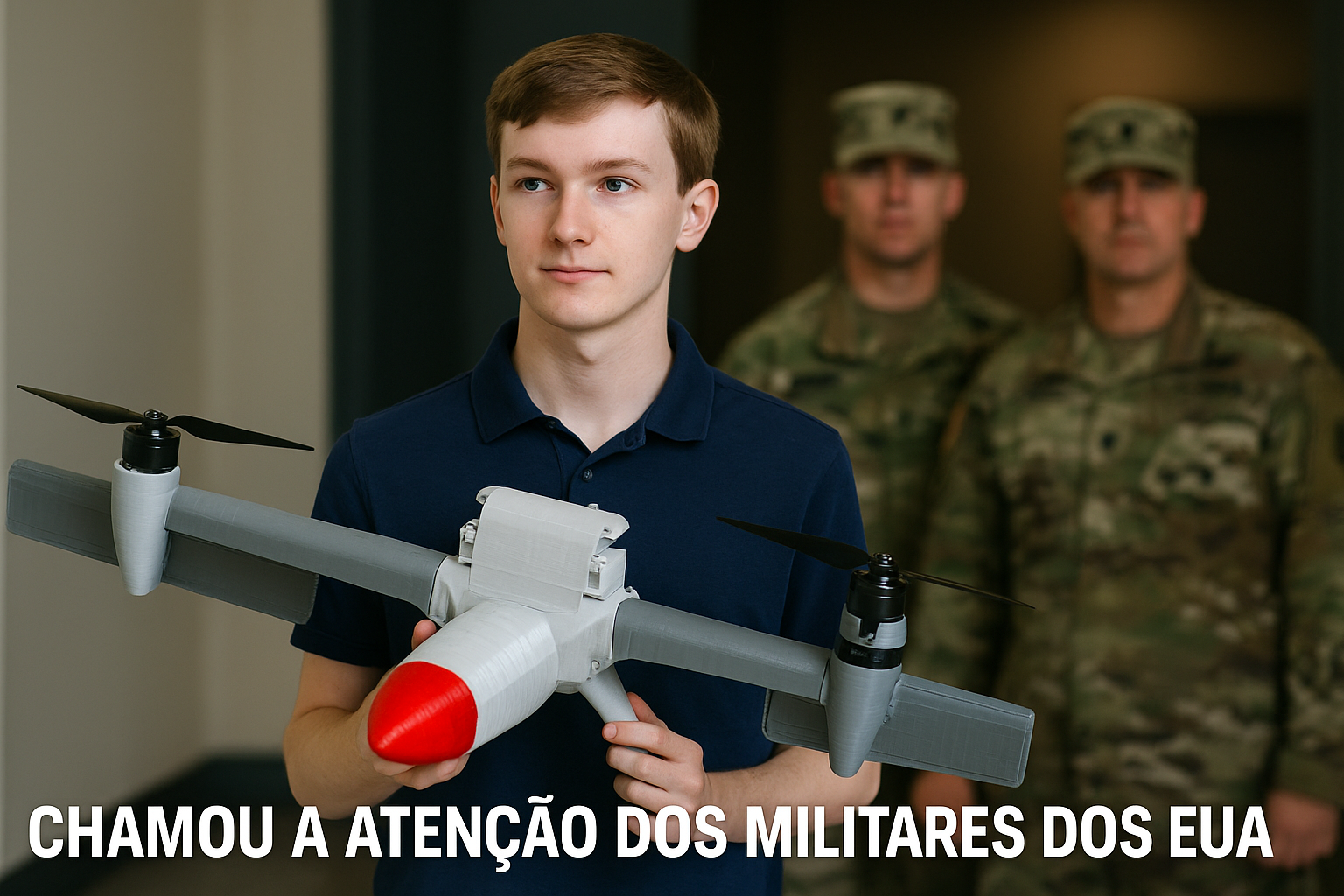
17-Year-Old American Designs VTOL Drone at Home, Overcomes Technical Challenges and Captivates MIT and the Department of Defense
While many young people his age are occupied with social media and games, American Cooper Taylor, just 17 years old, surprised the technology sector. In his own garage, he created a VTOL drone — vertical takeoff and landing — using 3D printed parts. The project has already earned him US$ 23 thousand in awards from the United States Department of Defense.
Inspiration Came From a Domestic Problem
It all started simply. Taylor noticed that his sister’s drone had low autonomy, flying for only 30 minutes. Curious, he decided to study VTOL models, which combine the capability of vertical takeoff with the speed of an airplane.
He quickly identified the main obstacles: high costs and the inefficient use of motors, which remain off during part of the flight.
-
Inspired by the armadillo, scientists create new technology that changes shape on its own to protect electronics against impacts and physical damage.

-
Capable of storing up to five times more carbon than terrestrial forests and protecting millions of people against tsunamis and storms, the planet’s mangroves are reemerging after decades of destruction and surprising scientists with their impressive natural regeneration capacity.

-
Engine without traditional cylinder head could change the future of hybrids: Aramco creates DHE technology that simplifies mechanics, promises to reduce consumption by up to 25%, and challenges decades of evolution in combustion engines.
-
Machine revolution failed and robot seen begging on the street: humanoid kneeling with bowl, backpack, and QR code goes viral in 11-second video as narration says there was no money to recharge the battery.



The Drone: Creative and Economic Solution
The answer came with an ingenious design. Taylor created a system of tilting motors, capable of switching between vertical and horizontal flight modes.
The entire drone was made with 3D printed parts and features a modular structure, allowing for easy replacement of wings, cameras, sensors, and other components. The final cost of the model is up to five times lower than that of similar professional drones.
The teenager did it all himself: coding, soldering, circuit design, and assembly. After three prototypes that failed, including financial losses, the fourth attempt succeeded.
Since then, he has been improving the equipment and is already developing an even smaller version that can fit inside a backpack.
Practical Applications and Recognition
The drone has potential applications in various fields: agriculture, rescue, medical deliveries, and environmental preservation. The idea is to democratize access to this technology for those who cannot invest in expensive equipment.
At 17, Taylor is preparing to start a new phase in his journey. This American summer, he will begin working at the MIT Reliable Autonomous Systems Lab, one of the most prestigious institutions in the world.
The young man is already standing out as one of the promising figures in the drone industry — and his path is just beginning.
With information from IGN.






-

2 people reacted to this.