






 Portuguese
  Spanish
  5 min of reading
  0 comments


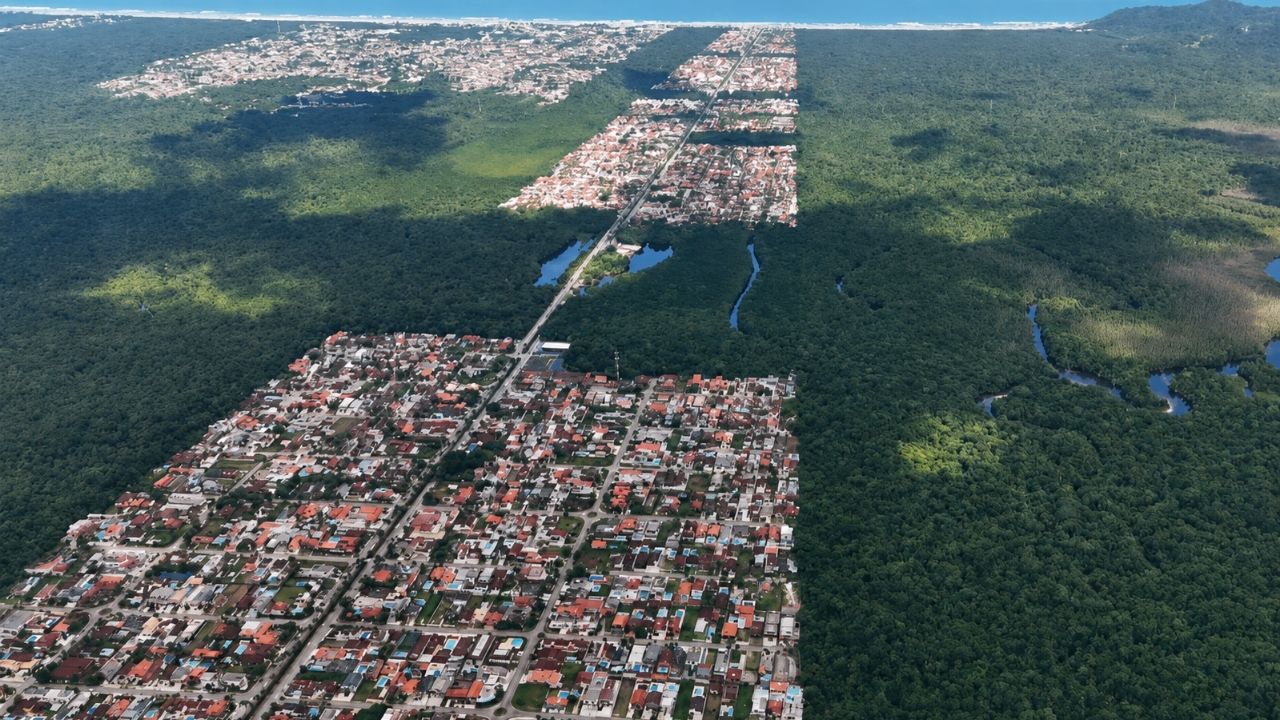
The Morada da Praia condominium, in Boraceia, reveals long streets, houses with pools, commerce, and services near the São Paulo coast, while the Atlantic Forest and Serra do Mar surround a residential area that the drone shows as almost a private city between beach, restinga, calm sea, and much aerial visual contrast.
The Morada da Praia condominium, in Boraceia, on the São Paulo coast, appears in drone images as a much larger structure than its entrance facade suggests. From above, streets, houses, pools, green areas, and internal services form a landscape resembling a small private city.
According to the channel Francisco – DRONE SHOW, located in the far north of Bertioga, the development stands out for its contrast: on one side, the beach with calm waters and a wide strip of sand; on the other, the Serra do Mar, restinga areas, and Atlantic Forest vegetation. It is this combination of size, location, and landscape that makes the flight so impactful.
Drone reveals an impressive extension in Boraceia
-
Survivor of 1966 SS Daniel J. Morrell Shipwreck in Lake Huron Recounts 38-Hour Ordeal in Extreme Cold

-
The Greatest Hoax in World Cup History? The Film That Denied Brazil’s 1958 Victory and Exposed How Fake Evidence Can Seem Convincing on TV
-
Fake South Korean Online Stores Offer Shopping Thrill Without Spending Money or Receiving Products
-
The War of Jenkins’ Ear: How a Severed Ear Sparked One of the 18th Century’s Most Unusual Conflicts


The images begin by showing Boraceia beach, a coastal strip sought after by families and tourists. The calm sea, open sky, and wide sand help create the scene before the drone turns towards the main objective of the flight: the Morada da Praia condominium.
As the camera advances, the scale of the development begins to appear. The footage shows a long sequence of streets, blocks, and houses, with the condominium extending towards the Serra do Mar. The visual sensation is of an organized urban area within a large enclosed space.
During the flight, the narrator states that he covered more than five kilometers until reaching the final stretch. At another point, he mentions a distance of approximately 4.7 kilometers when he was not yet entirely at the end of the area, reinforcing the perception that the location has an unusual extension for a residential condominium.
Morada da Praia functions as almost a private city

What stands out most about Morada da Praia is its internal structure. According to the video’s narration, the location brings together about 3,500 lots, high-standard houses, schools, a hospital, a supermarket, and other services. The description reinforces the idea of a residential space with its own dynamic.
This ensemble makes the condominium seem less like a common subdivision and more like a planned urban area. Internal streets, houses with pools, circulation areas, and commerce create a routine that can reduce the need for constant travel outside the development.
The comparison to a city appears precisely because the location concentrates housing, leisure, and services within the same territory. For many residents, this can represent practicality; for those observing from outside, the scale of the development is the most surprising point.
Houses with pools dominate the landscape seen from above

From above, the standard of the constructions is also evident. The video shows many houses with pools, backyards, and outdoor areas, forming a landscape of high-standard properties near the beach. The repetition of these structures reinforces the residential profile of the condominium.
The houses appear distributed in blocks and streets that advance towards the forest and the mountains. In some sections, the drone shows even more enclosed areas of vegetation, rivers, and spaces that seem to function as natural boundaries within or around the development.
This visual contrast is one of the strongest elements of the footage. Pools, rooftops, internal streets, and the Atlantic Forest appear in the same frame, creating an image that blends residential luxury, preserved nature, and urban occupation in a sensitive area.
Location between beach and Atlantic Forest rekindles debate

The condominium is in a region marked by beach, restinga, Serra do Mar, and Atlantic Forest. Therefore, the video also raises a discussion about occupation in environmentally sensitive areas, especially since the narrator himself classifies the development as controversial.
According to the report presented during the flight, the condominium’s origin dates back to the 1980s, and the area would have undergone a regularization process in 2013. The video does not detail the name of the regulation but indicates that the properties are currently legalized.
Still, the aerial image sparks debate. Even when an occupation is regularized, the presence of large developments near preservation areas often raises questions about limits, oversight, and environmental impact.
Public beach is close to an area with a strong resident presence

Another point mentioned in the video is the relationship between the condominium and Boraceia beach. The beach is public, but the narrator observes that certain stretches seem to be more frequented by local residents and people connected to nearby houses.
The proximity between the condominium entrance and the sandy strip creates the impression of privileged access to the sea. However, this does not mean a private beach. In Brazil, beaches are public assets, even when they are in front of condominiums, hotels, or high-end homes.
What stands out, in this case, is the concentration of housing and services alongside a valued coastal landscape. The combination of calm sea, internal streets, and large houses helps explain why Morada da Praia generates so much interest in aerial images.
Contrast between Serra do Mar and calm sea dominates the flight


As the drone approaches the back of the condominium, the Serra do Mar gains prominence in the frame. Low clouds, the green wall, and dense vegetation create a scene that contrasts with the blue of the sea and the urban design of the streets.
The video also shows rivers, stretches of dense forest, and restinga areas, natural elements that help to gauge the development’s location. The landscape reinforces that the condominium is situated in a transition zone between the coast and the mountains.
This scenario explains the impact of the images. It’s not just the size of the development that impresses, but how it appears nestled between the beach, forest, and mountains. The aerial view makes this relationship much more evident than an observation made from street level.
Condominium size draws attention to the coastal occupation model
Morada da Praia shows a very common type of occupation in valued coastal areas: large residential developments with robust internal infrastructure, high-end properties, and strong leisure appeal. In Boraceia’s case, the scale of the condominium further amplifies this perception.
At the same time, the record highlights the complexity of this model. For some, the development represents comfort, security, and access to services. For others, it raises questions about urban pressure in areas near the Atlantic Forest, restinga, and Serra do Mar.
In the end, drone images make visible something that often goes unnoticed from the road or the beach: the real dimension of a condominium that functions almost like a private city. And you, do you think developments of this size are an organized solution for the coast or should they have stricter limits near natural areas? Leave your opinion in the comments.





Be the first to react!