






 Portuguese
  Spanish
  4 min of reading
  0 comments


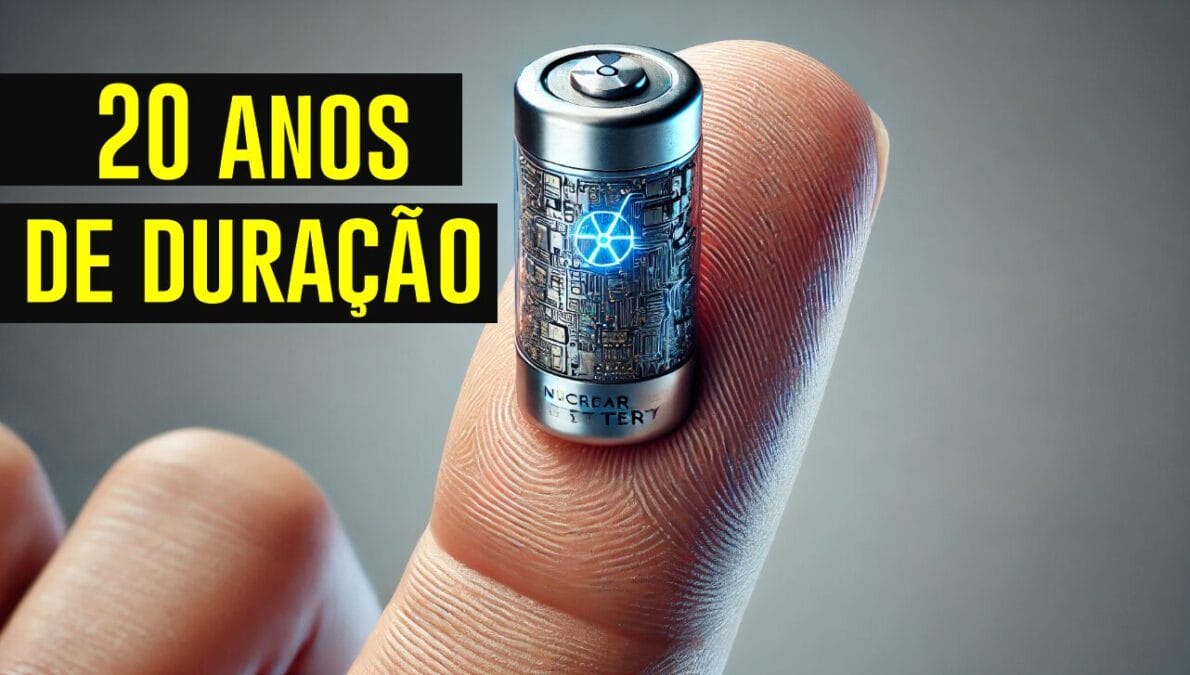
Researchers Developed A Micro Nuclear Battery Capable Of Lasting Up To Two Decades. Discover How This New Technology Is Surpassing Lithium Batteries In Durability And How It Can Transform The Future Of Long-Term Energy!
Lithium batteries have dominated the market in recent decades, driving the revolution of electronic devices. However, they have a significant drawback: limited lifespan. No matter how advanced they are, after about 1,000 charges, they start to lose efficiency, forcing the consumer to replace them. This raises the need for more durable solutions, and it is in this context that a micro nuclear battery has become a promising alternative.
Micro Nuclear Battery: What Are They?
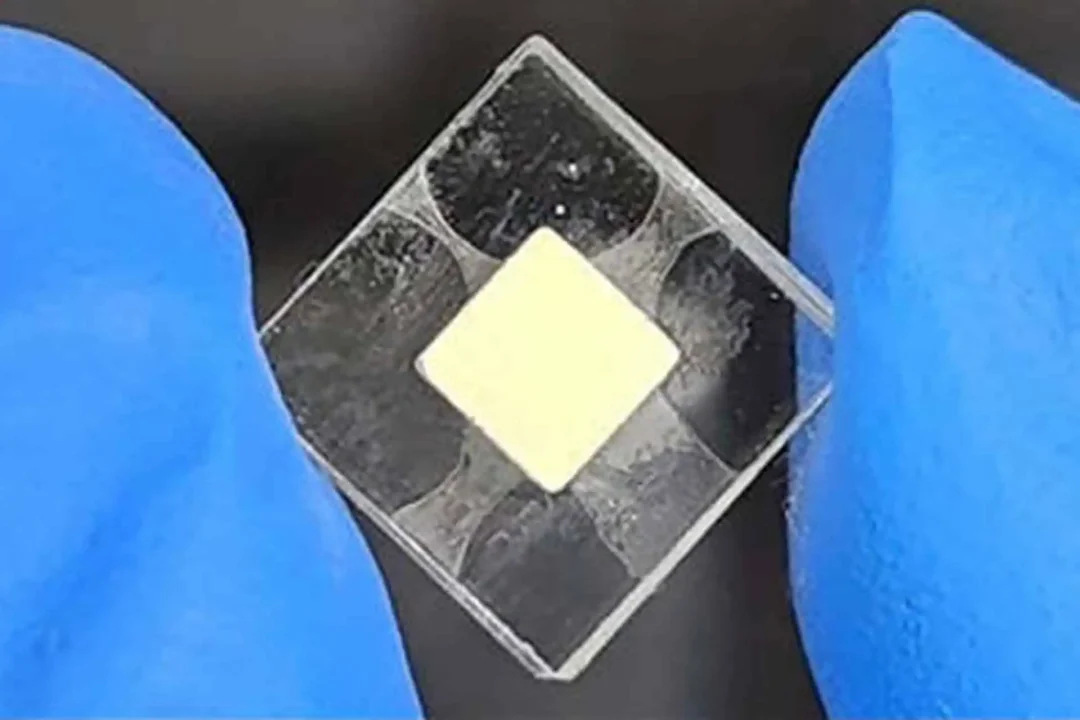
Micro nuclear batteries, as the name suggests, harness energy from small-scale nuclear processes. The technology uses americium, a radioactive material often treated as nuclear waste, but which can become a long-term energy source.
This type of battery operates through radioactive decay. When americium decays, it releases alpha particles, which are highly energetic. However, instead of wasting this energy, researchers developed a system to capture it efficiently.
-
WhatsApp prepares messages that disappear after a single reading and tests on iPhone a feature that could change the way users send private, temporary texts that are harder to keep saved in conversations.

-
The factory that fits in a container: Brazilian Army wants to produce bomber and kamikaze drones on the front line with 3D printing, seeks partners to set up a mobile combat unit, and tries to shorten in Brazil the war logic that exploded in Ukraine.

-
Man creates homemade system with laptop batteries and reduces dependence on the power grid; the project has been operating since 2016 with reused batteries, 24 solar panels, and more than 10 kW.

-
China’s logistical rise raises an alert for Brazilian infrastructure: AI-driven ports handle 47 million TEU, Beijing invests R$ 285 billion in Africa and threatens up to US$ 60 billion of Brazilian agribusiness while Santos faces historical bottlenecks.



How Does It Work?
In summary, americium is embedded in a polymer, which prevents rapid dissipation of the energy from alpha particles.
When these particles interact with the polymer, they produce a glow. This glow, in turn, is captured by a photovoltaic cell, converting it into electricity. This entire structure is protected by a quartz cell, which offers resistance and safety to the device.
The system, although it seems complex, has proven to be incredibly efficient during testing. Researchers were able to produce a stable amount of energy for over 200 hours with a minimal amount of radioactive material.
The efficiency of this process is highlighted as “unprecedented” by Shuao Wang, a professor at Soochow University, one of the study’s lead researchers.
Potential And Limitations Of The Micro Nuclear Battery
The great advantage of this technology lies in its longevity. The lifespan of a nuclear battery is linked to the half-life of the radioactive material, which, in the case of americium, is 7,380 years.
Although this does not mean that the battery will function for millennia, it is still an extraordinary durability compared to traditional batteries.
However, one of the challenges of this technology lies in the amount of energy generated. The power of the micronuclear battery is still far inferior to that of a common lithium battery.
To give an idea, billions of these batteries would be needed to power a common 60-watt light bulb. This limits their immediate use in high-energy consumption devices but does not rule out practical applications in specific areas.
Practical Applications
Despite the limitation in energy output, micronuclear batteries may be ideal for powering devices that require little energy but are located in hard-to-reach places. “These batteries would be perfect for powering sensors in remote or challenging environments, such as space missions, monitoring stations, or deep-sea exploration“, explains Wang.
These devices are often placed in locations where battery replacement or recharging is nearly impossible, making the longevity of the micronuclear battery a very attractive solution.
Future Challenges
However, there are still challenges ahead. Safety regarding the use of radioactive material is one of the biggest concerns. Even in small amounts, researchers need to ensure that these batteries can be produced and disposed of with safety.
Additionally, increasing energy production without compromising stability and durability will also be crucial for making this technology viable on a large scale.
The technology is currently in the proof-of-concept phase, and there is optimism that, with advances in research, these obstacles will be overcome. If all goes well, micronuclear batteries could be a revolutionary solution, especially in sectors where traditional energy sources are impractical.
What To Expect From The Future?
As research advances, it is possible that this technology will be refined and improved. The potential is enormous, and researchers are optimistic about increasing energy production and mitigating safety challenges.
Just as lithium-ion batteries transformed our way of interacting with the world, micronuclear batteries have the potential to extend the life of essential and hard-to-maintain devices.
The micronuclear battery may seem far removed from everyday reality, but its impact on sectors such as space exploration and extreme environments could be enormous.
The study was originally published in the journal Nature.





Be the first to react!