






 Portuguese
  Spanish


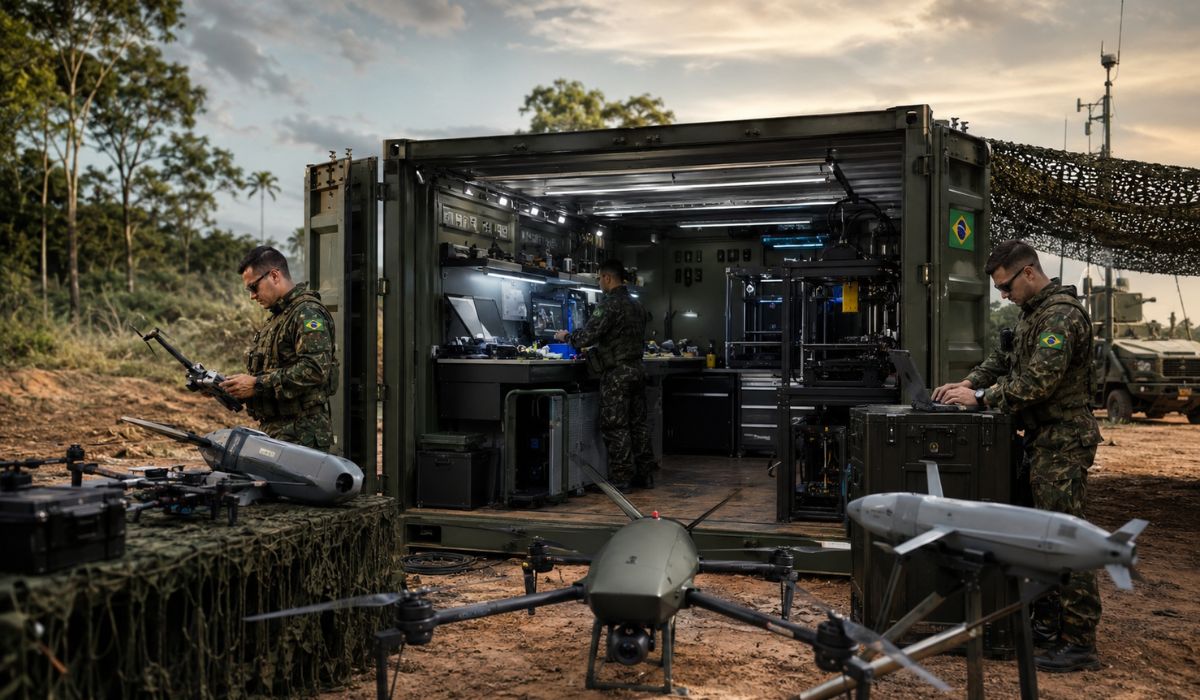

Army evaluates a mobile unit to manufacture drones with 3D printing in an operational environment, bringing production, adaptation, and maintenance closer to frontline demands.
The Brazilian Army seeks partners to develop a prototype of a mobile additive manufacturing unit aimed at producing bomber and kamikaze drones in an operational environment.
The concept was presented by the Rio War Arsenal during the 1st Unmanned Systems Symposium of the Land Force, held between May 25 and 27, 2026, and envisions a containerized structure with 3D printers, a workspace, and support equipment to manufacture unmanned systems closer to the frontline.
According to LRCA Defense Consulting, based on information attributed to the Brazil Defense Brief, the submission of proposals was opened on June 15, 2026, with a forecast opening on June 25.
-
What is a red flashlight used for, after all? See why it is so commonly used at night.

-
He has never read a line of code, but he already knows how to work: the French company UMA presented in Paris the Northstar, its first AI-powered humanoid robot designed for factories and warehouses, capable of copying tasks just by observing an employee in action.

-
A young Kenyan engineer collects plastic waste from the streets and transforms it into robots that translate physics lessons into sign language in real-time, a machine made with old bottles that teaches what was missing to deaf children left out of science.
-
What is the dark substance found in the sand of Ipanema Beach? Civil Police conduct an examination, collect samples of the material, and initiate an investigation to identify the composition, clarify the origin, and verify if there was an environmental crime.




The initial goal is to build a functional prototype, not to implement a serial production line.
The proposal seeks to evaluate, in Brazil, a logic that gained relevance after the war in Ukraine: quickly producing, adapting, and repairing drones, reducing dependence on fixed factories and centralized stocks.
Project originated from Army Aviation demand
The proposal presented by the Rio War Arsenal originates from a previous demand from the Army’s own structure.
In June 2025, during the 41st Meeting of War Arsenal Directors, held at the Department of Science and Technology in Brasília, the Army Manufacturing System received a request from the Army Aviation Material Command to study the production of remotely piloted aircraft through additive manufacturing.
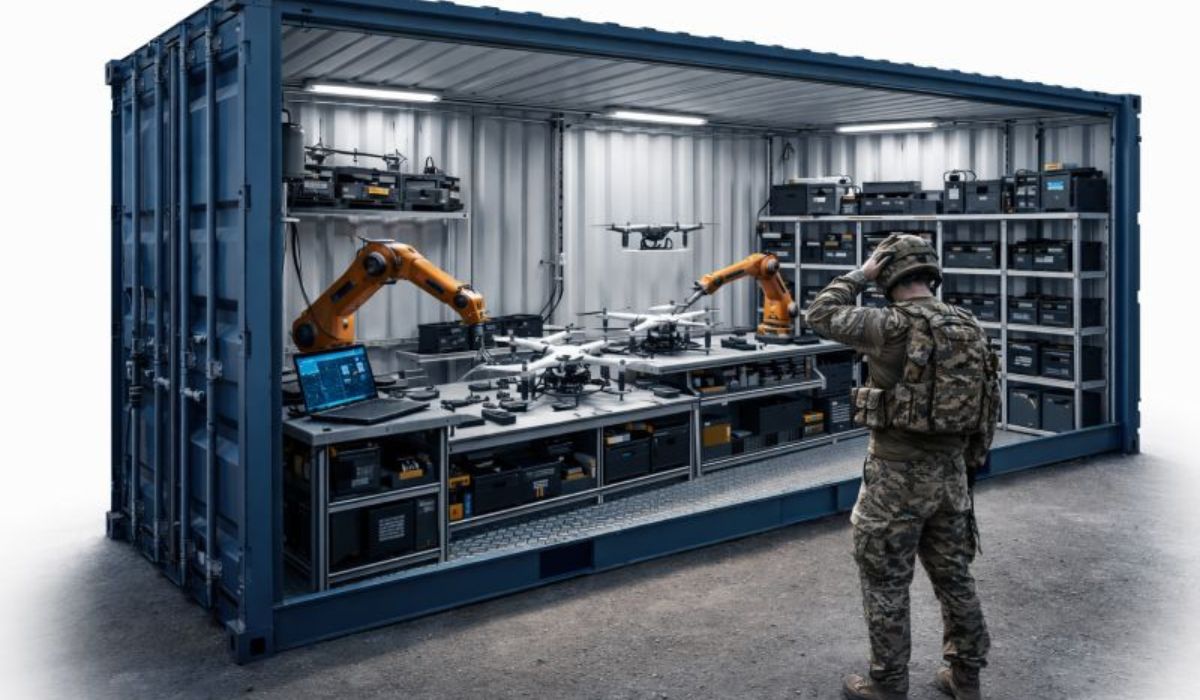
This study paved the way for the presentation, in May 2026, of a project for bomber and kamikaze drones.
At the center of the proposal is the installation of a manufacturing structure in a container, with the capacity to print parts, assemble components, and adjust models according to the operational needs defined by the Land Force.
In practice, the concept attempts to reduce the distance between an identified demand on the ground and the industrial response necessary to meet it.
Instead of relying solely on long cycles of purchasing, transport, and distribution, the Army intends to test if part of the production can occur closer to the location where the equipment is employed.
War in Ukraine accelerated the debate on drones
The war in Ukraine expanded the use of low-cost drones, loitering munitions, FPV platforms, and improvised attack and reconnaissance systems.
In this environment, equipment that worked at a certain time began to require frequent adjustments due to new electronic countermeasures, frequency changes, alterations in guidance methods, and adaptation of adversary defenses.
In the Ukrainian case, the response included decentralizing part of the production and maintenance.
Advanced units began to repair, assemble, and adapt drones near the combat front, using 3D printers, commercial components, and updated digital files.
This type of process reduced the interval between identifying a need and the equipment’s return to the field.
Belgian analyst Tim De Zitter, cited in the original text, summarized this change by stating that “the battlefield no longer asks who has the better drone, but rather who can rebuild the better drone tomorrow.”
The assessment points to a central aspect of the Brazilian initiative: in scenarios with a strong presence of electronic warfare, the ability to modify equipment can have significant weight for the continuity of operations.
Finland and United States test mobile solutions
The Brazilian movement occurs in parallel with international initiatives.
In March 2026, the Finnish company Sensofusion announced the Tactical Drone Factory, a drone factory installed in a standard 20-foot container.
According to the company, the system combines industrial 3D printers, an electronic assembly station, and a parts inventory, with a declared capacity to produce about 50 interceptor drones per day.
In the United States, Firestorm Labs is developing the xCell, a mobile manufacturing platform aimed at producing drones and components in advanced areas.
In April 2026, the company announced an investment round of US$ 82 million to expand the production of its containerized technology.
These examples indicate that the concept has begun to be studied by different countries and defense companies, although there is still no broad and public operational validation in a real combat environment.
The common premise of these initiatives is to reduce the vulnerability of fixed structures and allow productive units to be relocated, replicated, and updated with new project files.
Electronic integration is one of the main challenges
3D printing solves only part of the drone production process.
In a mobile factory, printers can manufacture fuselages, supports, structures, and specific parts, but electronic systems remain crucial to transform the printed structure into an operational equipment.
Flight controllers, communication modules, navigation receivers, batteries, motors, sensors, and payloads need to be available, integrated, and tested.
This point is considered sensitive in the defense sector because many global chains of electronic components depend on foreign suppliers, especially Asian ones.
For a military application, the availability of these items, supply chain security, and the ability for quick replacement are relevant factors for operation.
The printer installed in the container, by itself, does not eliminate the need for stock, certification, integration, and maintenance of other components.
Materials also impose technical requirements.
Carbon fiber filaments, reinforced nylon, and high-strength resins require control of humidity, temperature, and shelf life.
In an operational environment, maintaining these standards may require additional infrastructure and trained personnel.
Another point is related to software.
The main advantage of a mobile unit is not just printing parts, but loading new project files, correcting faults, adapting designs to specific needs, and preserving information security.
For this, protected transmission channels, version control, and technical validation before field use are necessary.


Defense industrial base can compete for space in the program
The call opens an opportunity for Brazilian companies involved in drones, embedded systems, electronic integration, and additive manufacturing.
The original text mentions names like SkyDrones and XMobots among potential members of this ecosystem, as well as defense companies already using 3D printing in industrial activities.
In Brazil, additive manufacturing already appears in different segments of defense and the aerospace industry.
The Rio War Arsenal employs 3D printers in activities related to maintenance and the manufacture of specific items.
Institutions like the Military Institute of Engineering also have technical involvement in the area.
Companies like ARES, Taurus, and Embraer use the technology in different stages of development, prototyping, or component production, according to the scope of each business.
The eventual participation of companies from the Defense Industrial Base will depend on the technical requirements of the prototype, the integration capacity, and the rules of the process conducted by the Army.
The moment coincides with the Invitation Letter MCTI/Finep/FNDCT nº 943682, aimed at promoting technological autonomy in the defense area.
The call, announced by Finep and the Ministry of Science, Technology and Innovation on May 26, 2026, provides up to R$ 500 million in non-reimbursable resources for Science, Technology, and Innovation Institutions linked to the Ministry of Defense.
Among the areas covered are guidance, control, and navigation systems for unmanned vehicles, artificial intelligence, robotics, computer vision, and additive manufacturing.
The submission deadline is until September 18, 2026, according to information released by the Brazilian Association of Defense and Security Material Industries.
Prototype still depends on operational validation
Despite military and industrial interest, the concept of a mobile factory of drones still needs to demonstrate performance in real conditions.
Producing dozens of units per day in a controlled environment is different from maintaining continuous operation under logistical pressure, adverse weather, operator fatigue, risk of attack, lack of parts, and electronic interference.
For this reason, the Brazilian prototype tends to function as a stage for technical and operational evaluation.
The project could test workflow, team training, component integration, digital file security, container transport, and the time required between a configuration request and the delivery of a ready-to-use drone.
The initiative could also bring the Army closer to the Defense Industrial Base in a field that combines manufacturing, software, electronics, advanced materials, and operational doctrine.
If it advances, the program will have to answer not only how many drones can be printed per day, but whether Brazil will be able to structure a chain capable of adapting, producing, and sustaining these systems autonomously when there is demand.


