Portuguese
  Spanish


International mission exposes contrast between the speed of Chinese ports and the limits of Brazilian infrastructure, at a time when Beijing’s expansion in Africa pressures routes, commodities, and strategic decisions for the Port of Santos.
The difference between Chinese logistical speed and Brazilian bottlenecks has been pointed out, based on impressions gathered during the International Port & Sea Mission 2026, as a relevant factor for the Port of Santos and the country’s foreign trade.
Organized by Grupo Tribuna, the mission identified two fronts of pressure on Brazil: on one side, China advances in port automation, digital networks, and productive integration; on the other, it expands its presence in Africa with financing, agriculture, infrastructure, and new trade routes.
The Port of Santos remains the main Brazilian logistical hub, and the Santos Port Authority reported that the complex ended 2025 with 186.4 million tons handled and 5.9 million TEU, historical records for the terminal.
-
Brazilian Engineer Who Grew Up Without Electricity Develops Software, Expands AltoQi to 67,000 Clients, Aiming for $21 Million by Digitizing Brazil’s Construction Industry

-
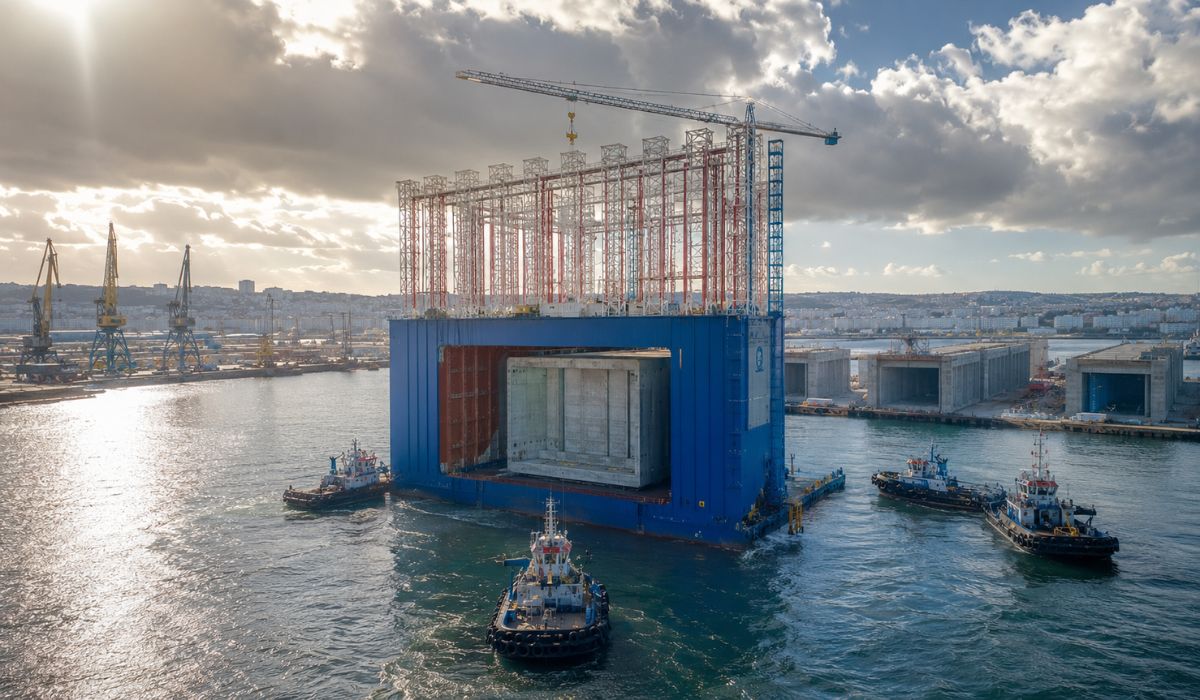
Spain Launches World’s Largest Floating Dry Dock: 56-Meter Giant Produces Massive Concrete Structures in A Coruña Using Technology Proven in Brazil

-
AI-powered toys that talk, recognize faces, and collect data face scrutiny from Brazilian government over children’s privacy concerns

-
4,000-Year-Old Child’s Skull Unveils Ancient Burial in 7,500-Year-Old Norwegian Rock Shelter, Impressing Archaeologists




In the comparison presented by the delegation, these numbers still fall below the scale of major Asian ports, which operate with larger volumes, automated systems, and greater integration between technology, land transport, and operational planning.
This difference in scale involves more than just cargo handling, as it also includes long-term planning, intensive use of technology, integration between ports and railways, reduction of operational times, and the capacity to receive larger vessels.
In Santos, the main obstacles cited in the infrastructure debate remain linked to land access, dredging, operational saturation, and the need to modernize internal and external port processes.
The complex maintains growth and national relevance but operates within a structure pressured by physical limits, regulatory disputes, growing demand, and the need for investments to enhance logistical efficiency.
China transforms ports into technological platforms
China has consolidated its ports as part of a broader industrial, technological, and commercial strategy, with automated terminals, digital systems, and integration between maritime infrastructure, railways, highways, and production chains.
The automation of terminals, the use of artificial intelligence, and connection through private networks appear, in this model, as productivity tools and also as components of an economic policy aimed at international competitiveness.
In Brazil, logistical corridors still face known bottlenecks, especially in the flow of grains, sugar, coffee, cellulose, meats, and minerals, sectors that depend on predictability in internal transport and port operations.
The cost of this inefficiency is distributed along the chain, affecting producers, exporters, importers, logistics operators, and consumers, especially during harvest periods, high demand, or congestion at access points.
When the country takes longer to ship, transport, and clear goods, the margins of export chains tend to be pressured in global markets with high competition and buyers attentive to price, deadlines, and regularity.
Even when Brazilian production shows efficient performance in the field or industry, part of this gain can be reduced before the cargo reaches the ship, due to internal freight, queues, storage, and bureaucracy.
In this scenario, the Port of Santos remains central to São Paulo and Brazil, while also adapting to new internal and external routes for the flow of goods.
The advancement of private terminals, regional railways, and ports in the North and Northeast changes the map of national exports and increases the need for coordination between public and private investments and international demand.
Africa gains weight in Chinese food security
The more sensitive geopolitical pressure appears in Africa, where Beijing has structured a cooperation agenda that includes agriculture, infrastructure, industry, energy, and financing, within a policy aimed at diversifying suppliers.
At the 2024 China-Africa Cooperation Forum, the Chinese government announced 360 billion yuan in financial support to the continent for three years, a package that involves different areas of economic and structural cooperation.
The same plan provides support for food security, agricultural modernization, technology demonstration centers, sending experts, and agricultural standardization areas, measures that can increase productivity in African countries.
This strategy does not represent an immediate replacement of suppliers like Brazil but expands alternatives for China in the medium and long term, especially in sectors considered strategic for food supply and economic security.
For Brazilian agribusiness, the topic is significant because the country has built a relevant part of its trade surplus by selling commodities to the Chinese market, especially soy, corn, meats, cellulose, sugar, and iron ore.
The relationship between Brazil and China is marked by commercial complementarity, with Brazilian exports concentrated in basic products and Brazilian imports focused on industrial goods, machinery, equipment, and technological inputs.
However, China has been seeking to reduce vulnerabilities in strategic sectors and expand its bargaining margin with suppliers, a movement that includes investments in production, logistics, and trade agreements in different regions.
By stimulating agricultural production in African countries and strengthening export corridors closer to their ports, Beijing creates an additional supply network, without eliminating, for now, Brazil’s role in bilateral trade.
Port of Santos becomes more exposed to the agro dispute
The Port of Santos is sensitive to this movement because a significant part of its operations depends on cargo related to agribusiness, including soybeans, corn, sugar, and coffee.
These cargos support terminals, storage, rail transport, truck circulation, port operators, and specialized services in the Baixada Santista, as well as influencing long-term contracts and investment decisions.
When agribusiness increases shipments, Santos gains operational and commercial scale, with greater use of terminals, demand for storage, and frequency of logistics services related to export.
In periods of margin loss, unpredictability, or market downturns, the logistics chain may feel effects on freight rates, contracts, terminal occupancy, ship frequency, and planning of new investments.
The presence of global and Chinese companies in Brazilian terminals indicates that Santos remains strategic for foreign trade, including serving agricultural flows and high-volume cargo.
These assets, however, depend on maintaining competitiveness, regulatory predictability, and the ability to ship increasing volumes efficiently, especially in light of the expansion of logistical alternatives within and outside Brazil.
The risk pointed out in the debate is not limited to the loss of a specific cargo to another country, but involves the possibility of a gradual reduction in Brazil’s advantage in cost, time, and reliability.
High internal freight rates, queues, less operational regularity, and competition for buyers with other alternatives can affect Brazil’s position in global chains that compare suppliers by final price and delivery security.
Brazilian bottlenecks pressure competitiveness
The Brazilian response depends on the implementation of measures discussed for years by governments, operators, and productive sectors, including permanent dredging, expansion of rail access, digital integration, and customs simplification.
This agenda also includes the planned expansion of port capacity, improvement of road access, and coordination between infrastructure projects, concessions, environmental licensing, and real export demand.
Despite advances recorded on different fronts, the Brazilian pace is usually slower than the transformation observed in Asian countries that have integrated ports, technology, and industrial planning into a single strategy.
This mismatch can affect competitiveness because Brazil remains strong in commodity production but faces additional costs in transportation and infrastructure before completing the export operation.
The logistics dispute is also not limited to the Port of Santos, as new corridors can strengthen the country when integrated into a national strategy and connected to the concrete demands of productive sectors.
Without coordination between the government, operators, producers, and major international buyers, however, these investments may advance in a fragmented manner and reduce potential gains in scale, integration, and efficiency.
For Santos, the agenda involves expanding capacity without losing urban, environmental, and operational efficiency, in a region where the port, city, industry, highways, railways, and preservation areas coexist in limited space.
In addition to continuing to serve agribusiness, the complex needs to diversify cargo, attract industrial activities, improve access, and approach international standards of automation and operational predictability.
The experience reported by the mission in Asia shows that ports have started to operate as platforms for trade, data, energy, production, and geopolitical influence, not just as places for loading and unloading.
Brazil combines productive scale, domestic market, territory, business capacity, and a relevant position in global trade, but it depends on logistics compatible with the speed of competitors to maintain external competitiveness.