





 Portuguese
  English
  Spanish
  5 min of reading
  0 comments


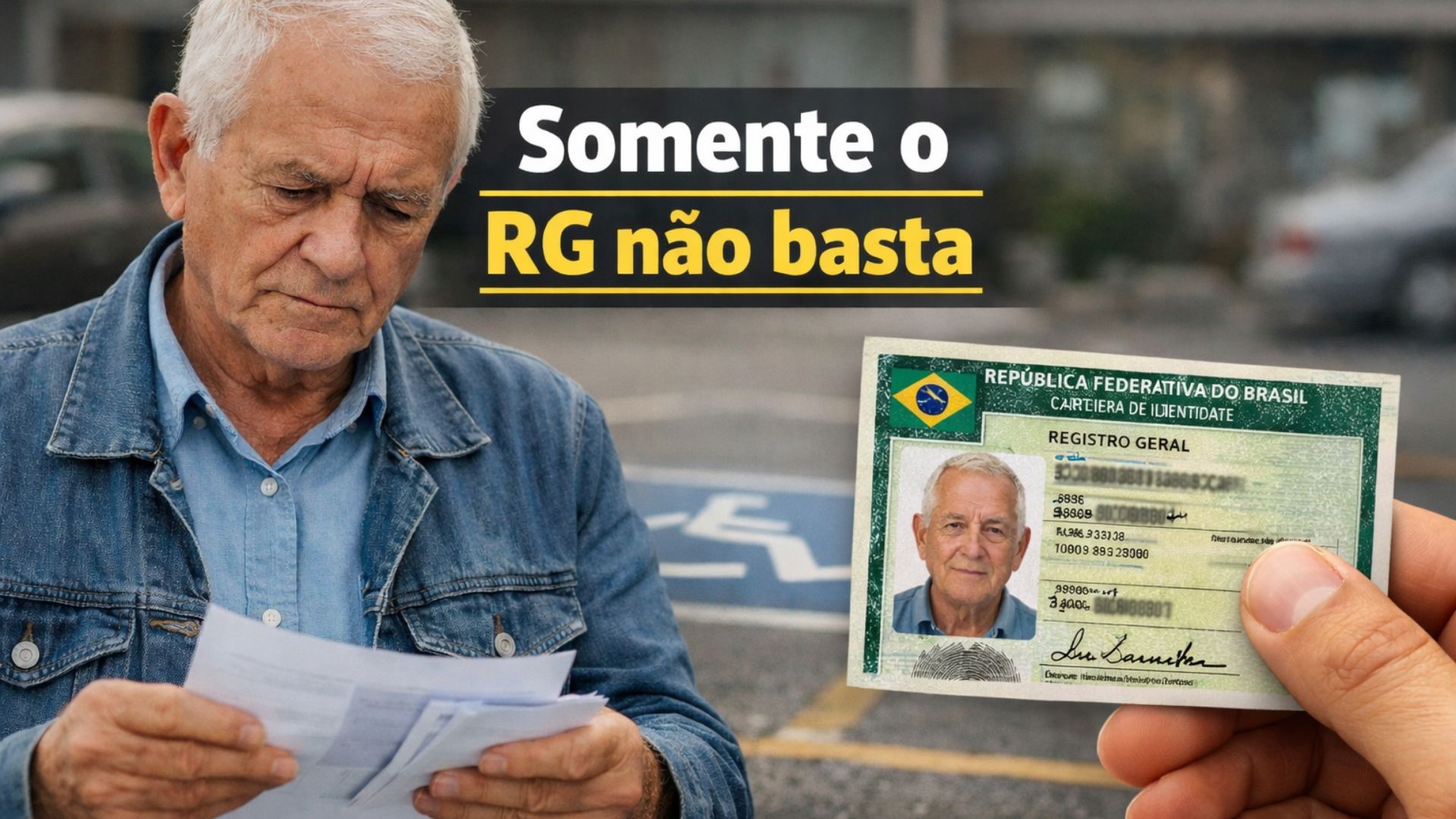
Mandatory document changes routine of elderly in Brazilian traffic and now has digital issuance with lifetime validity nationwide
Being 60 years old or older and carrying an identification document does not guarantee, by itself, the right to use reserved parking spaces in public and private parking lots, as Brazilian legislation requires a specific proof for this purpose.
Throughout the national territory, the use of these spaces is conditioned to the presentation of the beneficiary’s parking credential, accepted in physical or digital format, and recognized by regulatory bodies as an essential document to validate the occupation of the space.
With the digitization of the service and recent changes in the rules, the requirement has gained more prominence in the routine of elderly drivers and passengers, especially after the expansion of access to the document through official electronic means.
-
The end of Japan? Population is disappearing, country loses more than 3 million inhabitants in just five years and birth rate falls for the tenth consecutive year, raising alarm about demographic collapse and lack of workers.

-
China surprises the world by inaugurating a new era: the country will create a “digital ID” for 28,000 humanoid robots from 100 manufacturers, while machines capable of cooking, doing laundry, and caring for the elderly begin free domestic testing in 2027.
-
The world’s smartest ring is now 40% smaller, measures blood pressure signals during sleep, monitors over 50 health metrics, has a battery life of up to 9 days, and features enhanced sensors for more accurate readings on any skin tone.
-
Endless Brazilian: Blumenau resident turns 107 with a lucid memory, autonomy, and more than 100 direct descendants; the secret to longevity involves homemade food, a peaceful routine in the countryside, and simple habits maintained for decades.




Since October 25, 2024, the credential can be issued directly through the Digital Traffic Wallet app or the Senatran portal, eliminating the need for periodic renewal and consolidating lifetime validity for elderly individuals.
National rule requires credential for elderly parking space
Objectively, the regulation establishes clear criteria for the correct use of these spaces, reinforcing that authorization depends on the credential issued by a competent authority and valid nationwide.
According to Contran Resolution No. 965, of 2022, the credential is mandatory for parking in reserved spaces, while Resolution No. 1,012, of October 2024, began to guarantee a lifetime character to the document for individuals aged 60 or older.
Additionally, the Statute of the Elderly ensures a minimum reservation of 5% of parking spaces, as long as they are positioned in locations that facilitate access and reduce unnecessary movements within these spaces.
Although the right to the space is guaranteed by law, regular use depends on the specific proof required by traffic legislation, which differentiates the credential from common identification documents.
In practice, while the Identity Card proves the user’s age, the credential was created to allow standardized inspection, facilitating immediate verification of the legality of using the reserved space.
How to issue the digital credential via mobile
Currently, the issuance process has become more accessible with the integration to government digital services, allowing a large part of users to resolve the request without leaving home.
Through the CDT app or the official portal, citizens authenticated with a gov.br account can generate the credential in a few minutes, with automatic validation for those already registered in the national traffic system.
Within the application, the feature appears in the driver’s menu, while in the portal, the issuance occurs in the Senatran service area, with a simplified flow and no fee charged.
It is worth noting that the service is free, which helps to expand access and reduce administrative barriers that previously required travel to municipal or state agencies.
When the functionality was expanded nationally, the government estimated that more than 16 million elderly people with a history of licensing would gain direct access to the digital version of the credential.
Another relevant point involves the way of use, as the document can be linked to one vehicle at a time, allowing changes according to the user’s needs over time.
When the spot can be used without a fine
Contrary to what many imagine, the credential is not associated with the vehicle, but rather with the beneficiary, which changes how enforcement interprets the use of special spots.
Thus, the authorization is only valid when the elderly person is present in the vehicle, whether driving or as a passenger, an essential condition for the use of the spot to comply with current legislation.
If the document is left in the car for use by third parties or used without the presence of the beneficiary, the situation is considered irregular, even if the credential is visible.
Another important aspect involves additional charges, as possession of the credential does not guarantee exemption in rotating parking areas or in private establishments that charge for the use of the spot.
Severe fine and vehicle removal
Non-compliance with the established rules can result in severe penalties, provided directly in the Brazilian Traffic Code to curb the misuse of these spots.
In these cases, the infraction is classified as severe, with the application of a fine, recording of seven points on the driver’s license, and the possibility of vehicle removal as an administrative measure.
Although many associate the penalty only with the absence of the document, the legislation also considers irregularities such as misuse, forgery, alteration, or presentation of an invalid credential.
In any of these situations, in addition to the citation, the traffic officer may confiscate the document, and the issuing agency may suspend or even revoke the granted authorization.
This set of rules reinforces why the presentation of a common document, such as an ID, is not sufficient to justify the use of the reserved spot during inspections.
Who does not have a driver’s license should seek the local agency
Despite the expansion of digital access, not all elderly people can issue the credential through federal channels, especially those who do not have a National Driver’s License.
In these situations, the procedure continues to be carried out by municipal or state traffic agencies, according to the administrative structure of each locality.
The regulation establishes that the issuance must be done by the traffic executive agency of the municipality of residence of the elderly person, or by the state agency when there is no local integration into the national system.
Thus, although the right to the parking space is guaranteed by law, regular use depends on obtaining the credential through the channel available in the region where the beneficiary resides.






Be the first to react!