






 Portuguese
  Spanish


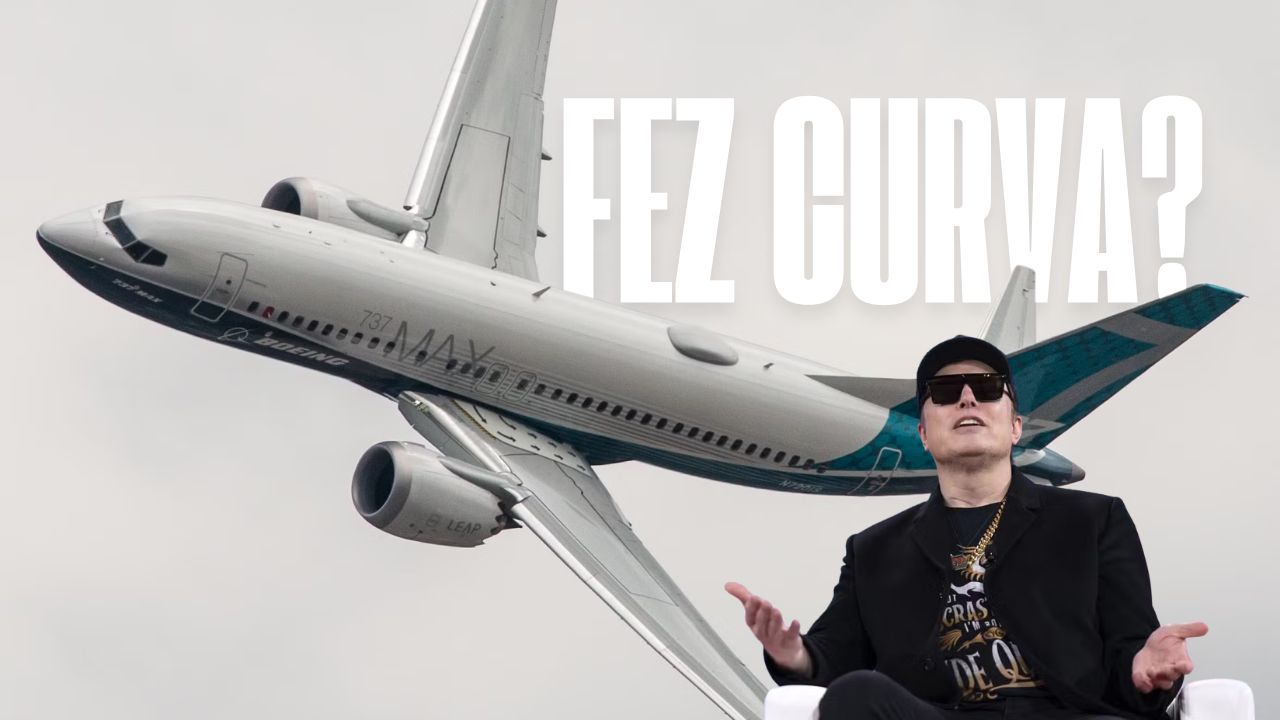

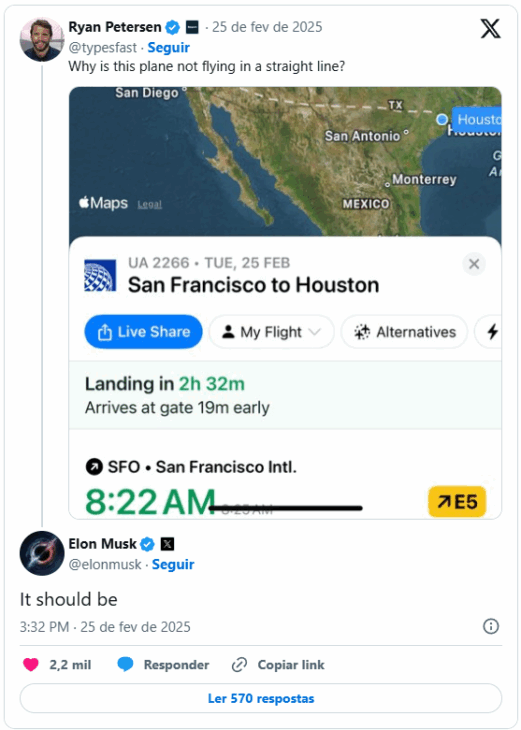
Elon Musk, known for his sharp opinions and influence on social media, has sparked controversy by commenting on the course of a commercial flight. It all started when Ryan Petersen, CEO of Flexport, shared his doubt about why United Airlines flight UA-2266 was not following a straight line between San Francisco and Houston.
In response to Petersen’s question, Elon Musk replied succinctly and directly: “It should be.” His statement quickly went viral, sparking debates among users on platform X, especially since the aircraft in question is a Boeing 737 MAX 9, a model that has faced controversies in the past.
The online community reacted promptly, with several users adding “community notes” to clarify that curved trajectories in commercial flights are common and occur for various reasons.
What Influences an Aircraft’s Route
One of the main reasons an aircraft may not follow a straight line is safety. Pilots adjust their routes to avoid storms, strong winds, or severe turbulence. Following a more favorable trajectory can reduce risks and provide a smoother flight for passengers.
-
China Develops Custom 140-Ton Electric Mining Truck with 770 kWh Swappable Battery, Deploys 290 Units in Xinjiang’s Largest Zinc Mine

-
Meta to Launch Arena, a New Prediction App Targeting 3.56 Billion Users, Competing with Polymarket and Kalshi

-
Scientist Challenges Famous Human Evolution Theory, Argues Homo Sapiens Evolved Gradually Over Thousands of Years
-
15-Year-Old American Builds Ocean Generator with PVC Pipe and 3D-Printed Propeller for $12, Wins National Prize, Presents at White House, and Makes Forbes 30 Under 30 List




Another fundamental point is that the curvature of the Earth influences how air routes are plotted. On two-dimensional maps, an optimally short route may appear curved, but in reality, it follows a more efficient path on a spheroid planet. This phenomenon is known as the “great-circle route” and is commonly used in aviation.
Not all airspace is available for commercial flights. Some regions have restrictions due to military installations, controlled airspace, or limits imposed by international agreements. Air traffic is managed by control towers to avoid congestion and ensure the safety of all aircraft.
Community Reaction to Elon Musk’s Comment and Explanatory Notes
After Elon Musk’s response, several users on platform X mobilized to explain why an aircraft might deviate from an apparently “straight” route. The phenomenon of the jet stream was also mentioned, highlighting that a curved route can reduce flight time and fuel consumption.
Musk’s statement also raised doubts about his understanding of commercial aviation. Some users speculated whether his response was merely a provocation or if he was unaware of the technical details that influence flight routes. “I’m not posting this to mock Elon Musk… I’m just curious about why he would respond this way,” commented one user.
The interaction between Musk and other users demonstrated how public figures have a significant impact on online discussions. A simple phrase from the billionaire sparked a broad debate about aviation, highlighting the importance of accurate information when addressing technical topics.







Ele está zombando.
O cara se acha superior a Deus, mas quem tem cérebro para pensar, ja sabe que ele é o Diabo.
A **** do foguete dele nem presta e ele fica dando opinião **** de avião dos outros. Muskito do inferno nunca vai pra Marte e os robôs dele só servem pra propaganda. Fora que o carro dele perde o controle, se incendeia e trava para matar quem tá dentro. Vai **** **** filho da ****!