






 Portuguese
  Spanish


Photography Has Always Played A Fundamental Role In Documenting Natural Phenomena. In 1882, American Photographer William Nicholson Jennings Made History By Capturing The First Image Of A Lightning Bolt, Significantly Contributing To Meteorological Studies And Atmospheric Electricity.
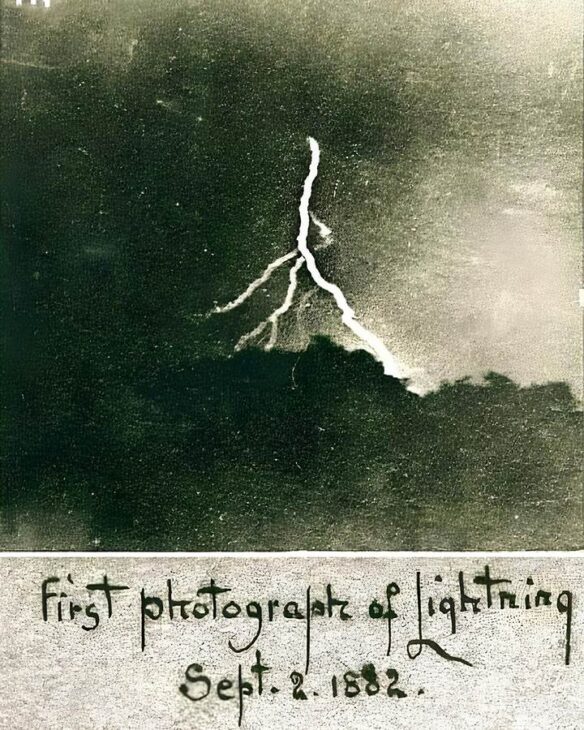
On September 2, 1882, a historical feat changed how humanity observes and studies natural phenomena. That night, photographer William N. Jennings managed to capture the first photograph of a lightning bolt.
The visual record of this phenomenon was a milestone for both photography and science, allowing a new understanding of one of nature’s most fascinating events.
-
Sixth-grader in Miami wins Lemelson Young Inventor Prize for creating water-absorbing concrete using discarded oyster shells and charcoal.

-
Brazilian Researchers Develop Portable, Painless, Radiation-Free Breast Cancer Tracker Using Microwaves, Costing Around $200 and Potentially Replacing $240,000 Mammograms
-
Beer as a Vaccine? Scientist Develops Experimental Method with Live Yeasts, Tests Own Brew, and Publishes Results on Zenodo

-
Brazilian Researchers Develop ‘Rapha’ Device Using Natural Latex and LED Light to Heal Diabetic Foot Ulcers and Prevent 50,000 Annual Amputations


The Pioneering Work Of William N. Jennings
Jennings was not only a photography enthusiast but also a scholar interested in the scientific aspects of the image.
A member of the Franklin Institute, one of the most respected scientific institutions in the United States, he found a conducive environment to develop his research and experiments.
In the late 19th century, photography was undergoing significant advancements. Although it had already been used to document landscapes, portraits, and events, capturing short-duration events like a lightning bolt was still a huge challenge.
The cameras of the time had technical limitations, such as long exposure times and difficulties in capturing rapidly moving elements.
The Night Of September 2, 1882
That night, Jennings was prepared for a bold experiment. Positioned at the top of a building in Philadelphia, he waited for the right moment to capture a lightning bolt. The challenge was immense: the phenomenon occurs in a fraction of a second, requiring extreme precision to be recorded in a photograph.
Despite the difficulties, his determination and technical knowledge allowed him to find the ideal setup. As soon as a lightning bolt crossed the sky, he triggered his camera, managing to capture the event with impressive detail.
It was the first time a human being succeeded in freezing in time a phenomenon that until then could only be observed momentarily.
The Image Of The Lightning Bolt That Revolutionized Science
The photograph obtained by Jennings showed branched patterns in the trace of the lightning, something that had never been recorded so clearly.
This visual record opened new possibilities for scientists to study the behavior of lightning and better understand its formation and impact.
Until then, the understanding of lightning was based solely on naked-eye observations and speculations.
With Jennings’ photograph, researchers were able to analyze the structure of lightning more accurately, identifying details that had previously gone unnoticed.
The feat demonstrated how photography could be used as a scientific tool to document and understand natural phenomena.
Impact And Legacy
The image captured that night quickly gained notoriety. Jennings was recognized as a visionary in both photography and science.
His work was celebrated by scientists, meteorologists, and the general public, impressed by the ability of a camera to record something so ephemeral.
Jennings’ contribution was not limited to a single event. His success inspired other researchers and photographers to develop new techniques for capturing natural phenomena.
With the advancement of technology, it became possible to not only record lightning with more precision but also other rapid natural events, such as solar flares, volcanic eruptions, and fast animal movements.
The Role Of Photography In Science
Jennings’ pioneering work showed that photography can go beyond artistic or documentary record.
It has become an essential tool for science, allowing for detailed study of natural phenomena and advancing knowledge in various fields.
Today, high-speed photography has evolved significantly, enabling the recording of events impossible to see with the naked eye.
Technologies like high-frequency cameras are used to analyze scientific phenomena and even improve industrial and medical processes.
Jennings’ photography, although rudimentary by modern standards, was an initial step in this evolution.
His work continues to be remembered as an example of how perseverance and scientific curiosity can lead to revolutionary discoveries.
The first photograph of a lightning bolt, captured by William N. Jennings, marked a milestone in the history of photography and science.
His achievement allowed for a new understanding of lightning and paved the way for advancements in capturing images of natural phenomena.
Jennings’ legacy lives on, inspiring researchers and photographers to continue exploring the limits of image and science.
Thanks to him, what was once just a fleeting glimpse of a phenomenon became an object of detailed study, showing that photography is much more than a simple visual record: it is a tool for discoveries and innovation.





Excelente reportaje histórico