






 Portuguese
  Spanish
  5 min of reading
  1 comment


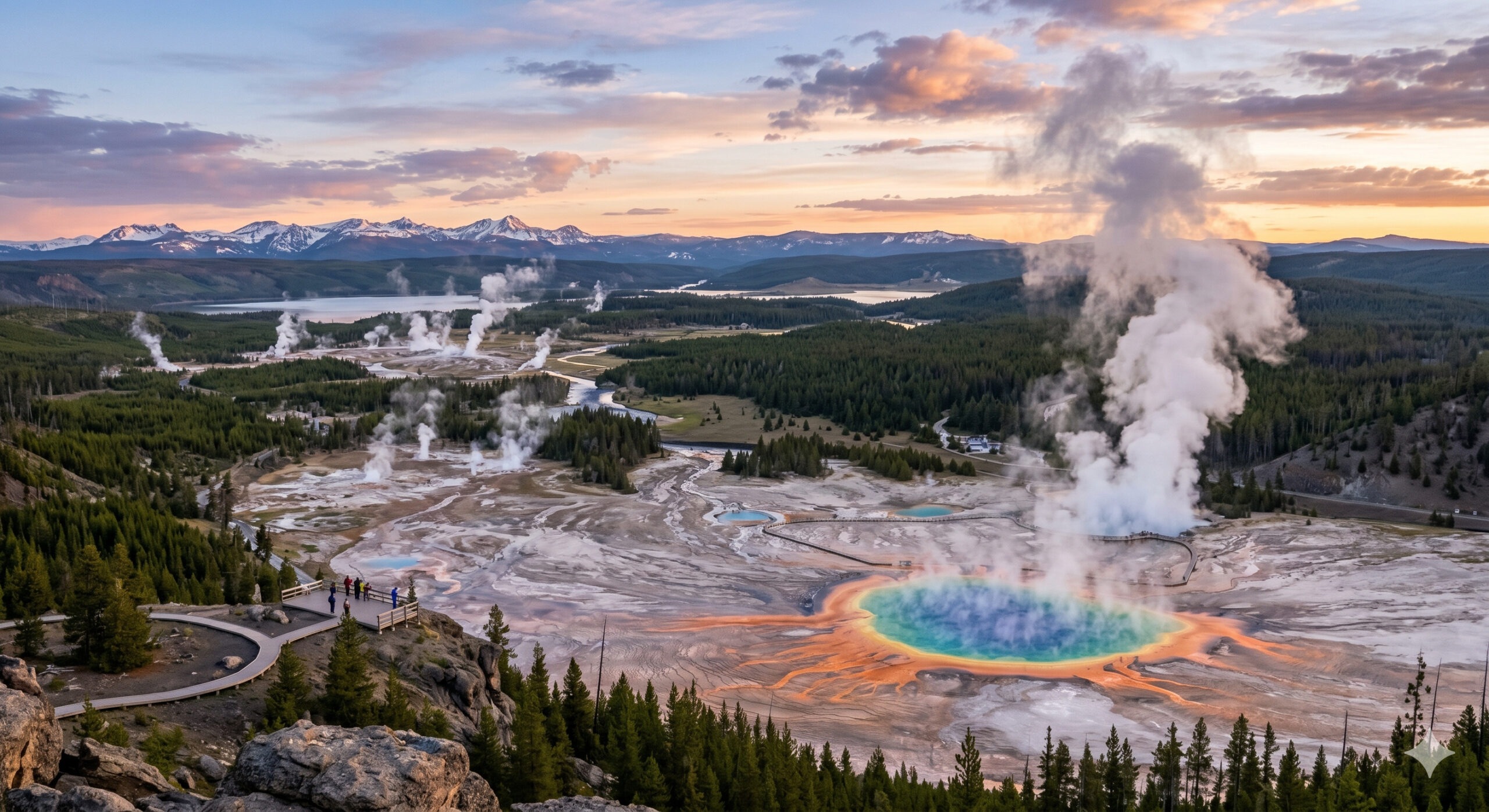


New study on Yellowstone suggests more complex magmatic system and reignites debates about global impacts of a supereruption.
In April 2026, a study published in the scientific journal Science reignited discussions about one of the most monitored volcanic systems on the planet: the Yellowstone caldera in the United States. The research, conducted by scientists from the Chinese Academy of Sciences, proposes that the supervolcano operates differently than much of the scientific community imagined, revealing a magmatic system controlled by tectonic forces and fed by magma closer to the Earth’s surface than older models suggested.
The work does not claim that Yellowstone is about to erupt. However, the new models reinforce that the underground system is much more dynamic, complex, and extensive than previously thought.
The study also reignited the debate about the possible global impacts of a VEI-8 supereruption, a category capable of releasing thousands of cubic kilometers of ash and gases into the atmosphere and causing a so-called “volcanic winter,” a phenomenon that can reduce global temperatures and affect large-scale agriculture for years.
-
Helicopter Drops 180 Tons of Sand and Gravel on Swedish River to Revive Ecosystem Damaged by Decades of Exploitation

-
Brazilian Company Launches Retro Smartphone with 48 MP Camera, T9 Keyboard, and Privacy Features for Social Media-Free Use

-
Self-Taught Chinese Farmer Builds 5-Ton Submarine from Scrap, Launches It in Anhui River
-
Invisible Induction Technology Enables Wireless Power for Blenders, Coffee Makers, and Air Fryers, Reducing Countertop Cables





Yellowstone hosts one of the planet’s most monitored volcanic systems
The Yellowstone volcanic system lies mainly beneath Yellowstone National Park, an area famous for geysers, hot springs, and intense geothermal activity. Beneath the surface, however, there is a gigantic volcanic structure formed by reservoirs of partially molten magma.
The region has recorded three supereruptions in the last 2.1 million years. The most recent occurred approximately 631,000 years ago and created the current Yellowstone caldera, which is more than 50 kilometers wide.


These eruptions are among the most powerful volcanic events known in Earth’s recent geological history.
New study challenges classic theory on magma origin
For decades, many scientists believed that Yellowstone was primarily fed by a deep mantle plume, a gigantic column of superheated rock rising from Earth’s interior.
The new study published in Science proposes a different explanation. According to the researchers, Yellowstone’s magmatic system may be primarily controlled by tectonic forces and deformations in the North American lithosphere.
Three-dimensional models showed that different densities in the Earth’s crust and the subduction of ancient tectonic plates could be opening pathways that allow magma to ascend.
This suggests that Yellowstone may function more as a dynamic tectonic system than as a simple “pipe” coming from the deep mantle.
Scientists say magma may be closer than old models indicated
The study also reinforces recent research that located important parts of the magmatic reservoir relatively close to the surface.
In 2025, geophysicists from the University of Utah and the University of New Mexico used artificial seismic vibrations to identify the top of the magmatic reservoir at a depth of about 3.8 kilometers.

Researchers detected a kind of “cap” of partially molten magma and underground gases. Despite this, scientists emphasize that the system currently releases gases continuously, which helps relieve internal pressure.
The new discoveries make Yellowstone more scientifically understood, but do not indicate an imminent eruption.
Supereruptions can launch thousands of cubic kilometers of material into the atmosphere
Supervolcanoes differ radically from conventional volcanoes. While common eruptions release relatively limited volumes of lava and ash, a VEI-8 supereruption can expel more than 1,000 cubic kilometers of volcanic material.
In the case of Yellowstone’s last major eruption, ash deposits covered enormous areas of North America.
These particles can remain in the atmosphere for long periods depending on their chemical composition and the altitude reached. An eruption of this scale would have global climatic consequences far beyond the United States region.
Volcanic winter can reduce temperatures and affect global agriculture
One of the most discussed scenarios by scientists involves the so-called volcanic winter. When large quantities of ash and sulfur-rich aerosols reach the stratosphere, part of the solar radiation no longer reaches the Earth’s surface.
This can cause temporary global cooling. Much smaller historical eruptions, such as Tambora in 1815, have already produced temperature drops sufficient to create the “year without a summer” in parts of the planet.
A supereruption like Yellowstone could produce much larger and longer-lasting climatic impacts.
Global aviation and logistics chains could suffer partial collapse
In addition to agriculture, aviation would be one of the most affected sectors. Volcanic ash poses an extreme risk to aircraft engines.

In large eruptions, the airspace of entire regions can be closed for days or weeks. In the case of Yellowstone, hypothetical models indicate the possibility of severe disruptions to air routes in North America.
The economic consequences could affect logistics chains, trade, and supply on an international scale.
Yellowstone is not “overdue” for an eruption
Despite popular imagination surrounding the supervolcano, scientists warn that Yellowstone should not be treated as a “bomb about to explode”.
The Yellowstone Volcano Observatory repeatedly states that there are no signs of an imminent eruption. Furthermore, supereruptions do not follow predictable regular intervals.
The idea that Yellowstone is “overdue” to explode is considered incorrect by experts. Recent studies change the understanding of how the system works, but they do not mean that a disaster is imminent.
Region remains extremely active from a geological point of view
Even without immediate signs of a supereruption, Yellowstone remains a very geologically active environment.
The region records thousands of small earthquakes per year, ground deformations, and intense hydrothermal activity. Geysers, hot springs, and gas emissions reflect the permanent subterranean heat of the magmatic system.
Researchers continuously monitor these signs using seismic networks, GPS, and geochemical sensors. Yellowstone is considered one of the most monitored volcanic laboratories on Earth precisely because of the system’s long-term destructive potential.
Discoveries help scientists understand other supervolcanoes on the planet
According to the authors of the new study, the models developed for Yellowstone can help understand other giant volcanic systems.
Among them are the Toba caldera in Indonesia and Taupo in New Zealand. The new tectonic interpretation can also improve models of magma migration and volcanic behavior prediction.
The main goal is not to predict an immediate explosion, but to better understand how supervolcanoes evolve over thousands of years.
Yellowstone shows how invisible processes shape the planet
Much of what happens beneath Yellowstone remains invisible to those who visit the national park. Below the forests, lakes, and geysers lies a gigantic system of partially molten rock, gases, and accumulated heat.
New studies show that deep tectonic forces continue to slowly reshape this underground system.
Yellowstone reinforces how geological processes capable of altering the global climate can remain hidden beneath the surface for thousands of years before any major eruptive event.
Given these discoveries, do you believe that science will be able to fully understand systems like Yellowstone before a future super-eruption occurs, or does part of the functioning of these geological giants still remain beyond humanity’s current monitoring capabilities?





I don’t think scientists have any idea what Yellowstone is going to do. It could erupt tomorrow the next day or a 100 years from now. I think the thing to do is prepare. The government should be store housing all the necessities for daily life and building shelters for the people of America