Portuguese
  Spanish


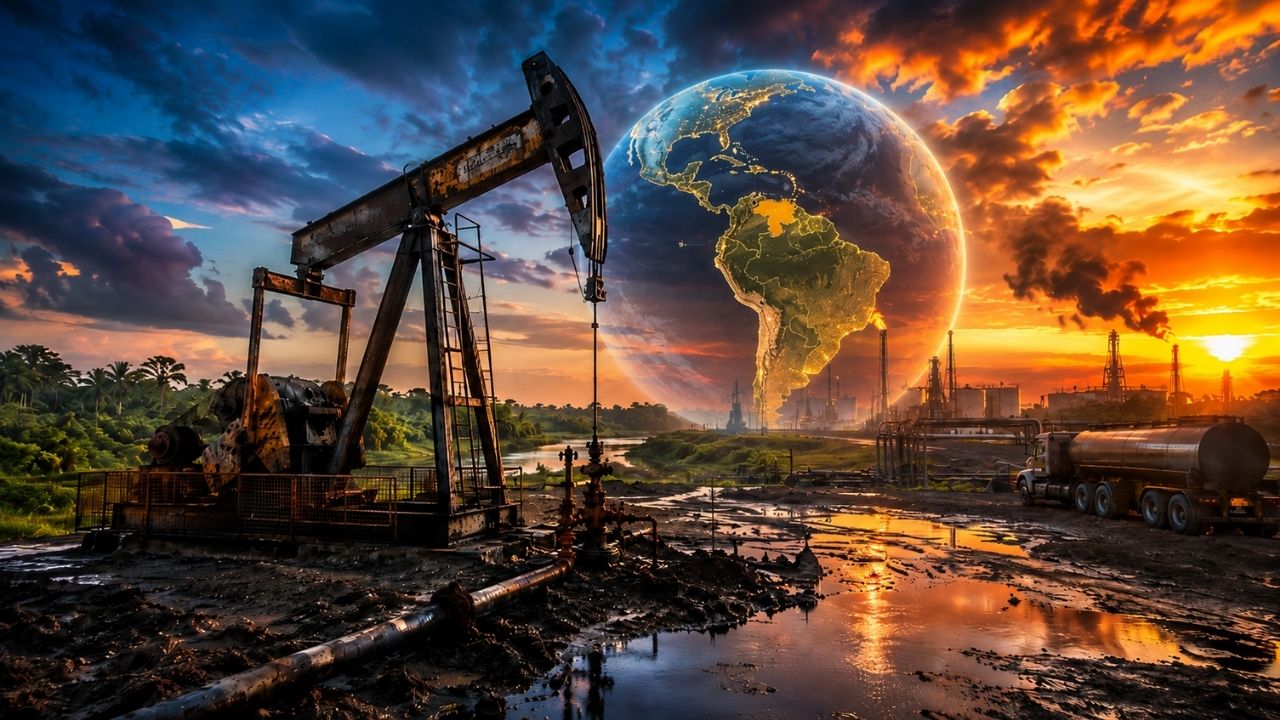


Venezuelan oil appears, at first glance, to be an unparalleled geological fortune, but the environmental burden of the Orinoco Belt, the technical complexity of extraction, and the climatic cost of refining a heavier and more polluting oil place the planet’s largest proven reserve before a dilemma that goes far beyond money
Oil returned to the center of global debate on May 3, 2026, when the size of Venezuela’s proven reserves once again drew attention for a disturbing reason. The country sits on 19.4% of all proven crude oil in the world, estimated at around 303 billion barrels, an amount that, on paper, would place the nation in a privileged position in a market pressured by geopolitical tensions and uncertainties about major producers. However, this wealth is mostly concentrated in the Orinoco Belt, an exploration strip surrounded by environmental, climatic, and industrial obstacles.
According to the Jalopnik portal, the problem is that this oil is not just abundant. It is also among the most difficult and most polluting to extract. Venezuelan oil is described as extra heavy, viscous, and carbon-laden, requiring more technical effort to extract from the subsoil, more processing to become a marketable product, and more infrastructure to be transported and refined. What seems like an energy treasure can, in practice, turn into an environmental and industrial cost so high that the economic advantage ceases to be simple.
The size of the reserve that makes Venezuela seem like an unparalleled power
When looking solely at volume, Venezuela seems unbeatable. With 303 billion barrels of proven reserves, the country appears far ahead of powers that normally dominate sector news. The presented data shows that Russia holds 5.1% of global proven reserves, Iran has 13.3%, and the United States appears with 2.9%.
-
Spain Launches World’s Largest Floating Dry Dock: 56-Meter Giant Produces Massive Concrete Structures in A Coruña Using Technology Proven in Brazil

-
AI-powered toys that talk, recognize faces, and collect data face scrutiny from Brazilian government over children’s privacy concerns

-
4,000-Year-Old Child’s Skull Unveils Ancient Burial in 7,500-Year-Old Norwegian Rock Shelter, Impressing Archaeologists

-
Norway Defeats Brazil in World Cup but Invests Billions to Preserve the Amazon, Strengthens Amazon Fund, and Joins Brazil in Leading Global Effort Against Tropical Deforestation



This contrast explains why Venezuelan oil arouses so much curiosity. At a time when major producers face sanctions, geopolitical disputes, or market restrictions, it would be natural to imagine that Caracas would be ready to fill the void. But reserve volume and actual exploration capacity are very different things, and it is precisely at this point that the reality of the Orinoco begins to weigh.
The Orinoco Belt concentrates wealth and also risk

Most of this oil is in the Orinoco Belt, a vast strip crossed by the Orinoco River, which flows into the Atlantic Ocean. It is there that Venezuela’s main energy promise is concentrated, and, at the same time, one of the greatest sources of concern.
Large-scale exploration of this area would mean disturbing a sensitive region, with impacts that would not depend on a major accident to appear. Even without a spill, the mere disturbance of natural habitats, the opening of new operational fronts, increased transportation, and pressure on local ecosystems would already represent a significant environmental cost.
Venezuela’s heavy oil costs more to the climate and industry
Not all oil is the same, and this is one of the most important points of the discussion. Venezuelan oil is described as one of the heaviest and most carbon-intensive in the world. This means it is thicker, harder to handle, and more expensive to turn into something marketable.
In practice, this profile pushes the cost up at every stage. More technical effort is needed to extract, more dilution or blending to transport, more processing to refine, and more energy to make it marketable. In other words, the reserve is gigantic, but it is also one of the most laborious and dirtiest to develop on a global scale.
The climatic risk may be greater than the economic advantage
The size of the reserve is impressive, but the climate cost is frightening. The presented basis indicates that making this oil commercially viable could consume 13% of the global carbon budget considered safe within the Paris Agreement’s goal to prevent warming beyond 1.5 degrees Celsius.
This data completely changes the project’s interpretation. It’s not just about whether Venezuela can profit from what it has underground. The question becomes whether the planet could absorb the impact of transforming this reserve into effective production without further exacerbating the climate crisis. In this context, geological wealth also begins to look like a global liability.
The region’s biodiversity would be in the line of impact
The debate about Orinoco oil involves more than just carbon and industry. There’s also a direct ecological dimension. The area is home to species such as dolphins, jaguars, macaws, and approximately 1,500 fish species, which increases the environmental risk associated with expanded exploration.
When large energy projects advance into such areas, impacts don’t only appear in the event of a disaster. They also arise from habitat fragmentation, machinery movement, alteration of natural routes, pressure on watercourses, and the need for auxiliary infrastructure. In a region so rich in biodiversity, exploring more oil inevitably means disturbing much more than just underground reservoirs.
Pipelines, oil tankers, and refineries increase the environmental cost


Extracting oil is only the first part of the problem. After that comes transportation. The basis highlights that pipelines require constant repairs and maintenance, in addition to increasing the risk of incidents and spills. A high flow of oil tankers at sea would also be necessary, with all the risks that this type of navigation already carries.
This means the impact doesn’t stop at the production field. It continues through pipelines, terminals, ships, and refineries, creating a chain of accumulated environmental risks. In other words, Orinoco exploration wouldn’t just open wells. It would open an entire structure of pressure on land, water, sea, and atmosphere.
Refining would also have consequences outside Venezuela
Another sensitive point of the basis is the indication that the refining of this heavy oil would likely occur in the U.S. Gulf Coast region, an area where refineries capable of handling this type of oil already exist.
The consequence of this is that the effects would not be restricted to Venezuela. Communities near large refineries face, according to the basis, high rates of cancer, heart disease, and reproductive problems, in addition to the risk of explosions and property devaluation. In other words, the expansion of Venezuelan oil would have a much broader geography of impact than that of the production field.
The gross value of the reserve is impressive, but it doesn’t solve the dilemma
In theoretical value, the reserve is staggering. With the barrel cited at around US$ 112, the approximate calculation would place Venezuela on something in the order of US$ 33.3 trillion in crude oil. This number helps to understand why the country arouses so much interest in any discussion about global energy security.
But this calculation has a trap. It considers the gross value of the resource, not the total cost of extracting it, processing it, transporting it, refining it, mitigating risks, dealing with degraded infrastructure, and managing environmental and social impacts. On paper, it looks like a fortune. In practice, it could turn into a project of extremely high cost, enormous wear and tear, and a return much more complex than the volume suggests.
Infrastructure and exploration capacity also limit this potential
The basis shows that Venezuela already faces deep structural challenges in its energy sector, with declining production over the last decade, underinvestment, mismanagement, technical limitations, refinery problems, and logistical difficulties. This helps to show that it’s not enough to have a lot of oil to transform reserves into prosperity.
Exploring large-scale extra-heavy oil requires capital, maintenance, skilled personnel, diluents, suitable refineries, and operational stability. Without these, the world’s largest reserve may continue to exist more as a geological promise than as a real capacity for sustainable production.
The oil that seems like a solution can also become a problem
There is a paradox at the heart of this story. Venezuela possesses a volume of oil that would make any country seem destined for energy wealth. At the same time, precisely because of the quality of this oil, the sensitivity of the territory, and the climatic impact of its exploration, this abundance can transform into a source of environmental, industrial, and geopolitical pressure.
The larger the reserve, the greater the temptation to exploit it. But, in this case, the greater the exploitation, the higher the cost can be for biodiversity, for the climate, and for the infrastructure needed to sustain this production. It is this contrast that makes the Orinoco as fascinating as it is dangerous.
Between subterranean wealth and the cost of bringing it to the world
In the end, the Venezuelan case summarizes a dilemma of the 21st century. Oil still drives a decisive part of the global economy, but not every available reserve should automatically be read as a simple opportunity for expansion. Some carry such a high cost that they force a rethinking of the logic of what is worth extracting from underground.
Venezuela has the largest proven reserve on the planet, but that doesn’t mean exploiting everything is necessarily rational, safe, or advantageous in the long term. The Orinoco is, at once, a geological monument and a brutal test of how far the world is willing to go to continue extracting fossil energy on an extreme scale.
If Venezuela truly sits on almost 20% of the planet’s proven oil, can this wealth still be treated as an economic blessing, or has it already become a climatic and environmental limit that perhaps the world can no longer ignore?