






 Portuguese
  Spanish
  3 min of reading
  0 comments


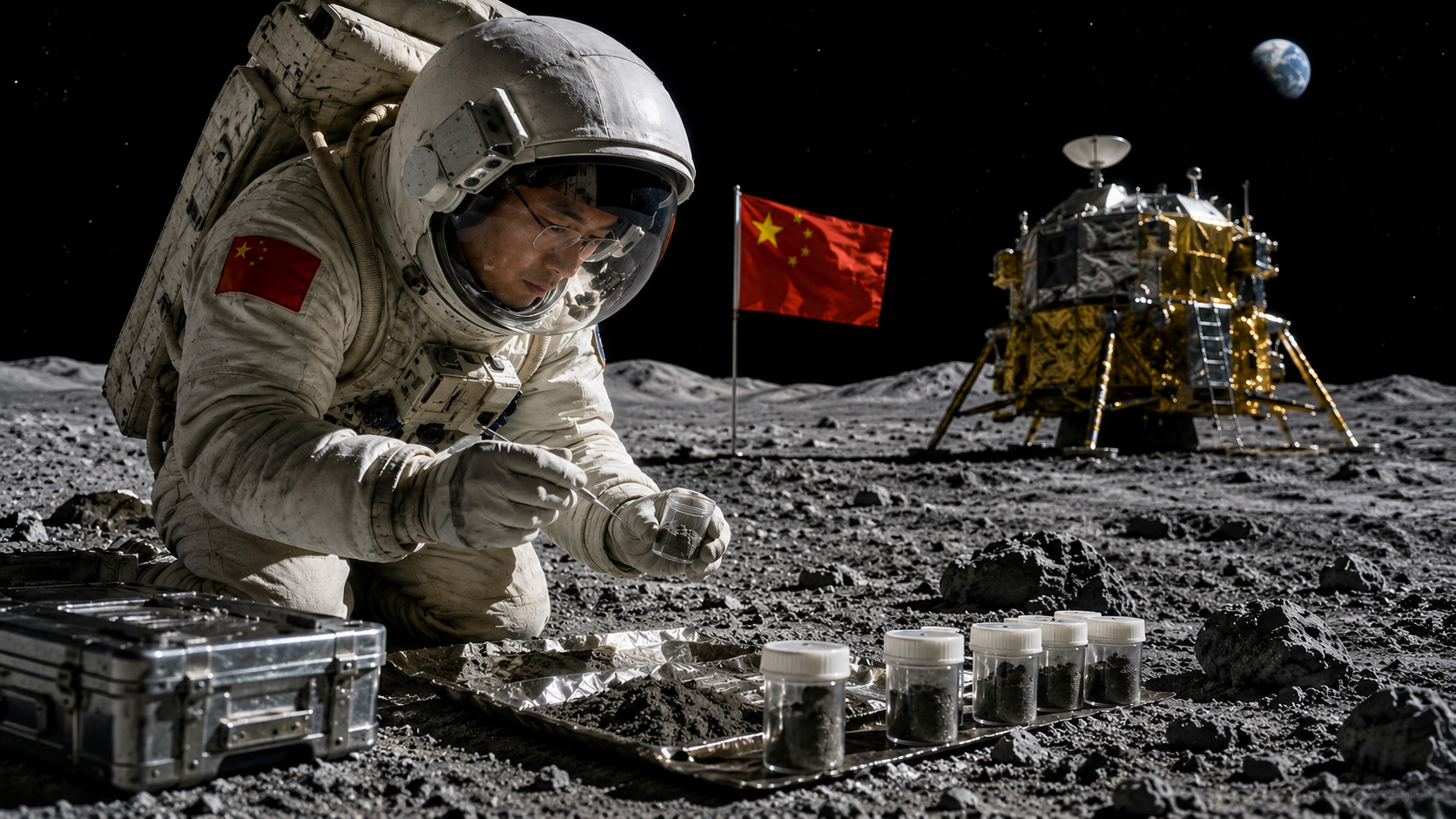
Lunar samples brought by China after more than 40 years revealed magnesiumchangesite-(Y) and changesite-(Ce), two unprecedented minerals that expand the study of the Moon’s composition.
The Moon has returned to the center of space exploration after researchers identified two new minerals in samples collected by the Chinese mission Chang’e 5, launched in 2020. According to the China National Space Administration, the discovery was announced on April 24, 2026, during the opening of China Space Day.
In this context, the materials were named magnesiumchangesite-(Y) and changesite-(Ce). Both were approved by the Commission on New Minerals, Nomenclature and Classification of the International Mineralogical Association, after analyses performed on the lunar material brought by the mission.
The announcement reinforces a new phase of lunar exploration. After all, between 1969 and 1976, missions from the Apollo programs, from the United States, and Luna, from the Soviet Union, had already brought samples from the Moon. However, after Luna-24, this type of mission was interrupted for more than four decades.
-
Space technology used to search for water on Mars is now hunting for invisible leaks under the streets of São Paulo, using satellites, AI, and chlorine signals to help Sabesp recover up to 6.7 billion liters of water.

-
Japan sends ship to extract mud rich in rare earths at nearly 6,000 meters deep in the Pacific, attempts to lift 350 tons per day from the seabed, and transforms sediments near Minamitori Island into a strategic weapon to reduce dependence on China.
-
Venus Aerospace promises a rotating detonation hypersonic engine that takes the Stargazer to Mach 9 and crosses oceans in 1 hour, but the flight that made history barely surpassed the speed of sound.

-
Brazilian student creates a cheap formula that makes plants grow up to 90% faster and wins an award in a global scientific competition.




Lunar Samples Reveal Unprecedented Chemical Composition
However, the importance of the discovery goes beyond the identification of new scientific names. The minerals present crystalline structures and chemical combinations with no known equivalent, formed under conditions very different from those found on Earth.
Thus, the absence of water, extreme temperatures, and the atmosphere-free environment helped shape a unique lunar chemistry. In this way, the materials reveal how the Moon’s regolith evolved over long periods without Earth-like erosion.
In this process, the formation of the minerals may be linked to the crystallization of ancient lunar magmas, the cooling of materials after meteorite impacts, and the slow transformation of lunar dust.

Chang’e 5 Ended a Hiatus of Over 40 Years
Then, in 2020, Chang’e 5 marked the first return of lunar samples in over 40 years. With this, China became the third country to achieve this feat, after the United States and the former Soviet Union.
Now, with more advanced scientific tools, the same material opens new answers about the Moon’s evolution. Therefore, the discovery shows that observing a known body again can reveal something completely unexpected.
Chang’e 6 and Chang’e 7 Expand Chinese Lunar Plan
Meanwhile, the Chang’e 6 mission advanced even further in 2024 by bringing 1,935.3 grams of samples from the far side of the Moon, a region with geology different from the more known face.
Next, the next stage will be Chang’e 7, planned to explore the lunar south pole. This mission is part of a broader Chinese project to establish the International Lunar Research Station, planned for the 2030s.
Therefore, the discovery of new lunar minerals does not only represent a mineralogical advance. It also shows that the Moon still holds unknown chemical processes and can sustain a new phase of scientific presence.
And you, reader? How many answers do you think are still hidden in the lunar dust?


-

1 person reacted to this.