Portuguese
  Spanish


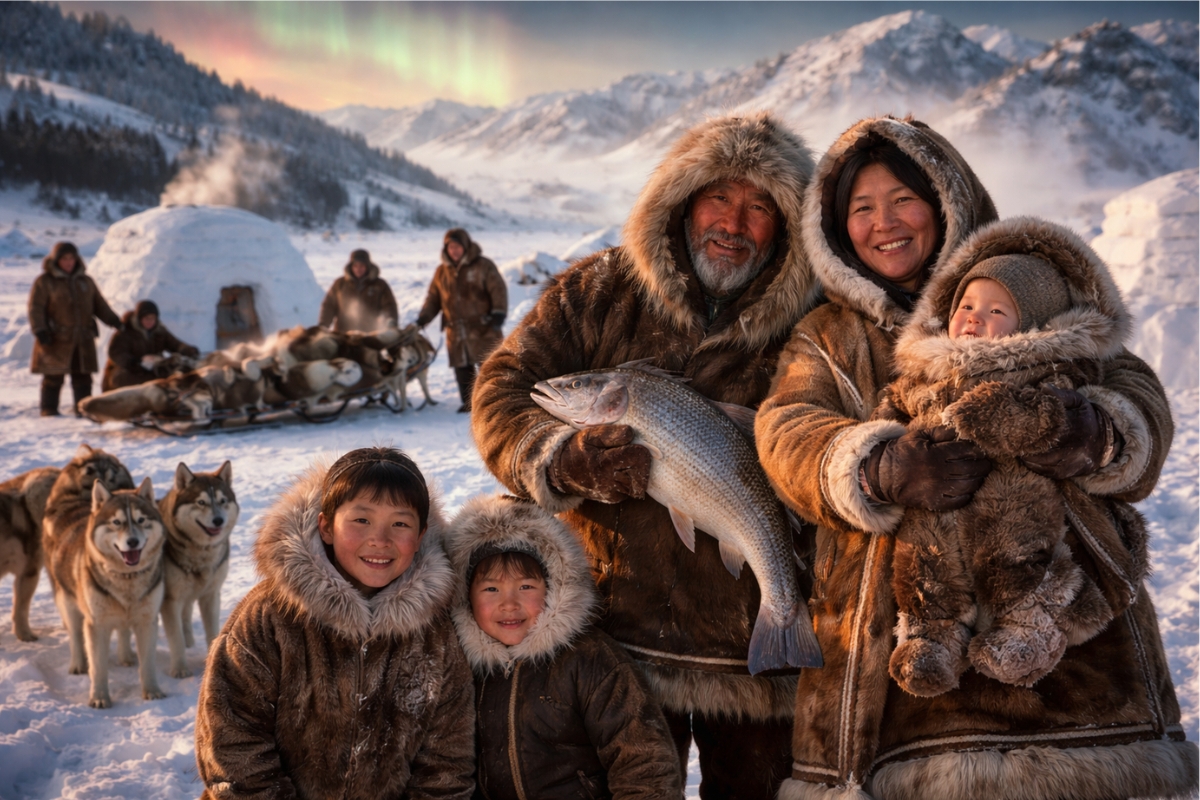

Amid Snow, Ice, and Long Winters, Arctic Peoples Combine Traditional Techniques and Community Life to Build Shelter, Obtain Food, and Preserve One of the Most Distinct Cultures on the Planet
In Arctic areas, Indigenous peoples have lived for centuries in low-temperature environments, preserving traditional customs, unique forms of social organization, and practical solutions developed collectively to cope with the intense cold.
Living in the North Pole, Alaska, or Arctic regions is often associated with snow, northern lights, sleds, and igloos. However, the daily life of the Indigenous peoples of these regions reveals a routine marked by knowledge passed down through generations, strong community cooperation, and a balanced relationship with the natural environment.
These populations have developed, over time, effective techniques to cope with the harsh climate and the seasonal availability of natural resources. Cultural continuity is linked to practices of construction, feeding, and coexistence that reinforce social ties and collective identity.
-
Miguel Krigsner opened a small compounding pharmacy in Curitiba in 1977, turned Brazilian fragrances into a national success, and created O Boticário, now one of the largest beauty networks in the world.

-
Meet the charming parrot grandpa, who became known for hugging free birds and revealed how he gained their trust over the years.
-
After 18 years of development, Bridgestone launches the AirFree airless tire, which requires no inflation and is puncture-proof, into daily service in Japan, starting with autonomous vehicles up to 20 km/h, used for transporting elderly people.

-
Couple buys 1905 colonial house, plans to tear down walls to unite three rooms, but finds hidden service staircase and rethinks the entire renovation to preserve details that have survived for over a century.



The topic draws attention by showing how different human societies build sustainable ways of life in challenging environments, maintaining cultural values and traditions that spark interest in various parts of the world.
The Term Eskimo and the Diversity of Arctic Peoples
The word Eskimo has different historical and linguistic interpretations. Some old associations attribute inaccurate or inappropriate meanings to the term. Over time, it has come to be seen as outdated and, in some contexts, inappropriate by the communities themselves.
Today, expressions like Indigenous Arctic Peoples or the specific names of each group are more commonly used, as they acknowledge the cultural, linguistic, and social diversity present in the region.
Sámi and Inuit: Peoples with Distinct Traditions

The Arctic peoples include various groups with their own habits and languages. Among them, the Sámi and the Inuit stand out.
The Sámi are natives of the region of Lapland, present in areas of Sweden, Finland, Norway, and Russia. Their traditions involve practices such as reindeer herding, fishing, and hunting, activities carried out in constant interaction with the territory and other communities.
The Inuit are distributed across Greenland, northern Canada, and Alaska, living in organized communities, often near coastal areas. Hunting and fishing are central activities, and the Inuktitut language is widely used.
Igloos as Applied Traditional Knowledge
Igloos are part of Inuit traditional knowledge and are primarily used in specific situations, such as support during hunting activities. Most families currently live in permanent homes, similar to those in other regions.
From an early age, children learn construction techniques using compacted snow, shaped strategically to ensure thermal resistance and protection against the wind. The dome shape helps maintain warmth inside, utilizing natural and artificial heat sources.

Food Based on Local Resources
The diet of Arctic peoples is adapted to environmental conditions and mainly relies on animal protein sources. Fish, birds, and marine mammals are part of the diet, always with full utilization of resources.
Traditional methods such as smoking contribute to food preservation and are part of the culinary knowledge passed down through generations.
Social Customs and Community Organization
The organization of communities follows a functional division of labor based on cooperation. Different members participate in hunting, food preparation, clothing making, and community care.
The gesture known as “Eskimo kiss,” where noses touch, reflects a cultural adaptation to climatic conditions, preserving affection and social bonds safely.
The way these peoples maintain their traditions over time illustrates cultural strength and the human capacity to develop practical solutions in challenging environments, valuing coexistence, collective knowledge, and respect for nature.
Source: Britannica Encyclopedia, entry “Inuit,” with an overview of history, language, and cultural and technological adaptations of the Inuit to the Arctic environment