






 Portuguese
  Spanish


The delivery took place on June 10, made by President Silvia Massruhá, and added 24 accesses to the Brazilian collection. The world’s largest seed bank holds about 1.38 million samples from 223 countries, and Embrapa still maintains another 126 thousand in Brasília.
Embrapa sent a new batch of seeds to the world’s largest seed bank, the Svalbard Global Seed Vault, in Norway, reinforcing Brazil’s participation in one of the main initiatives for the preservation of agricultural biodiversity. The delivery, with crops such as cashew, peanut, and sesame, was made on June 10 by the institution’s president, Silvia Massruhá, and expanded a Brazilian collection that already exceeds 8,000 samples stored since 2012.
The new shipment includes 24 accesses of different crops. Among them are cashew, fava bean, peanut, castor bean, and sesame, according to Embrapa, which detailed the contents of the shipment. Located in the Svalbard archipelago, the global bank currently holds about 1.38 million samples of more than 5,000 species from 223 countries and territories, aiming to preserve essential genetic resources for food production in the face of threats such as climate change, conflicts, and pests.
What Embrapa sent to the world’s largest seed bank
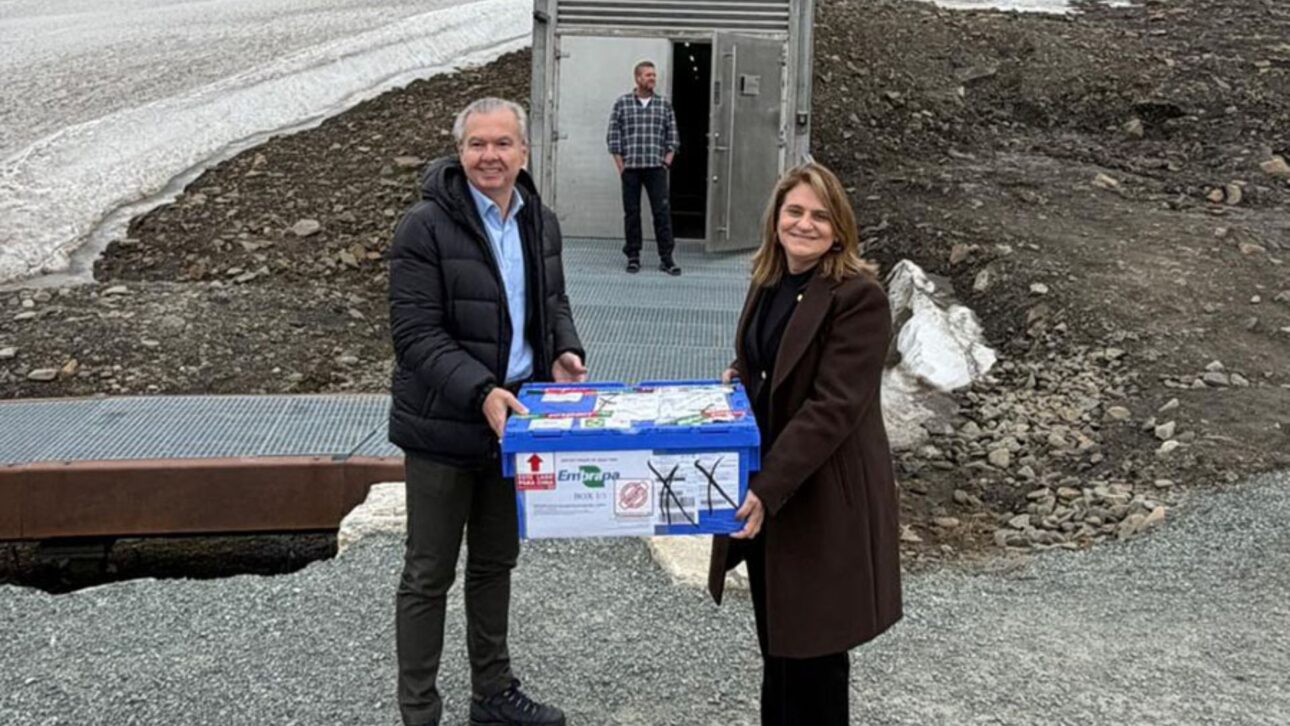
The new batch added five prominent crops to the national collection. Delivered on June 10 by President Silvia Massruhá, it includes 24 accesses of different crops, among them cashew, fava bean, peanut, castor bean, and sesame, which now integrate a collection that already exceeds 8,000 Brazilian samples stored in the structure. Each access represents a cataloged sample, ready to be recovered if the variety is lost in the field.
-
Workers renovating a playground in northern England uncover 176 World War II bombs buried underground; training artifacts still contained explosives.

-
Brazilian Architect Transforms Waste into Sustainable Homes with Solar Power and Rainwater Systems for 40 Years

-
Security Guard Becomes Doctor at Louisiana Hospital Where He Once Worked, Studied Chemistry Between Shifts

-
Engineers Develop Fridge-Sized Machine to Produce 95-Octane Synthetic Fuel from Air and Water, Aiming to Sustain Combustion Engines Without Oil





The country’s presence in the world’s largest seed bank is not new. Since 2012, Embrapa has represented Brazil in the initiative, and among the materials already deposited are key crops for food, such as rice, beans, and corn, as well as forage plants, fruit trees, vegetables, and other species of agricultural interest. The selection of seeds takes into account criteria such as relevance to food security and adaptation to Brazilian conditions.
A Vault in the Arctic with 1.38 Million Samples
The destination of the seeds is one of the most symbolic structures in global agriculture. Located in the Svalbard archipelago, Norway, the bank currently holds about 1.38 million samples of more than 5,000 species from 223 countries and territories, making it the largest agricultural safety reserve on the planet. This scale supports its title as the world’s largest seed bank.
The function of the vault is to serve as insurance for the food of the future. The purpose is to preserve the genetic resources essential for food production in the face of threats such as climate change, armed conflicts, and pests, functioning as a backup that allows a country to recover its varieties if the original collection is lost. It is protection designed for decades, not for immediate use.
Why Storing Seeds Became a Food Security Issue
Conserving genetic diversity is conserving options for agriculture. Preserving many varieties means maintaining characteristics that can withstand future droughts, diseases, or pests, which would risk disappearing if they depended solely on field cultivation. The world’s largest seed bank concentrates this protection network in one place, available to institutions worldwide.
For Brazil, participation has both strategic and domestic significance. The presence reinforces the country’s commitment to biodiversity and more sustainable agriculture, as well as highlighting the contribution of national research to global challenges related to food production. At home, the country maintains one of the largest genetic conservation structures in Latin America, with the Brasília bank gathering about 126,000 samples of more than 1,200 species, in controlled conditions that preserve viability for long periods.
Agreement with Norway Expands Scientific Cooperation
The trip yielded more than just seed deposits. During the agenda in Norway, the president of Embrapa participated in meetings with local authorities and research center representatives, focusing on expanding partnerships in areas such as bioeconomy, sustainability, agricultural innovation, and food security, on the same trip that brought new crops to the world’s largest seed bank. The effort to strengthen ties accompanied the scientific delivery.
The highlight was the signing of a letter of intent. The document was signed with the Norwegian Institute of Bioeconomy Research, NIBIO, and provides for the joint development of scientific and technological projects, with priority given to topics such as biotechnology, sustainable production chains, efficient use of natural resources, and solutions for mitigating climate change. The agendas reinforce Embrapa’s strategy to expand international insertion in a scenario of growing demand for more resilient food systems.
With cashew, peanuts, sesame, and other crops in 24 accessions, Embrapa expanded Brazil’s presence to over 8,000 samples in the world’s largest seed bank, the Svalbard vault, where the country has been depositing material since 2012.
The structure holds about 1.38 million samples from 223 countries as a backup against climate change, conflicts, and pests, while Brazil maintains another 126,000 samples in Brasília. The same trip resulted in a letter of intent with NIBIO, reinforcing scientific cooperation between the two countries in bioeconomy and sustainability.
And you, did you know that Brazil stores thousands of seeds in a vault in the Arctic to protect the agriculture of the future? Do you think initiatives like this should receive more attention? Share your opinion and exchange ideas with other readers about science and food security, with respect for different views.


