Portuguese
  Spanish


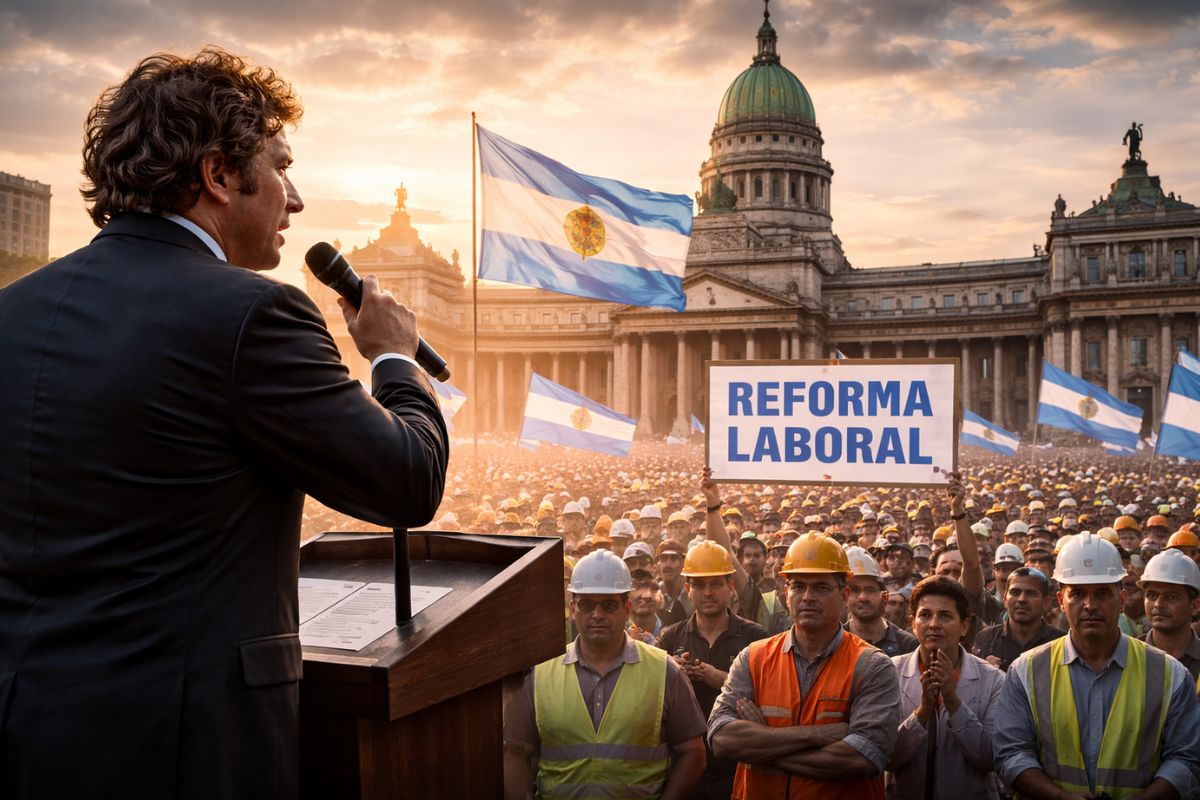


Javier Milei’s Labor Reform, Approved by the Argentine Senate on February 12, Arrives in the Chamber of Deputies Under Pressure from Unions and Protests in Buenos Aires. The Government Defends a Workday with a Time Bank, Fractional Vacations, and 12-Hour Days, While a General Strike is Announced.
The workday has become the most sensitive point of President Javier Milei’s new labor reform in Argentina, approved by the Senate in the early hours of February 12 and now headed to the Chamber, with a vote scheduled before March 1, 2026. The debate has become inevitable because it runs contrary to what is mobilizing part of Brazil today.
In the text approved by the Senate, the proposal includes flexibilities such as extending the workday to up to 12 hours, creating a time bank for exchanging extra hours for time off, and the possibility of splitting vacations into shorter periods. Union leaders and opposition figures reacted, and the discussion spilled onto the streets of Buenos Aires, with clashes during the session, while trade unions announce a general strike to pressure the Chamber.
What Changed in the Senate and Why the Chamber is the Finish Line
The approval in the Senate, recorded in the early hours of February 12, marked a political turning point for Javier Milei’s team.
-
Brazil’s 2026 Tax Refund: Record 9.58 Million Filers in Largest Payout Ever, But a Key Detail on Priority Recipients Draws Nationwide Attention

-
Itaú Alters Hybrid Work Model, Increasing Office Days from 2028, Prompting Employees to Adjust to New Routine
-
Facing Labor Shortage, Japan Plans to Invest $34 Million to Attract Foreign Workers in Construction, Healthcare, Industry, and Commerce

-
Brazilian City Makes Remarkable Leap, Becomes 4th Wealthiest in the Country with GDP of R$ 134.1 Billion




The text reached the plenary after changes were made precisely to secure votes, a typical move for reforms that impact routines and income.
When the workday comes to the agenda, every word becomes a power struggle.
Now, the decisive stage is concentrated in the Chamber.
The vote has been scheduled for before March 1, 2026, and the government is considering using the topic as a showcase when opening the ordinary sessions of Congress, with a speech planned by Milei.
The clock matters because, the closer the date approaches, the greater the room for street pressure, behind-the-scenes negotiations, and the risk of stoppages linked to the general strike.
The Core of the Reform and the Workday of Up to 12 Hours
The most striking point in the text is the possibility of extending the workday to up to 12 hours.
The wording indicates a flexibility of the traditional framework, promising to give more leeway to companies and sectors operating on long shifts, without needing case-by-case renegotiation.
This is a change that directly impacts the daily lives and bodies of workers.
Alongside this, the time bank is introduced, designed to allow the exchange of extra hours for time off.
In practice, the proposal seeks to replace part of immediate payment with future compensation, creating a sort of time current account.
This mechanism, alongside the extended workday, tends to require consistent oversight and recording, as the most common conflict arises when hours accumulate, and compensation does not come at the expected pace.
Fractional Vacations, Costs, and the Bet on Formalization
Another axis is the fragmentation of vacations into shorter periods. The idea, according to the government’s political presentation, is to provide flexibility for employers and employees to schedule breaks in irregular calendars, without halting operations for long blocks.
The problem is that flexibility can be seen as a gain or a loss, depending on how it is applied.
The reform is also presented as an attempt to alter regulations from the 1970s, reduce costs, and formalize jobs in an economy described as marked by high informality.
This justification helps to understand why the workday has become a symbol: for the government, it is part of the modernization package; for critics, it concentrates the risk of undermining acquired rights and pushing the adjustment onto those who already have less bargaining power.
Protests in Buenos Aires and the General Strike as a Veto Tool
The tension has not been confined to offices.
During the approval in the Senate, there were violent protests in Buenos Aires, with clashes between protesters and police, indicating that the reform has the potential to transcend the technical debate and become a governance crisis.
When the street enters the agenda, Congress loses total control over the script.
Furthermore, the Federation of Transport Workers announced stoppages in sectors such as land, air, and maritime transport, affecting operations essential to the economy.
The central union CGT called a general strike to coincide with the voting in the Chamber, in an attempt to amplify political costs and narrow the government’s maneuvering space.
The general strike, here, is not just protest; it is a tool to test how far Argentina is willing to redefine its workday.
Brazil Discusses Reducing While Argentina Reopens the Work Clock
The regional contrast stands out because, while sectors in Brazil discuss reducing the workday, Argentina is debating raising the daily cap to 12 hours.
This difference in direction creates a natural noise in comparisons: in one country, the focus is on quality of life and productivity; in the other, on cost, formalization, and attracting investments, according to the narrative of the Milei government.
This does not mean that the two realities are mirrors, but it helps explain why the Argentine case resonates here.
The workday, when it changes, alters contracts, salaries, schedules, and the very relationship between company and worker.
And in Argentina, the sequence of Senate, Chamber, and general strike before March 1 tends to define not only the final text but also the level of conflict that will accompany implementation.
Javier Milei’s labor reform has placed the workday at the center of Argentine politics, with Senate approval on February 12 and a rush for voting in the Chamber before March 1.
Amid promises of modernization, time banks, fractional vacations, and a cap of 12 hours, the dispute has already transcended the plenary and reached the streets, with protests in Buenos Aires and the announcement of a general strike.
If you had to choose in your sector, would you prefer a shorter and stricter workday or a model with a time bank and compensation in days off even with 12-hour shifts? And, looking at Argentina and Brazil, do you think the general strike changes votes in the Chamber or just hardens the conflict?