Portuguese
  Spanish


Discover How Naval Welding Transformed the Construction of Vessels and Learn About the Processes That Ensure Safety, Strength, and Durability in the Naval Sector.
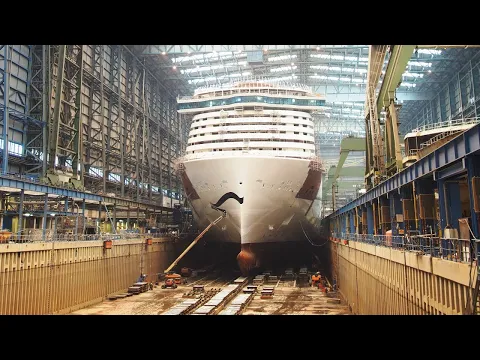
Naval welding plays an essential role in the construction and maintenance of vessels, from small boats to massive cargo ships or offshore platforms.
Although often invisible to passengers or crew, it connects the parts of the structure, ensuring strength and safety during navigation.
Therefore, in this guide, you will understand what naval welding is, its historical importance, the most used types of welding in the sector, and the challenges that professionals face in this area of engineering.
-
The U.S. Navy Conducts Submarine Tests in Idaho Lake to Detect Underwater Noises Hidden by the Ocean

-
Nuclear Submarine USS Alexandria Retired After 35 Years, Having Completed Over 1 Million Miles in Missions

-
MODEC Introduces New Hull Design for FPSO Gato do Mato to Produce Up to 120,000 Barrels of Oil Per Day in Brazil’s Pre-Salt Region
-
This Massive 12-Meter, 21-Ton Underwater Drone Can Operate Autonomously for Up to Five Days


Additionally, we explain how this technology has evolved over time and the role it plays today, especially in a world that increasingly values efficiency and sustainability in maritime industries.
What is Naval Welding?
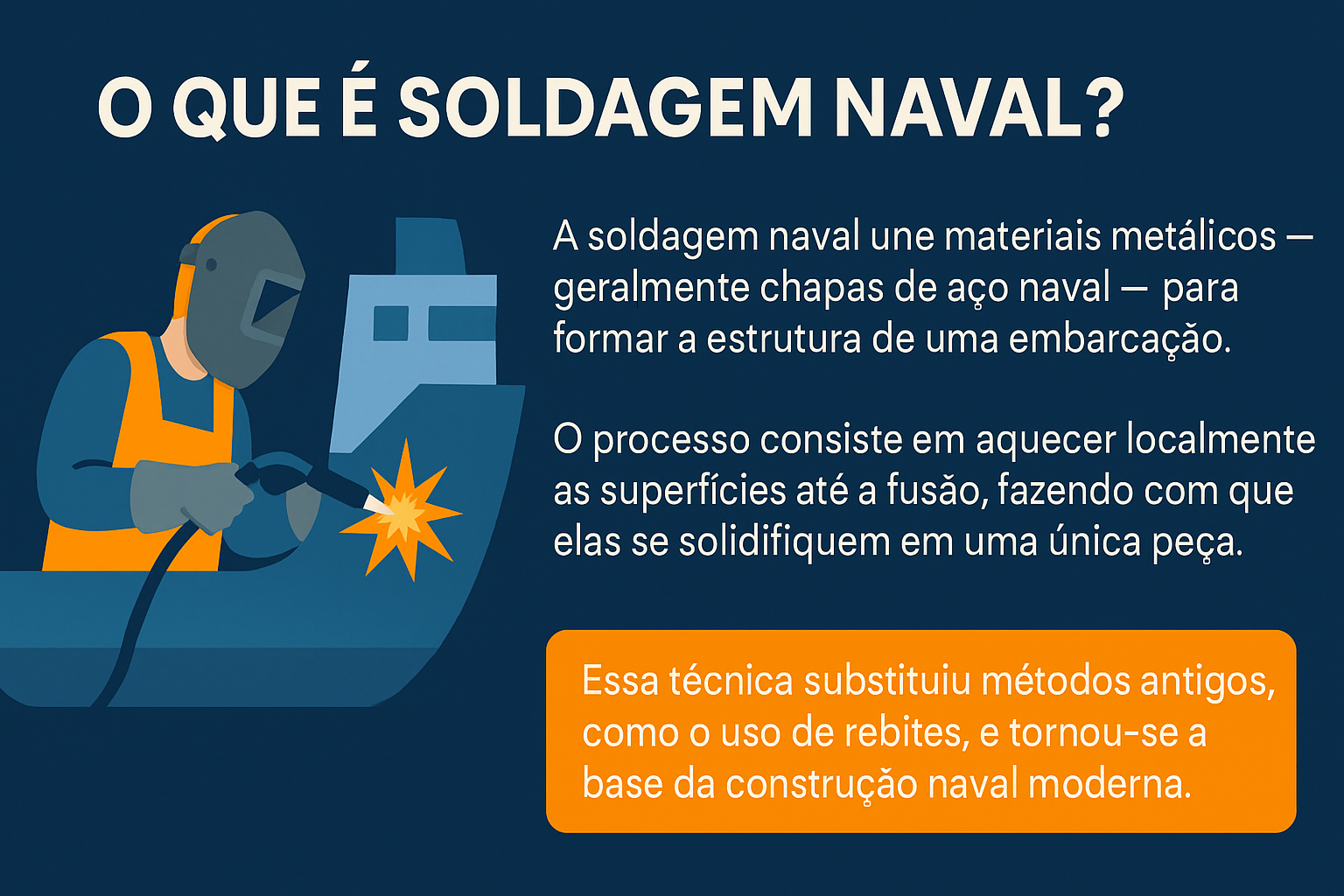
First, naval welding joins metallic materials — usually naval steel plates — to form the structure of a vessel.
The process consists of locally heating the surfaces until fusion occurs, causing them to solidify into a single piece.
This technique replaced older methods, such as using rivets, and has become the basis of modern naval construction.
Thus, shipyards manufacture the main parts of the ship — hull, bulkheads, decks, and internal structures — with welded metal sections.
This saves time and material, in addition to increasing rigidity and ensuring watertightness — preventing water ingress, which is essential for navigation safety.
Besides its structural function, naval welding contributes to the hydrodynamic integrity of the vessel.
Indeed, well-executed welds reduce drag in the water, improving the ship’s performance and saving fuel.
For this reason, shipyards focus heavily on the quality of welding during manufacturing.
How Did Welding in Ships Emerge?
Welding began to gain traction in the naval industry in the 20th century, especially after the First World War, as highlighted by the Brazilian Association of Naval Engineering (ABENAV).
Before this period, ships were built with wood or iron joined by bolts, nails, or rivets.
At the end of the 19th century, the USP Science and Technology Museum records that the first experiments with heat joining emerged, but only with the advancement of electricity did electric welding become viable for practical use.
During the Second World War (1939-1945), the need for rapid and large-scale production led shipyards to adopt welding as the primary method.
According to the Welding and Engineering Institute, this was a milestone as it allowed for the accelerated construction of American Liberty ships, essential for the war effort.
Thus, welding gradually replaced riveting since it offered greater strength, less weight, and faster construction.
From the 1950s onward, technological advancements detailed by the Welding and Engineering Institute enabled the development of more precise techniques, such as submerged welding and processes for special metal alloys, enhancing the durability and strength of vessels.
According to the Ministry of Labor, these innovations also contributed to greater safety for workers in shipyards, reducing exposure to toxic fumes and serious accidents.
Why is Naval Welding Indispensable?
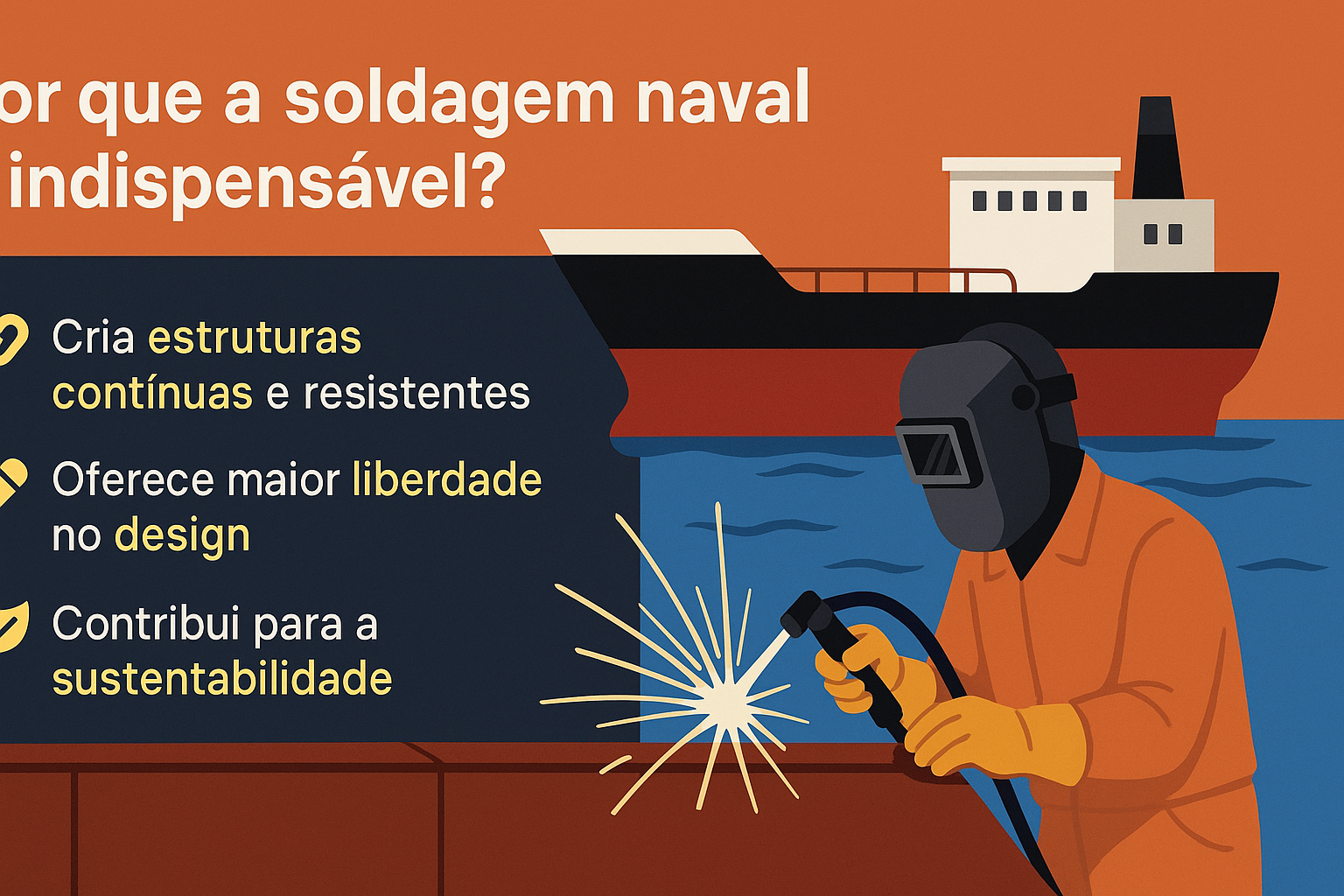
Welding creates continuous and strong structures that withstand the dynamic loads of the sea. A ship faces impacts from waves, temperature variations, twisting, and vibrations.
Therefore, the integrity of the welds determines the vessel’s durability and protects the crew and cargo.
Additionally, welding allows for greater freedom in design. While riveting limited shapes and materials, welding enables lighter, more aerodynamic, and energy-efficient solutions.
Equally important, welding technology keeps ships operational. Over time, they suffer from wear, cracks, or corrosion, especially in the hull and under aggressive marine conditions.
Thus, repairs through welding extend the service life of these vessels.
Another relevant point is the contribution of welding to the sustainability of the maritime industry.
According to a report by the International Maritime Organization (IMO) in 2022, strong welds reduce the need for frequent repairs and replacements, decreasing waste and environmental costs associated with shipbuilding.
What Are the Main Types of Naval Welding?
Engineers choose the type of welding based on the metal used (usually carbon or stainless steel), environmental conditions, plate thickness, and required precision.
For example, shielded metal arc welding still dominates the sector, using an electric arc between the electrode and the metal piece. The coating protects the fusion from external contamination, making it ideal for outdoor environments typical of shipyards.
Moreover, MIG/MAG welding uses a continuous wire protected by gas, great for workshops with controlled environments.
On the other hand, TIG welding, which is slower, offers high-quality finishing, suitable for internal or hard-to-reach parts.
Meanwhile, submerged welding caters to thick plates and long welds, featuring a high deposition rate and excellent protection against oxidation.
Each technique has specific advantages, and therefore, designers choose the one that best balances cost, strength, and safety for each need, according to the Welding and Engineering Institute.
What Are the Challenges of Welding in the Naval Sector?

Naval welding requires highly qualified professionals, as any failure can jeopardize the entire vessel.
Additionally, the work environment presents a significant challenge: many processes occur outdoors, subject to wind, humidity, and other conditions that affect the final quality of the weld.
Constant corrosion is also a challenge, as saltwater exposes welds to an aggressive environment, requiring special care in execution and protection, including anticorrosive coatings and proper material selection.
Finally, access to many parts of the ship is difficult, forcing the welder to work in uncomfortable positions or use specific equipment.
For this reason, shipyards place great value on technical training and certification of professionals.
It is worth noting that certification, according to the standards of the Brazilian Association of Technical Standards (ABNT) and the International Institute of Welding (IIW), ensures that welders master international standards and produce reliable welds to withstand the rigors of the sea.
How is Welding in Ships Today?
Today, naval welding is undergoing constant modernization.
For instance, many shipyards now incorporate welding robots and digital monitoring systems for real-time quality control, reducing errors and increasing productivity.
Moreover, sustainability is gaining traction with lighter and more durable metal alloys that help reduce fuel consumption in vessels.
This necessitates the development of specific techniques for these materials.
In Brazil, investments in maritime infrastructure and offshore oil exploration are driving the naval industry.
Consequently, shipyards in Rio de Janeiro, Pernambuco, and Santa Catarina are training professionals and modernizing processes to meet demand, according to recent data from the Ministry of Economy and the National Agency of Petroleum (ANP) in 2023.
As a result, the digitization of processes and the use of monitoring technologies make Brazilian shipyards more competitive in the global market.