Portuguese
  Spanish


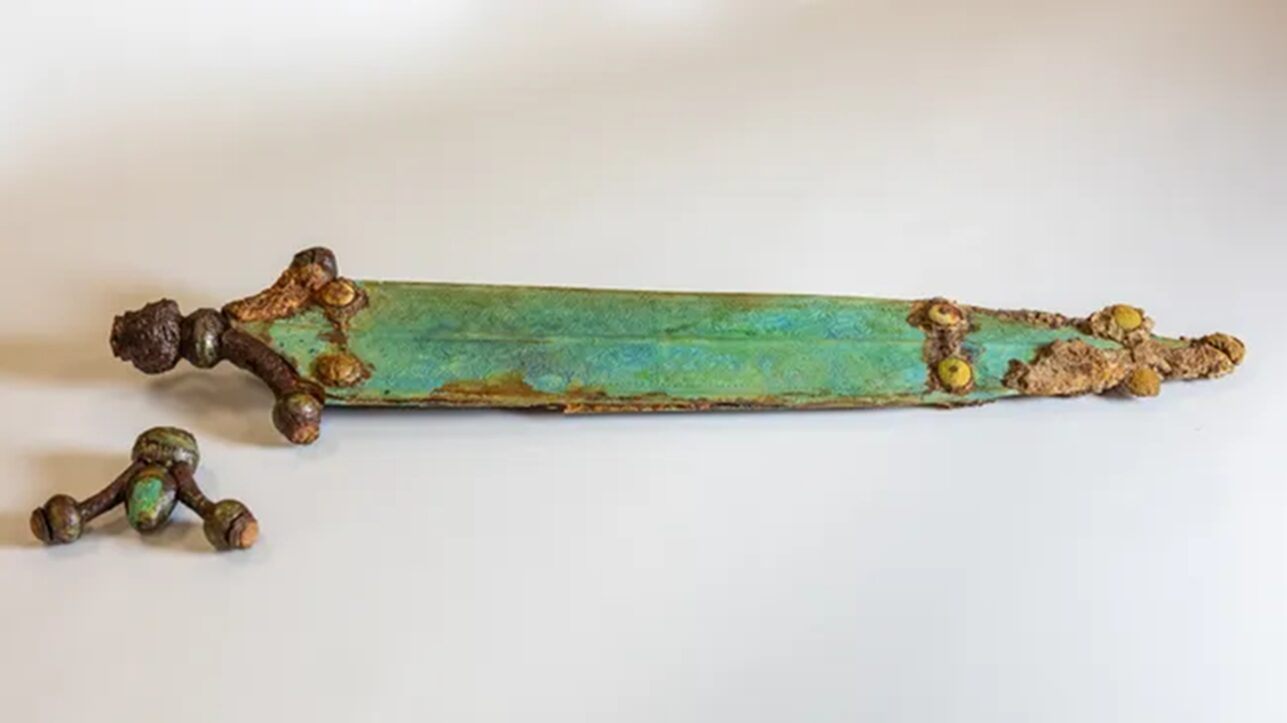

Iron Age Swords with Symbols Like Crescent Moon Found in Ancient Celtic Necropolis in France, Revealing Little-Known Aspects of Celtic Culture and Art.
Two swords over two thousand years old were discovered by archaeologists in France. One of them surprised by containing ancient symbols on its scabbard, including small swastikas.
The find was made in an ancient Celtic necropolis and, according to experts, has few equivalents in Europe.
Rare Archaeological Discovery
The discovery took place in Creuzier-le-Neuf, a small French town with about 1,500 inhabitants.
-
Stingless Bee Honey from Brazil Can Cost Up to $120 a Liter, Surprises with Flavors of Wood, Citrus, and Even Cheese

-
Woman Claims to Have Spotted a Technical Pattern in Recent FIFA Tournaments, Predicts Possible World Cup Winner
-
Chevrolet Offers Chance to Win a 2026 Sonic RS for Free via WhatsApp
-
Earthquake vs. Tsunami: Which Causes More Destruction and Why One Can Be Even More Dangerous


During the Second Iron Age, between 450 and 52 BC, the site was located between the territories of three powerful Celtic tribes: the Arverni, the Aedui, and the Bituriges.
The team from the French National Institute for Preventive Archaeological Research (INRAP) excavated a burial area with over 100 tombs. In total, the necropolis covered about 650 square meters.
Due to the region’s acidic soil, no skeletons were preserved.
Only one cremation tomb was identified, next to a vase decorated with perforated designs and painted stripes.
However, several metal objects survived, revealing funerary practices and aspects of Celtic culture.
Jewelry and Metallic Ornaments
Almost half of the analyzed graves contained metal ornaments. Copper alloy bracelets were the most common items.
In addition, archaeologists found 18 damaged brooches.
One of them drew attention for containing a polished gem, set in a disk adorned with gilded silver and designs made using the repoussé technique — that is, shaped using blows to the back of the metal piece.
Another brooch was decorated with eye-shaped markings, or ocelli. According to Vincent Georges, the archaeologist in charge of the excavation, this was a common style among Celtic craftsmen in the 5th and 4th centuries BC.
Celesial Symbols and Swastikas
Among all the objects found, the most impressive were two well-preserved swords.
The shorter one had a scabbard decorated with polished gemstones and swastikas.
Georges explained that, although the swastika is now associated with the Nazi regime, the symbol had other meanings thousands of years ago.
According to him, the swastika was used in various Mediterranean cultures and was incorporated by the Celts in the late 5th century and part of the 4th century BC. Despite this, it is not known exactly what the swastika represented for the Celts.
An X-ray analysis revealed even more details of the short sword. On the blade, there were symbols of a circle and a crescent moon, separated by a line.
These elements would be linked to sacred concepts, common in other Celtic swords and even in Etruscan swords, from what is now Italy.
S symbolic Function and Power
The sword decorated with swastikas was shorter and was likely not made for combat. Georges believes its function was symbolic.
It could represent power and military command. On the other hand, the second sword found, which was longer, had functional characteristics and could be used by a knight.
This larger sword also featured ocelli on the scabbard, like some of the brooches.
It still retained the suspension rings that allowed it to be attached to the waist. Unlike the short sword, it did not have lavish decoration.
Connection with Historical Moments
Georges pointed out that the short sword may have been manufactured around the time the Celts invaded northern Italy and sacked Rome, around 387 BC.
That year, the Gauls defeated the Roman army at the Battle of Alia. However, the archaeologist emphasizes that it is still not possible to establish a direct link between the weapon and these historical events.
The discovery of the swords and the objects from the necropolis helps to better understand the culture and rituals of the ancient Celtic peoples.
Even in the absence of human remains, the artifacts reveal details about the life, art, and beliefs of a civilization that occupied large regions of Europe before Roman domination.
INRAP classified the swords as pieces with few equivalents in Europe.
According to researchers, their preservation and the level of detail in the decorations make the archaeological find exceptional for the study of the Iron Age on the continent.