






 Portuguese
  Spanish
  9 min of reading
  0 comments


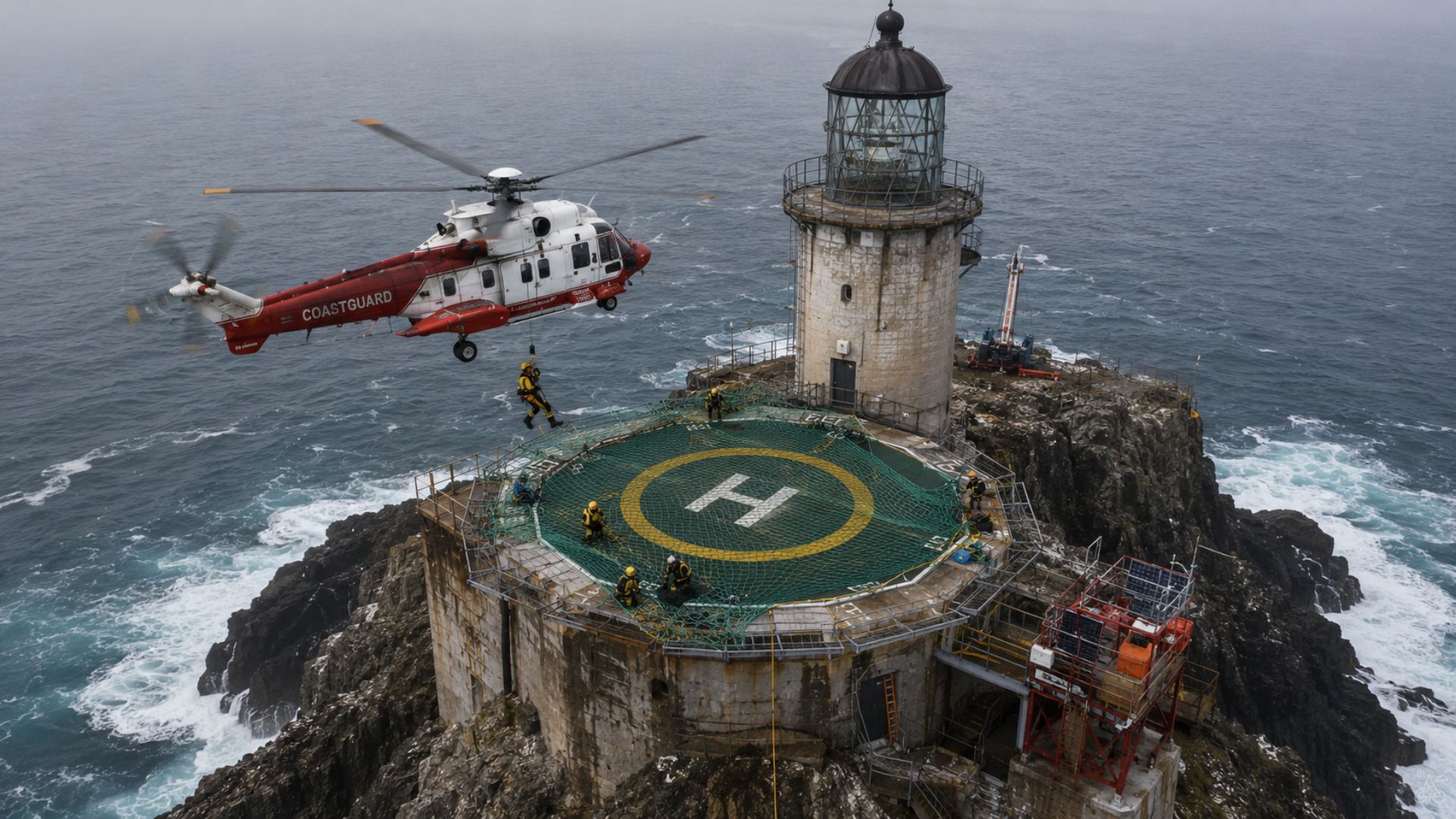
The Wolf Rock Lighthouse, located 13 kilometers from Land’s End, Cornwall, in the far southwest of the United Kingdom, receives technical teams who stay on site for about 12 consecutive days. The routine includes inspections of navigation systems and the complete replacement of the helipad’s safety nets, maintenance that occurs every three years.
The routine of professionals who maintain offshore lighthouses is often invisible to most people. In one of the UK’s structures, amidst the maritime traffic separation scheme, the Wolf Rock lighthouse continues to operate 24 hours a day thanks to the work of teams who temporarily stay inside the tower.
The structure is located 13 kilometers off the coast of Land’s End, Cornwall, in the far southwest of England. Access is only possible by helicopter, and technicians arrive for missions that usually last about 12 days, with routine inspections and specific tasks during each visit scheduled by the British navigation authority.
How helicopter arrival works

Logistics begin even before takeoff. The entire transport operation must consider the weight of equipment, tools, supplies, and crew, distributed over short trips to avoid overloading the aircraft during the overflight of the region’s rough ocean.
-
After swapping sewing for cement, a woman from Paraná became a mason, spent 12 years on construction sites, started building her own house, and even gained fame for restoring old Opalas.

-
Tired of relying on a conventional house, a young woman with no construction experience built an off-grid studio apartment with solar energy, rainwater, a biodigester bathroom, and a routine designed to live with more autonomy.
-
The European city hall that transformed an old urban avenue back into a canal, recovered a section that was filled in the 1970s, and delivered a new public space with water, vegetation, and pedestrian paths.
-
Buenos Aires and Montevideo are about 200 kilometers apart in a straight line, but the road trip can exceed 570 kilometers and take up to 8 hours and 30 minutes; see how long the journey takes by plane, ferry, car, and bus.



The helipad is located at the top of the structure. Wolf Rock was the first lighthouse in the world to have a helipad built on its own tower, a solution created precisely to facilitate the arrival and departure of professionals who carry out offshore maintenance.
On a typical 12-day mission, the team usually uses two to three cargo trips to transport everything they need. Priorities vary according to the planned work, with each visit requiring specific materials for technical inspection, parts replacement, or structural interventions previously scheduled by the team.
For the technicians, the most tiring part of the job is not the service itself. The greatest physical effort is concentrated during the moments of arrival and departure from the station, when all the material needs to be loaded from the aircraft into the lighthouse and distributed across the different levels of the tower.
The technical inspection that ensures safe navigation

The team’s main function is to confirm that all navigation aid systems are functioning within specifications. The first check involves the main light, which needs to receive the correct electrical power to maintain its brightness at the appropriate intensity to guide vessels.
The lamps used at Wolf Rock have 35 watts of power. Tests must confirm that the electrical results closely match this value to ensure the light maintains its expected range in the open sea.
If any adjustment is necessary, the technician makes modifications on site until the specification is met. The reserve light, known as standby, also undergoes the same testing procedures, receiving 10 minutes of warm-up before the complete verification of the secondary system.
The technical inspection is not limited to the lighting component. The team also checks the operation of domestic applications, fog detection systems, solar panels, batteries, and other critical equipment for the continuous operation of the lighthouse in adverse North Atlantic weather conditions.
Helipad net replacement every three years


One of the team’s most special tasks is replacing the safety nets that surround the helipad. This work occurs in long cycles, scheduled every three years, and requires meticulous planning before the actual execution at the tower site.
The operation involves considerable risks. All professionals must undergo specific training courses before they can work with the nets, a health and safety requirement that adds to extensive mandatory documentation before the intervention itself begins.
The three-person team divides into specific roles for the operation. Two technicians descend to the net area, while the third remains on the helipad assisting with material transfer, overseeing colleagues’ work, and monitoring the weather forecast throughout the delicate procedure.
The replacement process is repetitive and time-consuming. Old nets need to be cut, new ones need to be threaded through the outer bar, temporarily fixed over the old ones, and then permanently after the original material is removed, a sequence that needs to be repeated about 16 times around the entire circumference of the helipad.
The British weather hinders more than it helps
As with any outdoor work in Cornwall, the weather often interrupts activities without warning. Even with a favorable forecast early in the morning, strong winds and the risk of thunderstorms can quickly appear during the helipad operation.
When this happens, the team needs to pause external work. The nets remain half-finished until conditions improve, and technicians return inside the lighthouse to continue with other scheduled mission tasks, avoiding unnecessary exposure to lightning at the top of the tower.
This flexibility in the work plan is an essential part of the routine in offshore structures. There’s no point in forcing an outdoor operation in adverse weather, and any accident would mean a long wait for rescue, a situation that makes patience as important a skill as technical ability.
The unpredictable nature also affects professionals’ days off. Even when the 12-day period officially ends, bad weather delays can extend the stay for weeks or even months, a characteristic that makes this lighthouse particularly unpopular among technicians who usually work on different towers around the British coast.
The different levels inside the tower
Inside, the lighthouse is organized into multiple superimposed levels, each with a specific function. The base of the tower is practically empty, with only a few fuel pumps and the original entrance used before the construction of the helipad at the top of the structure.
The main fuel tank stores 3,600 liters of diesel. The old entrance door still exists, but it is rarely used nowadays because the rough sea in the region constantly throws waves over it, a system that requires plastic curtains and secondary doors to prevent internal flooding.
The engine room is on the next level. There, a TS3 three-cylinder diesel engine with an attached alternator operates, responsible for generating electricity when solar panels cannot meet demand on cloudy days or during the British winter with few hours of natural light.
When the team is staying at the lighthouse, energy consumption increases significantly. The engine operates 24 hours a day during the 12-day mission, with pauses only if there are ventilation system problems to prevent internal equipment from overheating.
Bathroom with diesel aroma and tiny kitchen
Life inside the tower has peculiarities that few professionals can imagine before taking on the role. The bathroom is normally equipped, but the diesel boiler leaves a characteristic fuel smell in the environment during use, an item that is part of the routine and cannot be completely eliminated.
The kitchen is compact but functional. Even with a small oven and a two-burner stove, the team can prepare complete meals like a traditional roast, simply adjusting cooking times according to the reduced capacity of the available equipment.
The kitchen sink features a curious technical detail. As the discharge point is below sea level at high tide, occasional water exchange occurs through the pipe, which is why there is a shut-off valve used whenever the team leaves the station to prevent flooding during periods when the lighthouse is unoccupied.
The bedroom, located directly above the kitchen, offers curved bunk beds conforming to the tower wall structure. This forces occupants to sleep at a slightly strange angle, a situation that quickly becomes routine, but which appears to be tighter and more uncomfortable at Wolf Rock than in other offshore lighthouses visited by the same technical team.
Batteries, solar panels, and redundant systems
The energy that powers the entire operation comes predominantly from the sun. Solar panels spread across the exterior of the tower capture light during the day and send energy to a regulation cabin that distributes electricity according to the needs of each system.
The battery room stores all this energy in individual cells. Each bank consists of 12 two-volt cells, totaling 24 volts per set, and the lighthouse has four different banks to ensure redundancy in case of failures, a system that offers a triple layer of operational security.
One of the banks is dedicated to domestic installations, powering basic lighthouse equipment. The other two main banks handle navigation aids, such as the light, the optical system, and the fog signal, with a configuration that allows the secondary to automatically take over if the primary presents any technical problem.
There is also an emergency bank reserved for extreme situations. This multiple redundancy is necessary precisely because any total system failure could compromise navigation safety, with a real risk of serious accidents involving vessels that rely on the lighthouse to navigate the rocky coast of Cornwall.
The service room and the electronic heart of the lighthouse
Going up another level, the team reaches the service room, where the electronic brain that controls the entire operation is located. This space concentrates essential equipment such as the main fog signal cubicle, the detector head, and the rack that houses practically the entire navigation system.
Telemetry functions as a complete status panel. The screen displays real-time information about the light, optical rotation, and the status of other critical systems, allowing the team to quickly verify if everything is working as expected during the inspection mission.
The fog signal operates on an energy-saving cycle. Every 17 minutes, the equipment turns on for 3 minutes for external verification, then automatically turns off again when the sensor confirms that visibility is adequate for navigation in the lighthouse area.
When the detector identifies fog or low visibility, the protocol changes completely. The system sends a signal to activate the audible fog signal, keeping the warning on until atmospheric conditions return to normal, providing extra safety for vessels crossing the traffic separation scheme in the vicinity of the British structure.
The lantern view and the sensor that turns on the lighthouse
At the top of the internal structure is the lantern room, considered one of the most special points of the entire tower. The view from the lookout reaches kilometers of ocean in any direction, a panorama often enjoyed by the team during breaks from technical work.
The light is controlled by a very ingenious automatic sensor. When external luminosity drops, the sensor’s electrical resistance increases and sends a signal to turn on the lighthouse, a system that operates without the need for any human intervention every day of the year.
The light remains on until sunrise, when the sensor identifies sufficient brightness to automatically turn off the equipment. This autonomy is fundamental considering that the lighthouse is unoccupied most of the time, with visits scheduled only for specific maintenance or for specific situations requiring in-person intervention.
The space also serves as a small informal office during missions. The team uses the location to rest between work shifts, especially on bad weather days, transforming the top of the tower into a welcoming environment even amidst the North Atlantic storms that batter Cornwall at different times of the year.
And you, would you face a work routine inside a lighthouse 13 kilometers off the coast, arriving only by helicopter and staying 12 consecutive days away from your family? Do you believe this type of role still makes sense in times of so much automation and digital technology applied to modern maritime navigation?
Tell us in the comments if you knew about the profession of a technical lighthouse keeper, if you would like to visit a structure like Wolf Rock, and what impressed you most about this routine inside the tower, from the curved bunks to the diesel-scented bathroom, passing through the manual replacement of the helipad nets. The discussion helps to understand how less visible professions still support global navigation safety today, even in the 21st century full of digital technology.






Be the first to react!