






 Portuguese
  Spanish


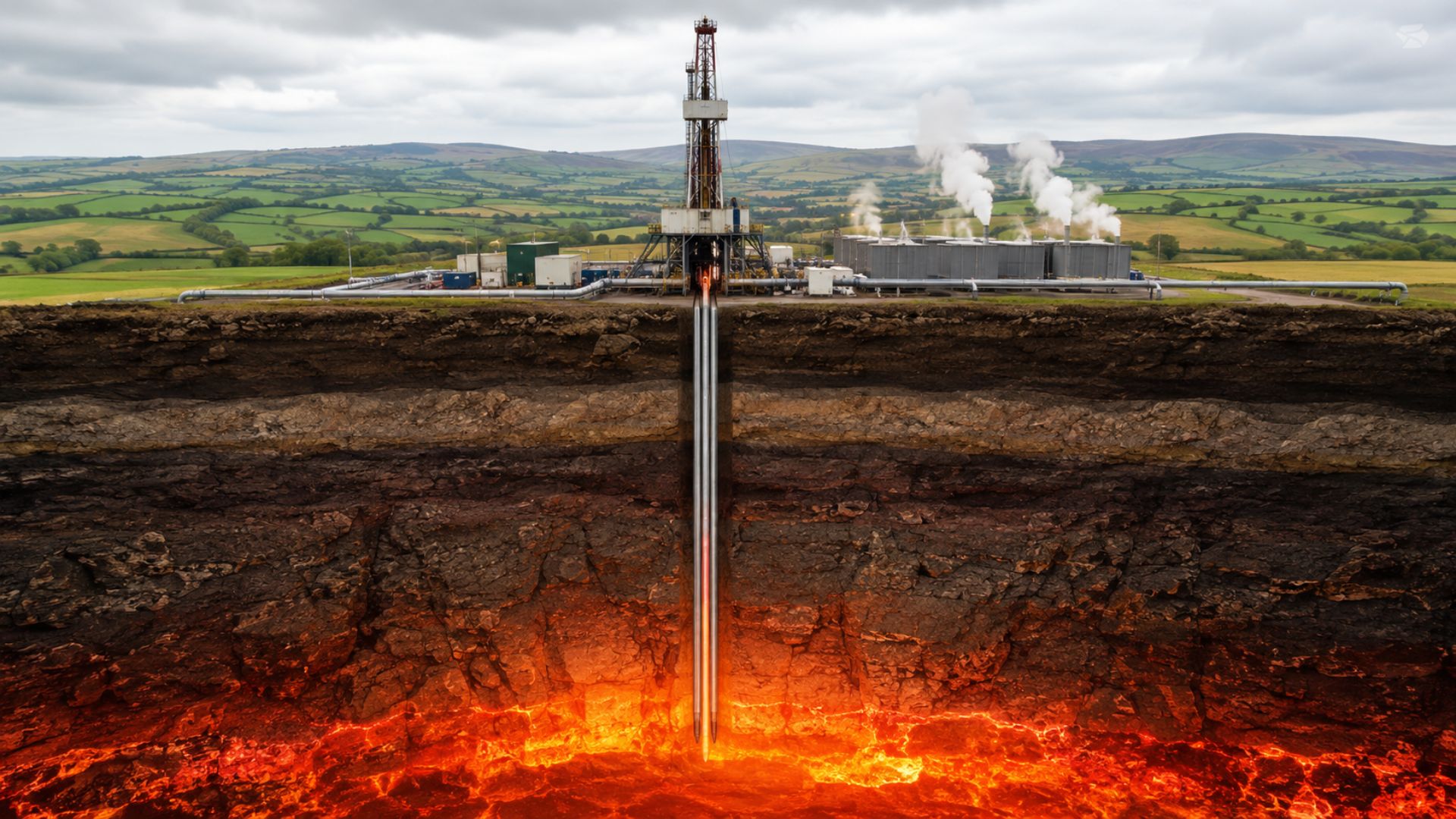


Geothermal Engineering Limited inaugurated a pioneering plant in United Downs, near Redruth, that generates electricity from hot brine extracted from over 4.8 kilometers deep and produces battery-grade lithium carbonate from the same fluid, in a closed-loop, low-emission model.
The energy transition gained a practical and impactful experiment in southwest England. British engineers drilled a well about five kilometers deep into the rocks of Cornwall and proved that a single hole in the ground can solve two problems at once, generating renewable electricity and producing battery-grade lithium.
The operation is located in United Downs, near Redruth, and is run by Geothermal Engineering Limited (GEL). The company announced that the unit already generates energy from hot brine extracted from over 4.8 kilometers deep and that the same fluid becomes raw material for batteries after passing through the plant.
What makes this well unprecedented in the United Kingdom

The novelty is not geothermal energy itself, which is already operating on a commercial scale in several countries. The point is the combination of two outputs from the same equipment, within British territory, without needing to open a new mine next door.
-
Californian gives up on buying a house, purchases a roughly 1-hectare island for $31,000 in Finland, learns construction from scratch, and begins building a refuge without running water or electricity.

-
A 3-year-old deaf student received the first white belt in Jiu-Jitsu and understood the achievement because the teacher learned Libras to communicate with him, in a video that surpassed 7 million views and moved social media by showing inclusion happening on the mat.

-
Miguel Krigsner opened a small compounding pharmacy in Curitiba in 1977, turned Brazilian fragrances into a national success, and created O Boticário, now one of the largest beauty networks in the world.

-
Meet the charming parrot grandpa, who became known for hugging free birds and revealed how he gained their trust over the years.




The deepest well at the unit reaches approximately 5,057 meters, or about 3.14 miles. Rock temperatures down there can exceed 190°C, equivalent to 374°F, more than enough heat to power an electric turbine.
The boreholes were designed to cross a geological structure called the Porthtowan Fault Zone. This fracture helps move the brine through the granite, allowing the fluid to rise heated and descend cooled in a continuous circuit.
The model is considered advantageous because geothermal energy operates continuously. Unlike solar and wind, it does not depend on sunlight or wind intensity, a characteristic that makes it strategic for peak consumption times on the electrical grid.
How rock heat turns into electrical energy

The obvious question is why not simply boil water and use steam, as traditional power plants do. At temperatures like those recorded in United Downs, the most efficient path involves a system called a binary cycle.
In this format, the heat from the brine is transferred to a second fluid, which has a lower boiling point and vaporizes easily. It is this secondary vapor that drives the turbine, without the brine ever needing to leave the closed circuit.
A technical document for the project, based on the Organic Rankine Cycle, describes the fluid’s path. The brine enters the system at approximately 170°C, close to 338°F, and exits at about 50°C, near 122°F, after yielding its heat.
The lower final temperature is not waste. On the contrary, it is precisely at this point that the project’s second function begins, mineral extraction, which takes advantage of the conditions of the already cooled fluid to initiate a completely different chemical stage.
Lithium without needing to open a new mine
This is where the experiment deviates from the standard of common geothermal plants. After generating electricity, the brine undergoes a process dubbed direct lithium extraction before being reinjected underground.
The result is the production of battery-grade lithium carbonate, a coveted input for the automotive industry and the energy storage sector. Hatch, GEL’s partner in this stage, states that the brine contains over 340 parts per million of lithium, a concentration considered significant for this route.
The expected production at the current scale is around 100 metric tons of lithium carbonate equivalent per year, according to The Chemical Engineer magazine. In American measure, the number is close to 110 short tons annually, a modest value compared to the global market, but significant as a proof of concept.
The big symbolic shift is to avoid a new front of traditional mining. Since lithium comes out with the water already being pumped to generate electricity, the environmental liability tends to be smaller than opening an open-pit mine or implementing a saline evaporation pond.
Project numbers: size, cost, and power
In terms of electricity generation, the United Downs unit counts as a 3-megawatt power plant. Industry reports estimate that this power is enough to supply about 10,000 homes, under a power purchase agreement signed with Octopus Energy.
The cost of the pilot project is also disclosed by the industry. The construction of the proof of concept was around US$ 68 million, a value considered high per unit generated, but justified by its experimental nature and the well’s dual function.
The occupied area is striking when compared to solar or wind farms. The entire plant occupies about 0.6 hectares, equivalent to approximately 1.5 acres, an area more similar to a medium-sized retail store than a conventional industrial park.
In terms of emissions, GEL states that geothermal projects can range between 5 and 15 grams of CO2 per kilowatt-hour. The number varies according to the operation’s design and the local geology, but it positions itself as one of the cleanest sources available today on a commercial scale.
Why lithium became a global climate issue
The project’s relevance goes beyond Cornwall. Electric vehicles, residential batteries, and grid storage systems require increasing amounts of lithium, and the mineral has become one of the most sensitive points in the energy transition chain.
The International Energy Agency projects that lithium demand will grow about fivefold by 2040, considering currently existing policies. This leap puts pressure on traditional mining routes, especially in regions with water scarcity or conflicts with local communities.
Given this, governments and companies are seeking alternative sources. Direct extraction from geothermal brines and the recycling of used batteries appear as options to reduce socio-environmental impact without hindering supply.
The British experiment fits exactly into this search. It does not solve the global supply problem alone, but it offers a replicable model for regions with compatible geology, especially in countries with an already consolidated mining tradition.
Environmental risks that still need to be observed
Despite the enthusiasm, deep geothermal energy is not without environmental cost. One of the most discussed risks is induced seismicity, a phenomenon where the injection and withdrawal of fluid in fractured rocks can cause small earth tremors.
Therefore, the project documentation emphasizes continuous monitoring and operational limits during all testing phases. Seismic monitoring is an essential part of the operation and tends to become a topic whenever the technology is replicated elsewhere.
Lithium extraction also has its own concerns. The direct route avoids some of the impacts of conventional mining but still requires industrial equipment, chemicals, and generates waste streams that need careful handling.
Transparency in reporting is pointed out by experts as the best way to validate this route. Without open data on efficiency, leaks, and disposal, the environmental gain may end up being less significant than announced by the companies involved in the sector.
The plan until 2030 and the real test of the model
The future of deep geothermal energy in the UK depends on what happens in the coming years starting from United Downs. GEL states that it is developing new exploratory areas in Cornwall, with the goal of adding about 10 megawatts of geothermal energy by 2030.
This plan only makes sense if drilling costs fall and if the chosen rocks offer a reliable brine flow in the long term. The British Geological Survey points out that some granites in the country can reach 200°C at five kilometers deep, a condition hot enough to sustain larger-scale electricity generation.
For now, United Downs functions as an open laboratory. The practical outcome will show whether a single well can deliver clean electricity and lithium without creating new environmental problems that negate the climate benefit.
The answer will take years to be definitive. Until then, the world closely watches what happens beneath Cornwall, searching for clues on how to make the energy transition less dependent on fossil fuels and traditional mines.
And you, do you believe that drilling a five-kilometer-deep well can indeed become a viable alternative to oil and conventional lithium mines? Or do you bet that this model will run into costs and seismic risks before scaling up?
Tell us in the comments if you trust deep geothermal projects, if you think Brazil should invest in something similar taking advantage of local geology, and how you imagine the future of lithium in the batteries of upcoming electric vehicles. The discussion promises to be as heated as Cornwall’s brine.


New Zealand is currently planning to drill a deep well bore about 4000m deep hoping to develop a high producing bore of more than 100mw
Totally support this effort.
I may be slightly biased as a retired geothermal drilling supervisor however geothermal has long been a very much underutilised source of energy.
Best if British to you