






 Portuguese
  Spanish
  4 min of reading
  0 comments


Researchers Record Galactic Collision in the Stephan Quintet at More Than 3.2 Million Km/H, with Shock Waves That Transform the Structure and Star Formation in the Cluster.
In deep space, an impressive scenario is unfolding. Giant galaxies are colliding with tremendous force, creating shock waves that traverse the universe.
This is what happens in the Stephan Quintet, a famous galaxy cluster located about 94 million light-years from Earth. Now, a new study has provided surprising data about this collision.
Impressive Speed
Using data from various telescopes, researchers calculated the speed of the collision of some of the galaxies in the Stephan Quintet.
-
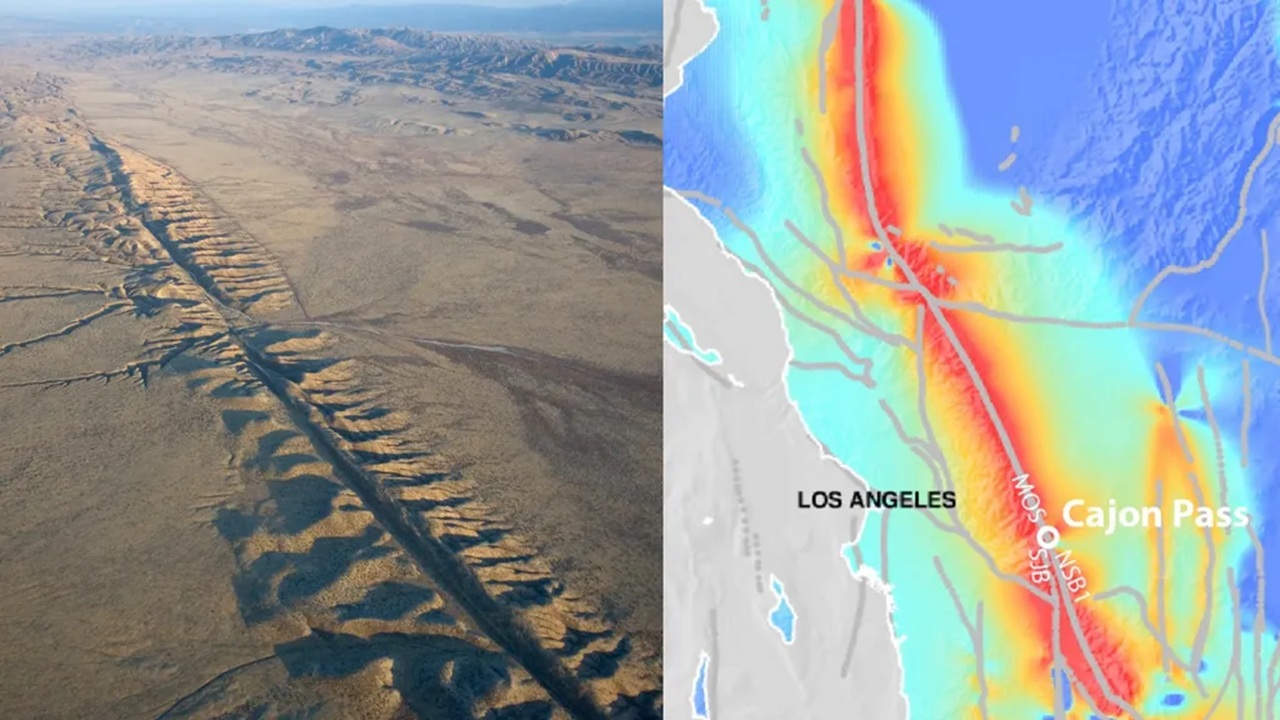
Giant earthquake returns to haunt California after study points out San Andreas and San Jacinto faults at highest stress level in 1,000 years, with risk involving Los Angeles and other populated areas.

-
Scientists have mapped for the first time the largest biological network on the planet, formed by underground fungi with an extension of 110 quadrillion km that transport 4 billion tons of CO₂ to the soil per year.

-
Where does the light go when you turn off the lamp? The answer involves invisible particles called photons, which disappear in fractions of a second inside the room but can travel billions of years through space to reach our eyes.

-
Light particle that shouldn’t be split surprises physicists


The result was impressive: more than 3.2 million kilometers per hour. Despite the violence of this encounter, the impact does not destroy everything it encounters along the way.
The Stephan Quintet is made up of five galaxies. Among them, four constitute the first compact group of galaxies ever discovered, nearly 150 years ago.
The scene can be compared to a galactic crossroads, where celestial bodies meet, interact, and collide.
A specific galaxy, called NGC 7318b, is primarily responsible for the current scenario. It is plunging into the group at high speed, triggering enormous shock waves.
Turbulence and Transformation
This turbulence generates profound effects. The collision provokes the birth of new stars, destroys molecular clouds, and alters the very structure of the involved galaxies.
To observe all these phenomena, scientists used the William Herschel Enhanced Area Velocity Explorer (WEAVE) telescope, located in La Palma, Spain.
WEAVE is a state-of-the-art spectrograph with excellent resolution capabilities. With it, it was possible to map the shock front with an unprecedented level of detail. However, the study was not limited to this instrument.
Researchers also used data from other sources, such as the LOFAR Two-Metre Sky Survey (LoTSS), X-ray observations, and archives from the James Webb Space Telescope (JWST). This combination of data allowed for a broad and detailed view of the phenomenon.
Based on these analyses, scientists confirmed that NGC 7318b is advancing at more than 3.2 million km/h, colliding with its neighbors and generating powerful shock waves.
Historical Crossroads
Lead researcher Dr. Marina Arnaudova from the University of Hertfordshire explained the fascination with the Stephan Quintet.
Since its discovery in 1877, the cluster has sparked great interest among astronomers.
It represents a true cosmic crossroads, marked by ancient collisions that left a complex field of debris in space.
According to Arnaudova, the intense activity occurring today was triggered precisely by the violent entry of NGC 7318b, which strikes the group at speeds exceeding 3.2 million km/h.
The generated shock is so powerful that it can be compared to the sonic boom of a jet aircraft, but on a cosmic scale.
Shocks and Their Consequences
The shocks occurring in the intergalactic medium act like gigantic pressure cookers. They produce energy through turbulence, heat gases, and promote the birth of new stars or destroy existing molecular clouds.
According to Dr. Arnaudova, when the shock reaches pockets of cold gas, it travels at hypersonic speeds, meaning several times faster than the speed of sound in the intergalactic medium of the Stephan Quintet.
This extreme force separates electrons from atoms, leaving bright traces of charged gas, visible with the help of WEAVE.
As it passes through the surrounding hot gas, the shock weakens, as explained by PhD student Soumyadeep Das, also from the University of Hertfordshire.
Instead of significantly disturbing the medium, the weaker shock merely compresses the hot gas. This compression produces radio waves detected by radio telescopes, such as the Low Frequency Array (LOFAR).
Resistance and New Stars
Despite the violence involved, some elements resist destruction. Molecule hydrogen grains and dust survive the shock. These materials can serve as a basis for post-shock cooling and the formation of new stars in the future.
The shock, moreover, amplifies radio emissions, increasing their brightness by up to ten times. Dense pockets of gas and dust, shielded from direct impact, continue forming molecular hydrogen.
Diffuse radio filaments and compact sources allow tracing the ongoing effects of the collision, including interactions with jets from the galaxy NGC 7319.
Scientific Importance
The analyzed system is a clear example of how galactic collisions transform the structure and chemical composition of galaxies. It provides scientists with important insights into cosmic evolution.
Thanks to advancements in instruments like WEAVE and observations made at different wavelengths, researchers are beginning to unravel the complex history of these interacting galaxies.
Unseen Details
Professor Gavin Dalton from RAL Space and the University of Oxford, also involved in the research, highlighted the advancement gained with these observations. According to him, the level of detail revealed by WEAVE is impressive.
In addition to clearly showing the shock and collision in the Stephan Quintet, the data offers a new perspective on similar processes that may occur in faint galaxies, still little studied, situated at the limits of current technological capabilities.
The study, led by MI Arnaudova and her team, was published in the journal Monthly Notices of the Royal Astronomical Society in 2024. The work is titled “WEAVE First Light Observations: Origin and Dynamics of the Shock Front in the Stephan Quintet“, and can be consulted with DOI: 10.1093/mnras/stae2235.
Study published in the academic.






Be the first to react!