Portuguese
  Spanish


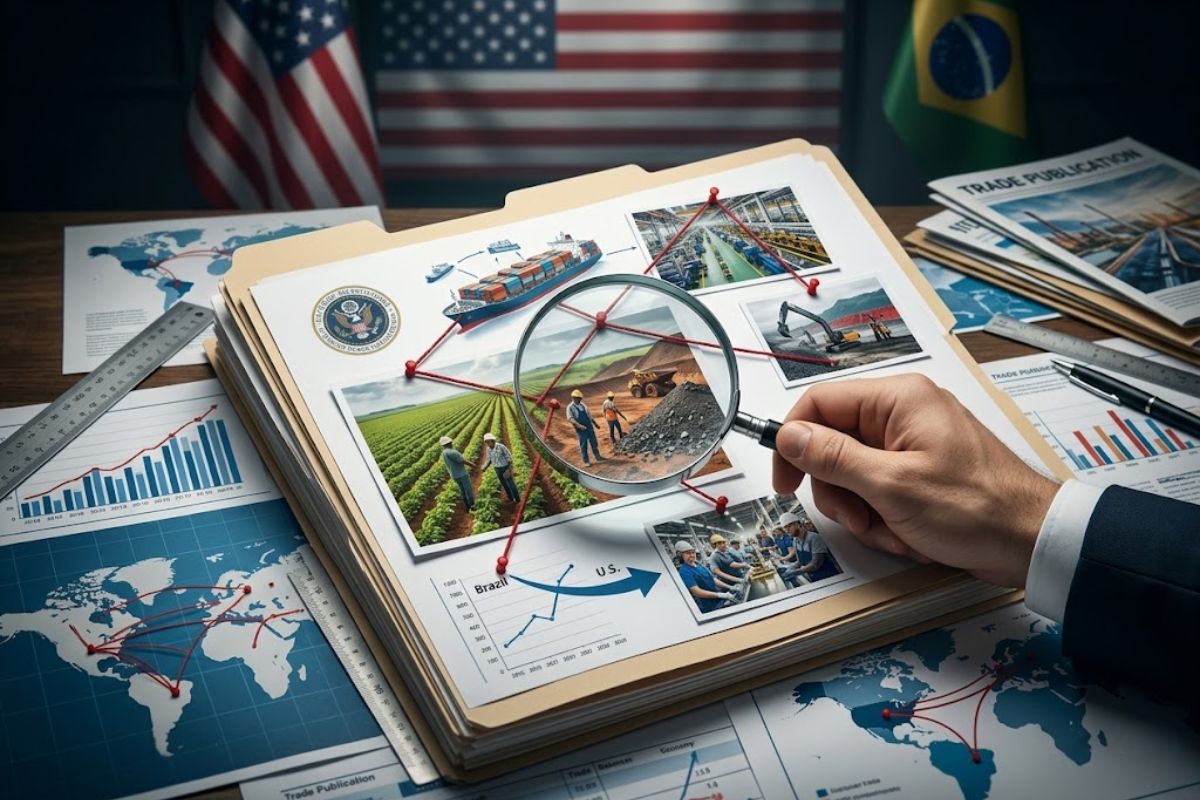

Brazil Entered a Trade Investigation Opened by the United States Involving Dozens of Economies and Seeking to Evaluate Whether Governments Are Taking Sufficient Steps to Prevent the Use of Forced Labor in Production Chains Supplying International Trade
The Brazil has become part of a trade investigation conducted by the United States involving more than 60 economies around the world. The investigation seeks to verify whether countries are taking sufficient measures to prevent the use of forced labor in the production chains that supply international trade.
According to American authorities, Brazil and other economies will be evaluated regarding the effectiveness of policies aimed at preventing the production or importation of goods associated with this type of practice. The investigation also aims to assess how possible failures may impact workers and businesses in the United States.
Why Brazil Entered the Trade Investigation
The inclusion of Brazil in the investigation was announced by the Office of the United States Trade Representative, known as USTR.
-
Brazil’s BNDES Funded Metro and Steel Plant Projects in Venezuela with Brazilian Support

-
Abandoned Building in Brazil to Become Biotechnology Unit with $10 Million Investment, Bridging Science, Industry, and Public Health
-
Company Offering “Stones to Diamonds” Scheme Sells Ruined Italian Homes to Brazilians for 1 Euro, Disappears with Promised Renovations, Leaving Buyers in Debt to Italian Tax Authorities Until 2028 Without Property

-
Plastic Packaging Drives Santa Catarina Industry to 230% Growth, Aiming for R$ 500 Million by 2030 Amid Sector Crisis, with New Gearless Line Expanding in Southern Brazil to Compete in South America



The process is being conducted based on the Section 301 of the Trade Act of 1974, a legal instrument that allows the U.S. government to investigate trade practices considered unfair or harmful to the country’s economic interests.
According to the agency, the goal is to verify whether foreign governments are taking appropriate measures to prevent products associated with forced labor from entering global trade chains.
This includes analyzing legislation, oversight mechanisms, and public policies adopted by the investigated countries.
The Brazil, therefore, was not automatically included as responsible for irregularities but has joined a list of economies that will be analyzed more in depth.
Countries Investigated Alongside Brazil
The investigation does not only involve Brazil.
The list includes about 60 countries and economies, encompassing strategic partners and important players in international trade.
Among them are Canada, European Union, United Kingdom, Australia, Israel, India, Qatar, and Saudi Arabia.
Countries frequently cited in commercial and geopolitical debates, such as China and Russia, are also part of the investigation.
The presence of such diverse economies shows that the process has global reach and is not limited to a single trading partner.
The declared objective of the U.S. government is to understand how different countries address the risk of forced labor in production chains that supply international trade.
The Trade Strategy Behind the Investigation
The investigation involving Brazil takes place at a time of intensification of U.S. trade policy.
In recent months, the U.S. government has sought to reactivate economic pressure instruments to deal with trade disputes and issues related to labor rights.
This movement gained momentum after internal court decisions limited some tariffs previously applied.
In response, Washington has begun to employ new legal tools to examine trade practices of economic partners.
Among these measures is the temporary application of 10% tariffs for 150 days, authorized under Section 122 of the Trade Act of 1974.
Additionally, parallel investigations have also been opened to examine issues such as excessive industrial capacity in relevant trading partners.
What May Happen After the Investigation
For now, the inclusion of Brazil in the investigation does not represent automatic punishment or immediate sanction.
The process consists of a detailed analysis of the policies adopted by countries to combat forced labor in production chains.
American authorities want to understand whether there are comparable mechanisms to those operating in U.S. legislation to block goods associated with these practices.
Depending on the conclusions, the U.S. government may recommend additional trade measures.
These measures may include trade restrictions, new tariffs, or regulatory requirements related to product origin.
The Expected Timeline for Conclusion
The United States government has indicated that the investigation involving Brazil and other countries is expected to conclude in the coming months.
The official expectation is that the results will be presented before July, a deadline that coincides with the end of the currently in-force temporary tariffs.
Until then, U.S. government officials are expected to analyze national policies, labor legislation, and oversight mechanisms adopted by the investigated countries.
The final result could influence future trade decisions between the United States and its international partners.
The inclusion of Brazil in a trade investigation conducted by the United States places the country within a broad process that examines global production chains and policies to combat forced labor.
Although the measure does not represent immediate punishment, it indicates that Brazilian trade policies and practices will undergo detailed analysis within the American trade strategy.
The outcome of the investigation may influence trade negotiations and the dynamics of global production chains in the coming years.
In your opinion, does this type of international investigation help to strengthen global labor standards, or can it just become a tool for commercial pressure between countries?