






 Portuguese
  Spanish


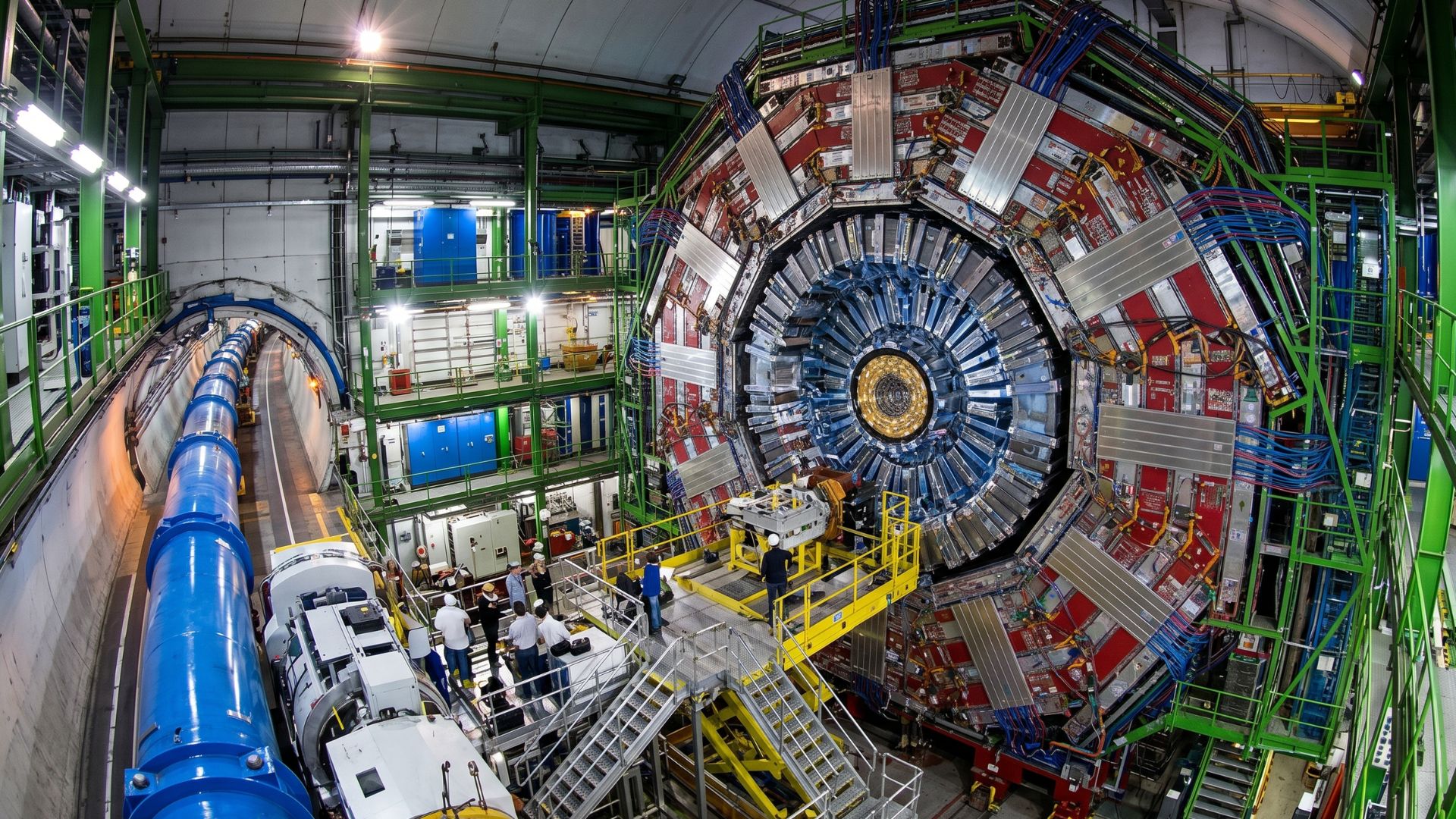


LHC accelerates protons to 99.9999991% of the speed of light, uses 9,600 superconducting magnets, and paved the way for the 91 km FCC.
According to CERN, the Large Hadron Collider, LHC, is the largest and most powerful particle accelerator in the world, built between 1998 and 2008 in collaboration with over 10,000 scientists from more than 100 countries. Buried up to 175 meters below the ground on the Swiss-French plateau near Geneva, the LHC has a 27 km circumference and operates as one of the most complex scientific machines ever built.
The structure uses 9,600 superconducting magnets cooled to -271.3°C, a temperature close to absolute zero and colder than any known point in interstellar space. These magnets bend the proton beams along the ring and accelerate each particle to 99.9999991% of the speed of light.
When two beams collide at the four crossing points of the ring, the energy released reconstitutes, for fractions of a second, conditions similar to those that existed less than a trillionth of a second after the Big Bang. In July 2012, this machine found the Higgs boson, the last particle predicted by the Standard Model that had not yet been observed.
-
The Trap of Modern Technology: How Screen Overload and Digital Connections Can Impact Your Mental Health and Well-being

-
Wyoming Couple Grows Tropical Fruits Year-Round in -40°C Using Geothermal Greenhouse, Demonstrating Earth’s Heat Can Produce Oranges and Lemons in Snow Without Traditional Heating

-
Ship Returns from Brazilian Coast with Thirty Newly Discovered Life Forms
-
Nigerian Professor Invents Electricity-Free Refrigerator Using Clay Pots and Wet Sand, Extending Shelf Life of Vegetables to 27 Days; 7,000 Units Distributed in Energy-Deprived Villages



Large Hadron Collider is the largest particle accelerator in the world and recreates Big Bang conditions
A particle accelerator uses electromagnetic fields to give kinetic energy to charged subatomic particles. The physical principle is not new, but the scale of the LHC transforms this idea into a machine capable of observing phenomena that do not naturally exist in the current universe.
The protons circulate in two beams that travel through the tunnel in opposite directions. Radiofrequency cavities add energy at each passage, while the superconducting dipole magnets keep the particles on the 27 km circular path.
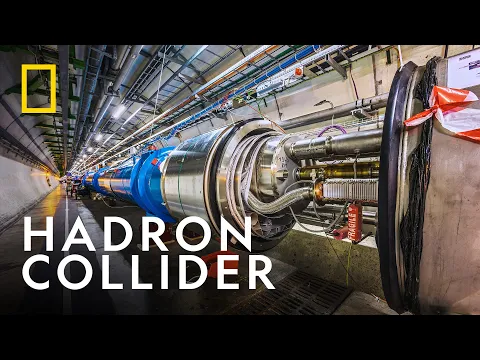

Without these magnets, the protons would follow a straight line and exit through the tunnel wall. The LHC is a machine built to control particles almost at the speed of light and make them collide at specific points, where giant detectors record the fragments of matter.
Proton collisions at 13.6 TeV reveal particles that existed in the primordial universe
The third round of LHC operation began in July 2022, after more than three years of upgrades, and was planned to continue until July 2026. In this phase, the collision energy reached 13.6 TeV, or teraelectronvolts.
Each collision transforms kinetic energy into mass, following the equation E=mc². The result is the production of hundreds of particles that appear and disappear quickly, before being recorded by the detectors installed at the crossing points.
These collisions do not recreate the entire Big Bang, but reproduce extreme conditions of temperature and density that existed in the first moments of the universe. That is why the LHC functions as an experimental window into the physics of the primordial universe.
Higgs Boson completed the Standard Model, but opened even bigger questions
The discovery of the Higgs boson, in July 2012, was one of the greatest results in particle physics in decades. The particle had been predicted in 1964, but no previous accelerator had enough energy to observe it directly.

The Higgs boson is the excitation of the Higgs field, a field that permeates all space and gives mass to the elementary particles that interact with it. Electrons, quarks, and W and Z bosons acquire mass through this mechanism, while photons do not interact with the field and remain massless.
The discovery completed the Standard Model, a theory that describes known fundamental particles and forces, except gravity. The problem is that completing the Standard Model also made clear what it does not explain: dark matter, dark energy, and the asymmetry between matter and antimatter.
Standard Model explains visible matter, but leaves 95% of the universe out of the equations
The Standard Model describes with great precision the behavior of visible matter, but this matter represents only about 5% of the total content of the universe. The other 95% are associated with dark matter and dark energy.
Dark matter helps explain the formation and rotation of galaxies, but does not interact with light. Dark energy is associated with the acceleration of the universe’s expansion, a phenomenon still without a complete explanation within current physics.
The LHC found the Higgs boson, but has not yet found the particles predicted by popular theories beyond the Standard Model, such as supersymmetry. The machine delivered the missing piece, but also revealed an experimental silence where many physicists expected new physics.
LHC superconducting magnets operate at -271.3°C to bend protons almost at the speed of light
The LHC’s cryogenics system is one of the largest and most complex ever built. To bend protons at extreme speeds, the magnets need to generate intense and stable magnetic fields, something only possible with superconductivity.
Superconductivity occurs when certain materials, below a critical temperature, lose electrical resistance. The LHC dipole magnets use niobium-titanium cables, which become superconductors below -263°C.
To ensure operational stability, the LHC operates at -271.3°C, just 1.85 degrees above absolute zero. The system cools 36,800 tons of equipment with liquid helium distributed along the 27 km of the underground ring.
CERN’s cryogenic engineering keeps 36,800 tons of equipment colder than space
Liquid helium is essential because it remains liquid at extremely low temperatures. CERN operates one of the largest liquid helium facilities in the world outside the aerospace industry.
This system allows the 9,600 superconducting magnets to maintain the magnetic field necessary to control the proton beams. Without cryogenic cooling, electrical resistance would destroy the system’s efficiency and make it impossible to operate the accelerator on this scale.
In the 1990s, when the LHC was still in the planning stages, part of the scientific community considered this engineering too ambitious to be completed on time and within budget. Today, LHC cryogenics is one of the foundations supporting modern particle physics.
LHC has already discovered 79 hadrons and tested the strong nuclear force in extreme regimes
By February 2026, data from the first three rounds of LHC operation allowed the discovery of 79 new hadrons. Each represents a new configuration of quarks confirmed experimentally.
Hadrons are particles composed of quarks held together by the strong nuclear force. Protons and neutrons are the most well-known examples, but the LHC has also confirmed more exotic particles, such as tetraquarks, pentaquarks, and rare combinations predicted theoretically.
These discoveries test quantum chromodynamics, the theory that describes the strong force, in regimes that previous experiments did not reach. Each new hadron shows which combinations of quarks nature allows and how the strong force organizes matter on subatomic scales.
Future Circular Collider of 91 km could be the successor to the LHC at CERN
The LHC is expected to operate until the 2040s, but scientists are already planning its possible succession. The most ambitious project is the Future Circular Collider, FCC, a new underground circular accelerator with a circumference of 90.7 km.

The FCC would be more than three times the size of the LHC, with a depth between 180 and 400 meters, eight surface sites, and four main experiments. The plan foresees two stages: first the FCC-ee, an electron-positron collider, and then the FCC-hh, a proton-proton collider.
The FCC-ee would function as a “Higgs factory,” producing large quantities of Higgs bosons for high-precision measurements. The later stage, FCC-hh, could reach 100 TeV of collision energy, about seven times more than the current LHC.
100 TeV FCC would search for dark matter, antimatter, and the true nature of the Higgs boson
The FCC was designed to search for exactly what the LHC has not yet found. Among the central questions are the nature of dark matter, why there is more matter than antimatter, and the possibility that the Higgs boson is not truly elementary.
The energy of 100 TeV would allow the production of particles with much greater masses than those accessible to the LHC. This would expand the search for signs of physics beyond the Standard Model and open up an area of investigation not yet explored experimentally.
The discovery of the Higgs occurred in 8 TeV collisions. A 100 TeV accelerator would not just be larger: it would be a machine capable of testing entire regions of physics that today remain beyond experimental reach.
Private donation of €860 million pressures decision on FCC expected for 2028
The projected cost of the FCC could reach €21 billion, depending on the configuration and stages approved. The financial scale made it necessary to seek support beyond the CERN member states.
In December 2025, Yuri Milner and Eric Schmidt led a consortium of private donors who pledged €860 million to support the project’s approval. The donation was described as the largest private contribution in CERN’s history.
The FCC feasibility study, published on March 31, 2025, evaluated geological, environmental, and technical conditions in the region between France and Switzerland. The decision on whether or not to build the new accelerator is expected around 2028.
The LHC found the Higgs, but the next machine can search for what is still missing in the universe
The history of the LHC shows how a machine built to test a theoretical prediction can change the understanding of the universe. It confirmed the Higgs boson, discovered dozens of new hadrons, and placed particle physics at an unprecedented experimental level.
But the LHC’s own successes have left bigger questions open. The Standard Model works impressively, but it does not explain most of the cosmic content, does not incorporate gravity, and does not account for why the observable universe is dominated by matter.
The FCC emerges as a response to this impasse. If approved, the 91 km accelerator will be the most ambitious attempt of modern science to surpass the Standard Model and discover what makes up the invisible part of the universe.





Congratulations and success….