






 Portuguese
  Spanish


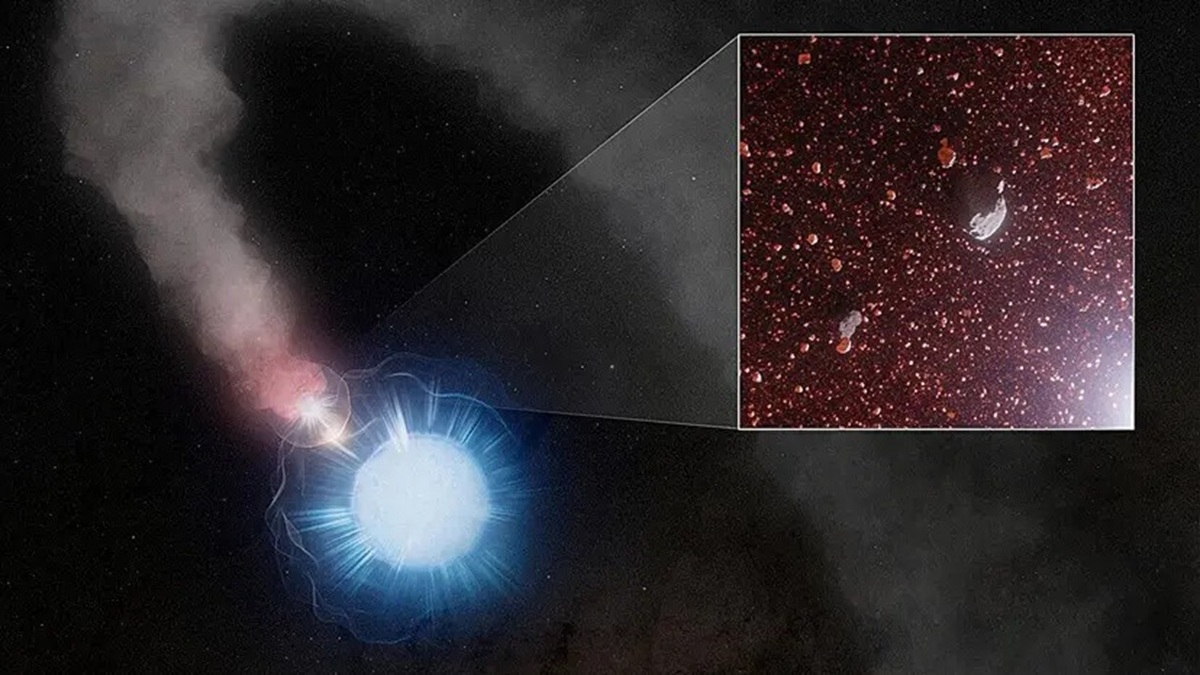

Researchers Reveal That Wolf-Rayet Stars, in Their Final Stage, Not Only Emit Intense Light but Also Generate Nanoscale Dust, Fundamental for the Formation of New Worlds, Helping to Understand How Carbon Is Distributed in Galaxies
A study on the binary star system WR 112 revealed that extremely massive stars produce cosmic dust on a nanoscale, a discovery made from combined observations from the JWST and ALMA observatories, providing new evidence about the formation of carbon in the universe.
Some stars not only emit intense light but also produce particles fundamental for the formation of new cosmic environments. The study shows that massive stars close to the end of their life are generating dust grains measured in billionths of a meter.
According to researcher Donglin Wu from the California Institute of Technology, the size difference between these stars and the formed dust reaches about one quintillion to one, highlighting an extreme contrast between the stellar scale and the produced particles.
-
China Develops Custom 140-Ton Electric Mining Truck with 770 kWh Swappable Battery, Deploys 290 Units in Xinjiang’s Largest Zinc Mine

-
Meta to Launch Arena, a New Prediction App Targeting 3.56 Billion Users, Competing with Polymarket and Kalshi

-
Scientist Challenges Famous Human Evolution Theory, Argues Homo Sapiens Evolved Gradually Over Thousands of Years
-
15-Year-Old American Builds Ocean Generator with PVC Pipe and 3D-Printed Propeller for $12, Wins National Prize, Presents at White House, and Makes Forbes 30 Under 30 List




The discovery helps to resolve an old scientific deadlock related to divergent measurements of dust around extreme stars and enhances understanding of how carbon is distributed in galaxies.
System WR 112 Shows How Massive Stars Produce Dust in Extreme Environments
The research focuses on WR 112, a binary system that hosts a Wolf-Rayet star, a rare type of extremely hot stars in their final stage of evolution. These stars have short lives and release large amounts of material into space.
In the system, the Wolf-Rayet star orbits a companion while both blow high-velocity gas flows. The interaction of these flows causes compression of the material, making it dense and allowing the formation of solid particles.
As the gas cools, atoms come together and create cosmic dust. The radiation emitted by the stars pushes this newly formed dust out of the system, creating expansive spiral structures similar to a cosmic pinwheel.
For decades, observations of similar stars had presented incompatible results. Some data indicated extremely small particles, while other measurements pointed to grains close to one-tenth of a micrometer.
Combined Observations of Stars with JWST and ALMA Reveal Invisible Particles
To investigate the phenomenon, the researchers utilized data from the James Webb Space Telescope and the Atacama Large Millimeter/submillimeter Array. The combination allowed for the analysis of the spectral energy distribution of the WR 112 system.
The JWST observes the universe in infrared light and has high sensitivity to hot dust. Its images had already identified bright spirals around the binary system.
ALMA, located in Chile, operates at millimeter wavelengths and is efficient in detecting cold dust and larger grains. If larger particles were present in large quantities, they should have been clearly observed.
However, ALMA did not register a strong signal corresponding to the spirals seen by the JWST. This absence indicated that most grains are too small to emit efficient radiation at millimeter wavelengths.
Modeling Confirms Two Distinct Populations of Dust Produced by Stars
The joint analysis showed that most grains are less than one micrometer and predominantly only a few nanometers in diameter. One nanometer corresponds to one billionth of a meter.
The scientists identified two populations of particles. The dominant group is made up of nanoscale grains, while a smaller fraction has about 0.1 micrometer.
The researchers tested four different size distribution models. The model that best reproduced the observed data was a bimodal distribution, consisting of an abundance of nanoscale particles and a larger secondary population.
This structure explains why previous measurements produced contradictory results. Both small and larger grains exist, but the smaller ones predominate in the observed spirals.
The team also assessed the impact of intense radiation on the dust. The energetic environment can erode or evaporate particles, making intermediate grains particularly vulnerable, which helps to understand previous detection failures.
Annual Production of Carbon-Rich Dust Influences the Formation of New Stars
The WR 112 system is considered one of the largest known producers of this type of dust, generating an amount equivalent to approximately three times the mass of the Earth’s Moon each year.
Since this dust contains carbon, its distribution directly influences estimates of how much of this element massive binary systems provide to galaxies.
Over time, the material does not remain close to the stars. It migrates to interstellar space and mixes with gas clouds capable of forming new stars and planets.
The predominance of tiny particles may alter growth and survival processes of dust, as well as influence later stages of planetary formation.
Future Observations Should Broaden Understanding of Star Evolution
Despite the advancements, several questions remain unanswered. Scientists are still seeking to determine how long nanoscale grains survive after leaving intense radiation regions.
Among the uncertainties are whether these particles merge into larger grains or if they are destroyed by shocks in interstellar space. It also remains uncertain whether WR 112 represents a typical system among Wolf-Rayet stars.
Future observations using JWST and ALMA on similar systems should allow for additional comparisons and improve models of carbon accumulation in galaxies over time.
According to Donglin Wu, many phenomena associated with these stars continue to be difficult to observe due to the rarity and complexity of these environments.
The study was published in the scientific journal The Astrophysical Journal.






