






 Portuguese
  Spanish


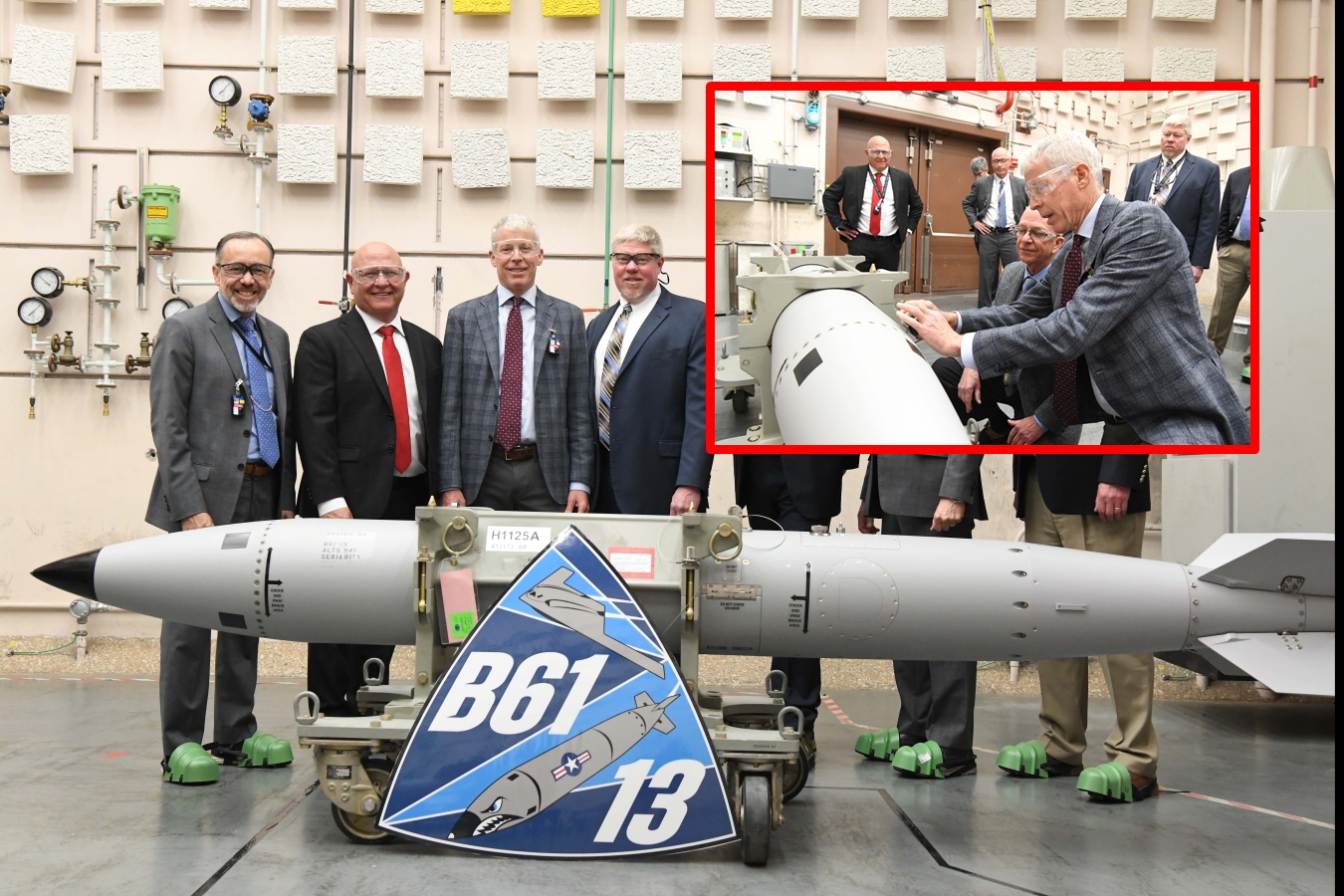

United States Completes Assembly of First Nuclear Bomb B61-13, With 360 Kiloton Warhead, Marking a New Phase in the Modernization of the Nation’s Strategic Arsenal.
The United States National Nuclear Security Administration has completed, in record time, the production of the first unit of the B61-13 nuclear bomb.
The confirmation was made by Secretary of Energy, Chris Wright, on May 19.
The weapon was assembled at the Pantex facility, located in Amarillo, Texas, and marks a significant advancement in the modernization of the U.S. nuclear arsenal.
-
China Develops Custom 140-Ton Electric Mining Truck with 770 kWh Swappable Battery, Deploys 290 Units in Xinjiang’s Largest Zinc Mine

-
Meta to Launch Arena, a New Prediction App Targeting 3.56 Billion Users, Competing with Polymarket and Kalshi

-
Scientist Challenges Famous Human Evolution Theory, Argues Homo Sapiens Evolved Gradually Over Thousands of Years
-
15-Year-Old American Builds Ocean Generator with PVC Pipe and 3D-Printed Propeller for $12, Wins National Prize, Presents at White House, and Makes Forbes 30 Under 30 List




The production of the B61-13 was completed nearly a year ahead of schedule. The program had been publicly announced less than two years ago.
This speed of development caught the attention of experts and authorities, as it recalls the rapid pace of nuclear projects from the Cold War.

A New Generation of Nuclear Bomb
The B61-13 was developed in partnership with the United States Air Force.
It is a more modern version of the traditional B61 family of bombs, which has been in use since the 1960s. The new model is a direct result of the previous version, the B61-12, whose production ended only five months ago.
According to Secretary Chris Wright, the new bomb reinforces the country’s deterrent strategy. “The speed of this achievement reflects both the ingenuity of our nuclear endeavor and the urgency of our times, ” he stated. For him, the modernization of the arsenal is a key element in the policy of “peace through strength.”
The new warhead will be used exclusively by strategic bombers, such as the B-2 Spirit. It is also expected to equip the future B-21 Raider. These aircraft operate from bases within the continental United States.
Penetration Capacity and Greater Yield
The main differentiator of the B61-13 is its ability to penetrate large, well-protected military targets.
The bomb was designed to hit underground structures or heavily fortified command centers. This represents a clear strategic function: to neutralize critical facilities in the event of conflict.
While sharing design elements with the B61-12, the new bomb features a greater yield, similar to the B61-7, which had an estimated power of 360 kilotons.
This characteristic makes the B61-13 more suitable for deterrence operations that require both destructive power and precision.
The updates include improvements in safety and guidance systems, such as the use of inertial navigation. This allows for greater accuracy in striking specific targets, even in complex scenarios.
Accelerated Program with Focus on Innovation
The speed of the program was made possible by a different strategy. Instead of following all the traditional project validation stages, known as “design gates,” engineers opted to consolidate or skip phases.
The decision was based on decades of accumulated knowledge about the B61 line.
As a result, hardware testing began just three months after Congressional authorization. This pace is considered unusual in the post-Cold War era.
David Hoagland, acting administrator for Defense Programs, praised the execution of the project. “The delivery of the B61-13 without impacting our other modernization efforts demonstrates genuine programmatic discipline. The flexibility and innovation demonstrated here should serve as a model for future modernization timelines,” he declared.
Recalibration of Deterrence Power
The B61 family consists of different variants. Among them are the tactical models B61-3 and B61-4 and the strategic B61-7 and B61-11. The B61-12 had already introduced an advanced guidance system, with adjustable low to medium yield. However, its maximum yield was 50 kilotons.
The B61-13, in turn, returns to high yield with modern features, offering an unprecedented combination of power and precision.
The intention is to ensure that the U.S. maintains response capability against emerging threats, focusing on reinforced and underground targets.
Although it is not a completely new invention, the B61-13 represents an important strategic evolution. It strengthens the role of nuclear deterrence, combining the power inherited from the past with 21st-century technology.






