






 Portuguese
  Spanish


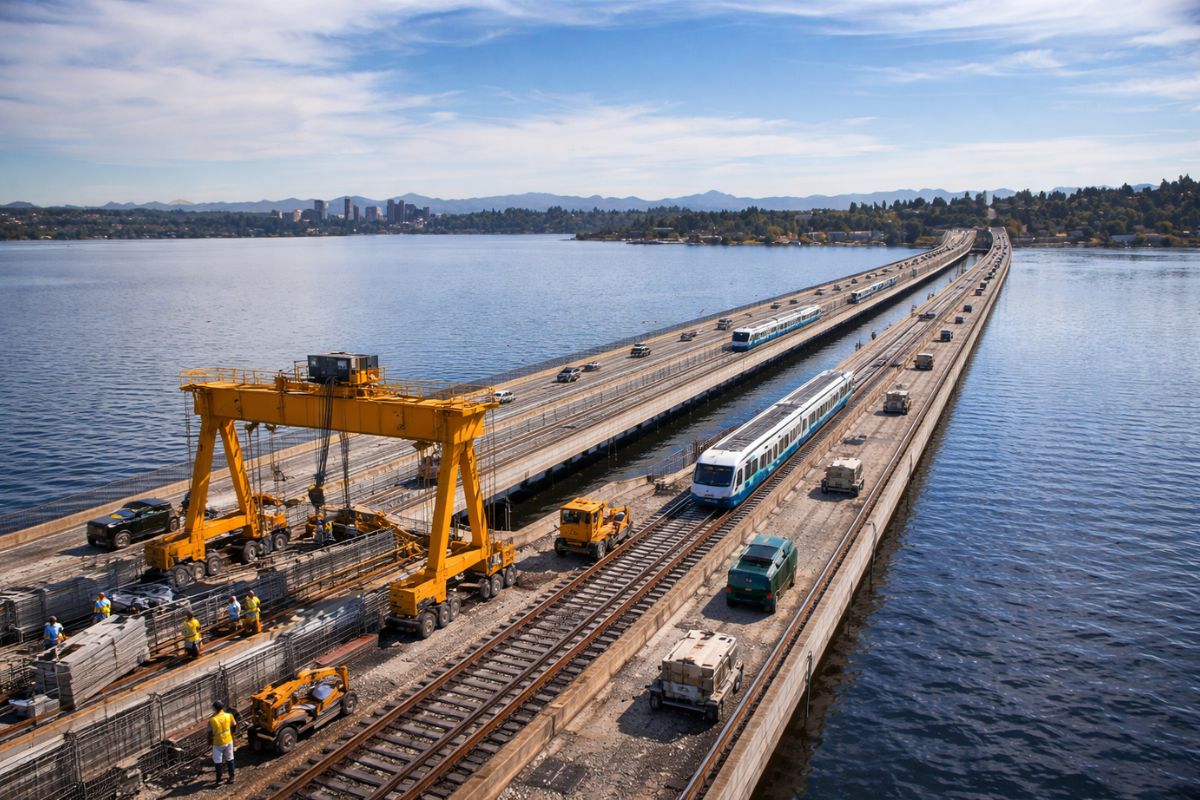


In King County, the High-Speed Train Is Fitted Into a Floating Bridge with 38 Pontoons on Lake Washington, Connecting Bellevue to Seattle. With 324,000 Tons of Concrete and Track at 1500 V, Engineers Distribute Movements and Combat Corrosion to Avoid Cracks, Misalignment, and Failures at Every Peak.
The high-speed train has become the most unlikely bet to shorten the path between Bellevue and Seattle, in a stretch where water has always dominated more than asphalt. The crossing over the freezing depths of Lake Washington, nearly 2.5 km, turns daily commuting into a real engineering laboratory.
In King County, where cranes and congestion have become the landscape, the direct connection between Bellevue and Seattle appears as an infrastructure necessity, not a whim. The challenge is to make tracks coexist with a floating bridge that moves with wind, lake level, and load, without accepting improvisation.
A Lake Too Deep for Piers, Too Demanding for Shortcuts

Lake Washington appears as a geographical obstacle and also as a technical argument for the high-speed train.
-
Giant Robots Build Entire Neighborhood of 100 3D-Printed Homes in the U.S., Showcasing Technology’s Impact on Construction Industry

-
Helsinki Residents Receive Water That Travels 120 Kilometers Through a Hidden Rock Tunnel from a Lake Before Treatment

-
Brazil’s Sertão Region Nears Completion of Latin America’s Longest Artificial River, Transforming Water Access in Drought-Prone Ceará
-
Pre-mixed stabilized mortar set to revolutionize construction in 2026: extends usability to 36 or 72 hours, boosts productivity, and minimizes waste in building projects.



The cited depth exceeds 100 meters in sections with mud and sediments, making traditional columns a costly and unstable project, requiring crossing dozens of meters of clay to find a firm base.
When the soil won’t hold, the solution needs to float.
Not even a tunnel emerges as a simple solution in this scenario, as crossing nearly 2.5 km over water and soft material would require a different scale of intervention.
The floating bridge comes in as a viable way to connect Bellevue to Seattle without interrupting the routine of those who today depend on an axis already described as congested, especially at peak times.
38 Pontoons and 324,000 Tons of Concrete That Need to Act Like a Ship

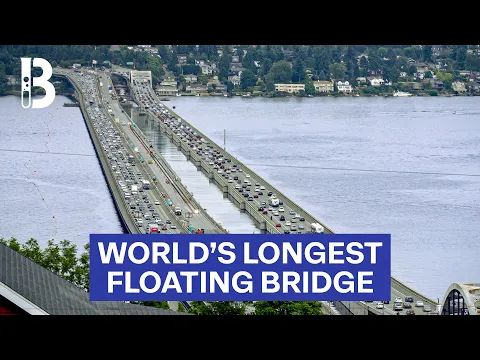
The floating bridge on Lake Washington is a massive reinforced concrete structure considered one of the largest floating bridges in the world, resting on the surface without support from columns.
The assembly is supported by 38 giant pontoons and totals 324,000 tons of concrete, with 64 meters of water just below the surface in sensitive areas.
It is bridge mass, with a hull logic.
Each pontoon is divided into sealed cells with watertight hatches, in a concept similar to ship compartments.
Redundancy is the central point: if one cell fails, the others keep the floating bridge operating.
This architecture already supports heavy traffic, cited as 142,000 cars per day, and is part of a system that, over 4.8 km, is vital for more than 50 million vehicles per year, now with the high-speed train entering the same corridor.
From Canoe to Floating Bridge, the Crossing That Has Always Been Mobile
Before concrete, Lake Washington was already a path, not a barrier. Indigenous peoples used canoes for thousands of years, and 19th-century settlers resorted to ferries on such a scale that the fleet earned the nickname mosquitoes, congesting the waterways.
The need to connect Bellevue to Seattle dates back a long way; only the vehicle has changed.
The floating bridge enters as the industrial version of this tradition of mobile crossing, but with scale and redundancy.
The system builds on the idea of pontoons that distribute weight and allow replacement, like the Queen Emma Bridge, a pontoon bridge made of wood with 17 pontoons known as the old lady who sways.
In Seattle, the logic is similar, but scaled for highways and the high-speed train.
An Articulated Ramp from the Past That Explains the Problem of Today
To understand why the alignment of tracks on a movable structure is so critical, engineers refer to a historical precedent associated with the Scottish engineer Thomas Bouch.
On a rail ferry operating in Norway, the transition between land and vessel relies on an articulated ramp capable of adjusting the angle as the water level changes. Misalignment here is synonymous with disaster.
A winch system lowers the ramp and aligns the connection, allowing wagons to enter and exit in a continuous process of boarding and disembarking.
Civil engineer Bertha Dongmo England is linked to this reference and emphasizes the central element: the hinge that adapts the angle to any water level. In Seattle, the principle reappears not to make the train float, but to allow the high-speed train to transition from fixed segment to moving segment.
How the High-Speed Train Enters a Moving Structure

The most delicate point is not just placing tracks; it’s connecting solid ground and floating bridge without concentrating all the movement at a single point.
If the track were rigidly fixed at the ends, the transition would absorb variations in level, wind, and load like a forced hinge, risking breakage and misalignment. For the high-speed train, a micrometric step becomes a real threat.
Engineer John Slavven describes the crossing as a structure that moves, like any maritime vessel. Rubber tires can accommodate irregularities, but steel on steel requires continuity.
The floating bridge must withstand movements caused by the levels of Lake Washington, wind, and uneven traffic loading, without creating transition angles that could derail the high-speed train with passengers on board.
Electricity, Water, and Corrosion, the Risk That Does Not Show Up on the Track
The railway system uses a 1500 V direct current supply, with current return through the tracks.
Engineer Craig Dala summarizes the problem: nobody had put this type of energized track on a floating bridge in the middle of Lake Washington, and water with electricity paves the way for parasitic current. The most feared danger is not shock; it’s silent corrosion.
If the current escapes into the water, it can accelerate the loss of metal in critical components at the exit point, threatening the integrity of the floating bridge. To block the path, insulating elements appear, including plastic parts between the track and fixation, along with dielectric coating on the structure.
There is also an active barrier: eight sets of anodes suspended 15 meters deep and over 1,400 anodes introducing a protective electric charge into the water, allowing polarization of the structure and keeping parasitic current under control.
The Joint That Decides Everything and the Bridge Over Tracks That Extends the Problem
When the high-speed train leaves the land and enters the floating bridge, the transition joint becomes the point of greatest responsibility. The solution received a straightforward name: bridge over tracks.
Instead of making the movement happen at a single point, the design distributes the adjustment over a greater distance and adds degrees of freedom not seen in common railway bridges. The idea is to turn a shock into a smooth curve.
The mechanism uses curved wings that rotate up or down as the level of Lake Washington changes, bending the tracks in a gentle arc and maintaining alignment.
The assembly provides for eight track bridges, each 13 meters long, crossing four joints between fixed and floating segments, ensuring continuous transition for the high-speed train.
The tests generated 500 data channels, and at project speed, with a maximum cited of 55 mph, the stresses were adequate, and the journey was considered comfortable for passengers.
Anchoring Cables, 65-Ton Tension, and Maintenance as Routine
Floating is only half the story to keep Bellevue and Seattle connected. To prevent the floating bridge from drifting, anchoring cables enter, visible just below the water, with cited lengths reaching 739 feet and working at depths up to 165 feet, close to 50 meters.
Engineer Jim Stonecipher describes the pressure exerted by currents and seasonal movements, which wear out cables over time. Without adjusted anchoring, the floating bridge becomes drift.
The adjustment is made inside the pontoons, in narrow compartments, using a 150-ton hydraulic jack to maintain an average cited tension of 65 tons on the cable.
At certain times of the year, the necessary movement is about an inch; in spring and autumn, it can reach six inches.
So far, 32 new giant cables have been installed, and the practical risk remains: without fine-tuning, the floating bridge could drift with the wind, a scenario incompatible with the continuous operation of the high-speed train.
700 Tons at One Point and the Post-Tension That Compresses the Concrete from Within
Beyond the movement, there is the concentrated weight that the high-speed train can impose. The described composition has four cars, each weighing about 175,000 pounds.
A fully loaded train can reach 350 tons, and two trains crossing can lead the load to 700 tons in a short stretch, raising the pressure on the concrete and creating a risk of cracks. The enemy here is eccentric load, the one that forces one side more than the other.
The structural response comes from post-tension applied at an unusual scale. Post-tension cables about 1,200 meters long run through the pontoons in conduits, allowing the braiding of 20 super cables, totaling 24,000 meters in all.
Hydraulic jacks tension the system supported by internal reaction structures, described as 20 steel pieces weighing about 7.5 tons each, which act as supports compressing the floating bridge from both sides.
The cited precision level for the process ranges between 1 and 12 millimeters because extreme compression only works when it’s controlled in detail.
Bellevue and Seattle are separated by water, but also by infrastructure choices.
The high-speed train on a floating bridge on Lake Washington does not try to conquer the lake just with speed; it aims to overcome movement, corrosion, and weight, using redundancy, electrical insulation, adjustable anchoring, and post-tensioning on a rare scale.
It’s a crossing that relies less on heroism and more on method repeated every day.
If you depended on this path to work, study, or attend an event downtown, which part would make you most uneasy: crossing 2.5 km over pontoons, trusting a 1500 V energized track in water, or accepting that the floating bridge moves like a vessel and still promises alignment for the high-speed train? And, in your place, would you switch from car to high-speed train on this route, or only board after seeing years of operation without scares?






Eu confio pela especialização dos construtores ,muita experiência e auxílio de IA