Portuguese
  Spanish


British Researchers Create The World’s Smallest Violin, At Only 35 Micrometers, Using Advanced Nanolithography Technique.
Researchers from Loughborough University presented a surprising creation: the world’s smallest violin.
Although it cannot be played like a regular instrument, the platinum piece represents an important advancement in the field of nanotechnology.
Impressive Size
The microscopic violin measures just 35 micrometers in length and 13 micrometers in width.
-
In Andradina, in the interior of SP, a tannery transformed tilapia skin that slaughterhouses used to throw away into exotic leather for bags, shoes, and even wedding dresses, producing about 2,000 pieces per month and exporting to seven countries, proving that fish waste has become high-value fashion.

-
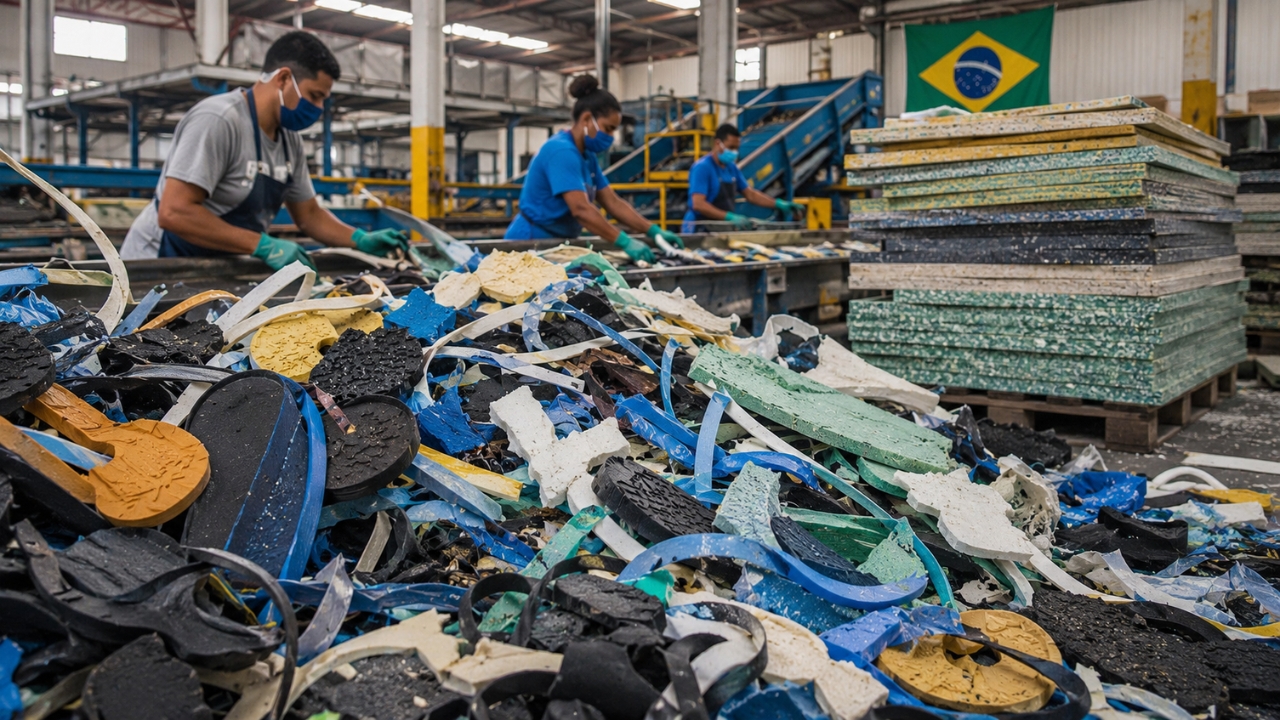
The industrial waste that even recyclers didn’t want has gained value in the interior of Bahia: two entrepreneurs invested R$ 2.8 million to transform 350 tons per year of foam, rubber, and plastic into boards that can replace wood and MDF.

-
What is a red flashlight used for, after all? See why it is so commonly used at night.

-
He has never read a line of code, but he already knows how to work: the French company UMA presented in Paris the Northstar, its first AI-powered humanoid robot designed for factories and warehouses, capable of copying tasks just by observing an employee in action.



For comparison, a human hair ranges from 17 to 180 micrometers in thickness.
Even tardigrades, tiny microscopic creatures, vary from 50 to 1,200 micrometers. In other words, the violin is smaller than many elements visible under a microscope.
Despite its tiny size, the violin was manufactured with extreme precision and serves as a practical demonstration of the capabilities of a new nanolithography system developed at the university.
The Role Of Nanolithography
The development of the violin is part of advanced research conducted by the Physics Department at Loughborough University. Professor Kelly Morrison, head of the department, explained how the system works.
“Our nanolithography system allows us to design experiments that investigate materials in different ways — using light, magnetism, or electricity — and observe their responses“, Morrison stated.
She added that, from understanding these behaviors, it will be possible to develop new technologies, improve computer efficiency, and seek new forms of energy harvesting.
How The Violin Was Created
The manufacturing of the violin began with coating a chip with two layers of a gel-like resistant material.
After that, the NanoFrazor, a giant nanolithography machine, came into play. This equipment uses a technique called thermal scanning probe lithography.
Thermal scanning probe lithography employs a heated tip capable of reaching temperatures between 24 and 1,012 °C. With extreme precision, this tip engraves the desired patterns onto the chip’s upper layer.
Once the design is engraved, the team dissolved the exposed lower layer of the resin. This formed a cavity in the shape of the violin.
Next, a thin layer of platinum was deposited onto the chip. To finish, an acetone wash removed the remaining material and revealed the complete violin.
The entire process took place in a controlled environment, closed off and free of dust and moisture. This measure was essential to ensure precision and avoid any contamination that could compromise the research.
Almost Invisible Details
The final result is so small that it can only be seen in detail using a microscope. On the surface of the chip, the microscopic violin has dimensions comparable to dust particles.
Although the creation of the violin is partly a technical demonstration, it also references a well-known expression from pop culture: “Can you hear the smallest violin in the world playing just for you?” This phrase is used ironically to mock those who make exaggerated complaints and became popular in shows like MASH*.
Advancements For Next-Gen Electronics
Despite the playful tone, the development of the violin represents a significant step in the research of modern electronic devices.
According to the team, after the successful completion of this test, new, more challenging projects are already underway.
The current major challenge in digital technology is to increase efficiency by reducing device size and improving speed.
Moreover, there is the issue of heat management since many devices waste electricity in the form of heat.
With the new system, researchers aim to explore how uneven heat distribution can generate useful physical effects. This could pave the way for new computing devices that are faster and consume less energy.
Exploring New Data Storage Forms
Another goal of the researchers involves magnetic data storage. Dr. Fasil Dejene from the same university is studying how quantum materials can improve data storage.
The idea is to develop smaller, faster, and more reliable memory devices. Currently, according to information from Science Direct, conventional hard drives store data in nanometer-sized magnetic bits on a spinning disk.
The microscopic violin created at Loughborough University is not just a technological curiosity.
It represents a milestone in nanoscale manufacturing techniques and may influence the development of future electronics and more efficient storage systems.