





 Portuguese
  English
  Spanish
  6 min of reading
  0 comments


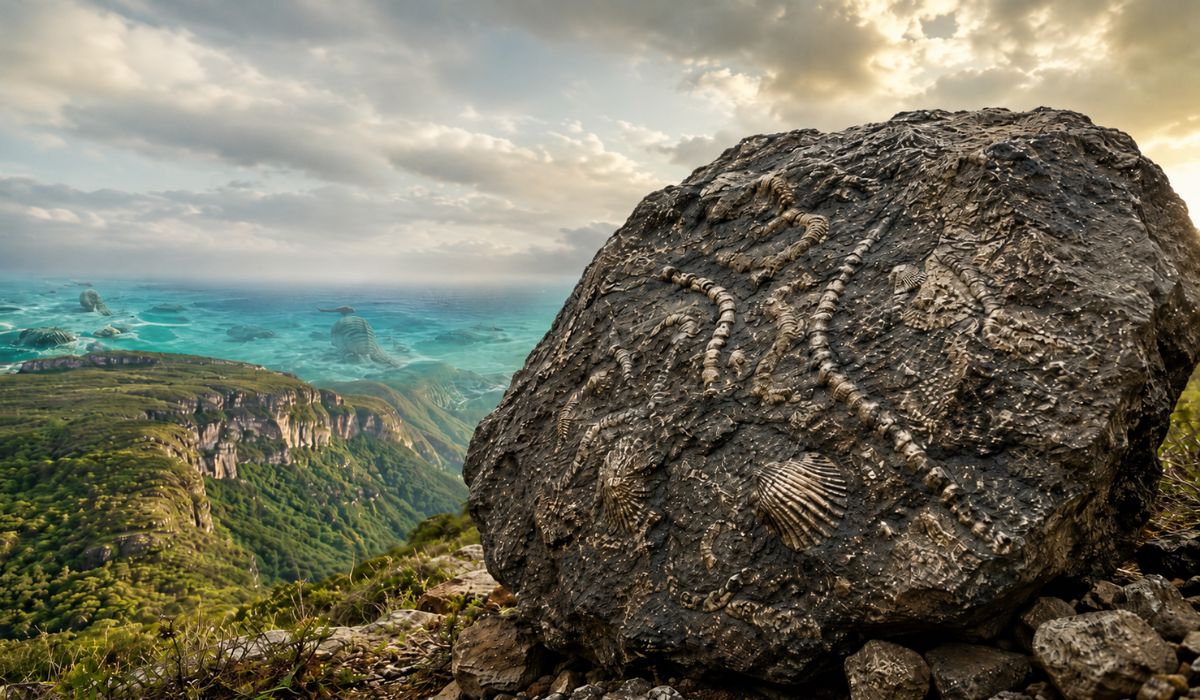
Rock found in Tianguá contains traces of marine invertebrates from 430 million years ago and helps researchers analyze evidence of an ancient marine environment in the Serra da Ibiapaba.
Fossils attributed to marine invertebrates about 430 million years old were identified in a rock weighing approximately 700 kg located in the Ubajara National Park, in the interior of Ceará.
According to the Paleontology Laboratory of the Biological Sciences course at the Universidade Estadual Vale do Acaraú, the Labopaleo/UVA, the traces reinforce the interpretation that part of the region now occupied by the Serra da Ibiapaba was associated with an ancient marine environment.
The images of the material were released on May 8.
-
Only 28% of the ocean floor has been accurately mapped, less than what is already known about the surface of Mars and the Moon, and scientists consider the topic strategic for Brazil, with a global goal to map everything by 2030.

-
Japan wants to bury a 500 km “cargo conveyor” between Tokyo and Osaka to replace up to 25,000 trucks per day, move goods through tunnels and automated driverless corridors, and avoid a logistical collapse in an increasingly aging country.

-
Vietnam dumps sand in the South China Sea and transforms disputed reefs into artificial islands with an area equivalent to more than 1,500 football fields, builds 15 ports in the Spratly Islands, and expands bases in the ocean while challenging Chinese pressure in one of the most tense maritime regions on the planet.

-
Is Rosie from the Jetsons becoming a reality? China tests “robot cleaners” with artificial intelligence inside homes for R$ 114, capable of collecting trash, folding clothes, and mapping apartments, turning domestic cleaning into a living laboratory for companies that want to teach machines to act like humans.




The piece was found in the municipality of Tianguá and is part of the collection of the Dom José Museum in Sobral, but remains on indefinite loan to the Ubajara National Park, where it can be observed by visitors and researchers.
The records are classified as ichnofossils, a name given to traces left by the activity of organisms in sediments or rocks.
Unlike body fossils, such as bones, shells, or carapaces, this type of evidence preserves marks of movement, feeding, resting, excavation, or other forms of interaction of living beings with the environment.
Fossil in Ceará indicates ancient marine environment in the Serra da Ibiapaba
According to the UVA, the ichnofossils found in Tianguá record activities of marine invertebrates that lived in the region approximately 430 million years ago.
The estimated age places the material in a period long before the emergence of dinosaurs and also before the formation of the Serra da Ibiapaba with its current characteristics.
The interpretation of the presence of an ancient sea in the region is based on the traces preserved in the rock and the geological context of the material.
According to the Labopaleo/UVA release, the marks indicate that marine organisms inhabited that environment in a remote phase of Earth’s history.
The rock weighs about 700 kg and contains fossilized marks visible on the surface.
Due to the weight and preservation conditions, the removal and allocation of the material involved coordination between research institutions, environmental management, and members of the local community.
The work was carried out in partnership with the Dom José Museum, the Chico Mendes Institute for Biodiversity Conservation, ICMBio, and local residents.
The participation of these institutions allowed the piece to be incorporated into a public visitation space, while still remaining linked to the museum collection.
Piece available for visitation at Ubajara National Park
The piece belongs to the Dom José Museum, an institution with a collection related to history, culture, and science in the interior of Ceará.
Nevertheless, the fossil is on loan to the Ubajara National Park for an indefinite period, which keeps the material in the territory where it was found and increases visitor access to the paleontological record.
In the park, the rock can be observed by tourists, students, and researchers.
The exhibition also allows the public to associate the current landscape of the Ibiapaba Mountain Range with geological processes formed over millions of years.
The presence of the piece in a conservation unit adds a scientific dimension to the visitation itinerary.
The Ubajara National Park is already known for natural attractions such as trails, rock formations, and caves, and now also houses a record related to the region’s paleontology.
According to UVA’s announcement, the study of the material involves Labopaleo and institutional partners.
The university treated the discovery as a milestone for Ceará’s paleontology, due to the fossil’s age, the rock’s size, and the find’s relation to the geological history of the Ibiapaba Mountain Range.
Understand what ichnofossils are
Ichnofossils are indirect evidence of organisms that lived in the past.
Instead of preserving parts of an animal or plant’s body, this type of record keeps signs of biological activities left in the environment, such as tracks, tunnels, borings, resting marks, and feeding structures.
Educational materials from the Institute of Geosciences of the University of São Paulo define ichnofossil as any trace of animal and plant activities preserved in sediments and rocks.
This field of study is used by paleontologists to understand the behaviors of extinct organisms and the characteristics of the environments in which they lived.
In the case of the rock found in Tianguá, the marks were attributed to marine invertebrates.
This type of trace can indicate forms of movement and occupation of the environment, but does not allow for the identification of all the details of the organisms without complementary studies and specific scientific description.
For this reason, the information released by the institutions focuses on the approximate age, the marine origin of the traces, and the presence of marks produced by ancient organisms.
No species identifications or taxonomic descriptions not informed by the consulted sources were added.
Discovery expands studies on the geological past of Ceará
The discovery expands the paleontological documentation of the Serra da Ibiapaba, a region located in the northwest of Ceará.
Although the state is often associated with fossils found in the Araripe Basin, especially in Cariri, the material from Tianguá evidences the presence of records in other areas of Ceará as well.
The relationship between the ichnofossils and an ancient marine environment helps explain changes that occurred in the territory over hundreds of millions of years.
The current landscape, marked by mountains and rock formations, results from geological processes that occurred after the formation of the sediments where the traces were preserved.
The information that the region was once associated with an ancient sea does not mean that the Serra da Ibiapaba existed with the same relief during that period.
As reported by UVA, the traces are prior to the current configuration of the mountain range, indicating a difference between the environment recorded in the fossil and the landscape known today.
The use of the material in scientific education activities was also highlighted in the institutional disclosure.
With the exhibition in the park, schools, researchers, and visitors can directly observe evidence of the local geological past, without relying solely on images or academic descriptions.
Preservation of fossils requires technical documentation
The study of fossils requires proper recording of the place of origin, conservation of the piece, and analysis by professionals in the field.
Removal without technical control can impair scientific interpretation, as information about the rock’s position, sediment type, and geological context are part of the set analyzed by researchers.
In the case of the Tianguá fossil, the allocation to the Dom José Museum and its permanence in the Ubajara National Park indicate an attempt to reconcile preservation, research, and public access.
Institutional custody also reduces the risk of losing information associated with the material.
The disclosure of the finding by Labopaleo/UVA reinforces the role of universities and regional museums in identifying paleontological records.
In areas where fossils appear in exposed rocks, pavements, or natural terrains, communication with researchers can help determine if the material has scientific value and what the conservation procedure should be.
No data on any specific scientific publication dedicated to the piece now on display in Ubajara have been found in the public sources consulted.
Therefore, information such as detailed identification of organisms, formal description of ichnofossils, and complete stratigraphic analysis were not included in the text.
The confirmed data indicate that the rock contains traces of marine invertebrates, weighs about 700 kg, was found in Tianguá, and is linked to the collection of the Dom José Museum, with an indefinite exhibition at the Ubajara National Park.
Based on this information, the piece becomes part of the set of records used to understand what part of the Ceará territory was like in a past before the dinosaurs.





Be the first to react!