Portuguese
  Spanish


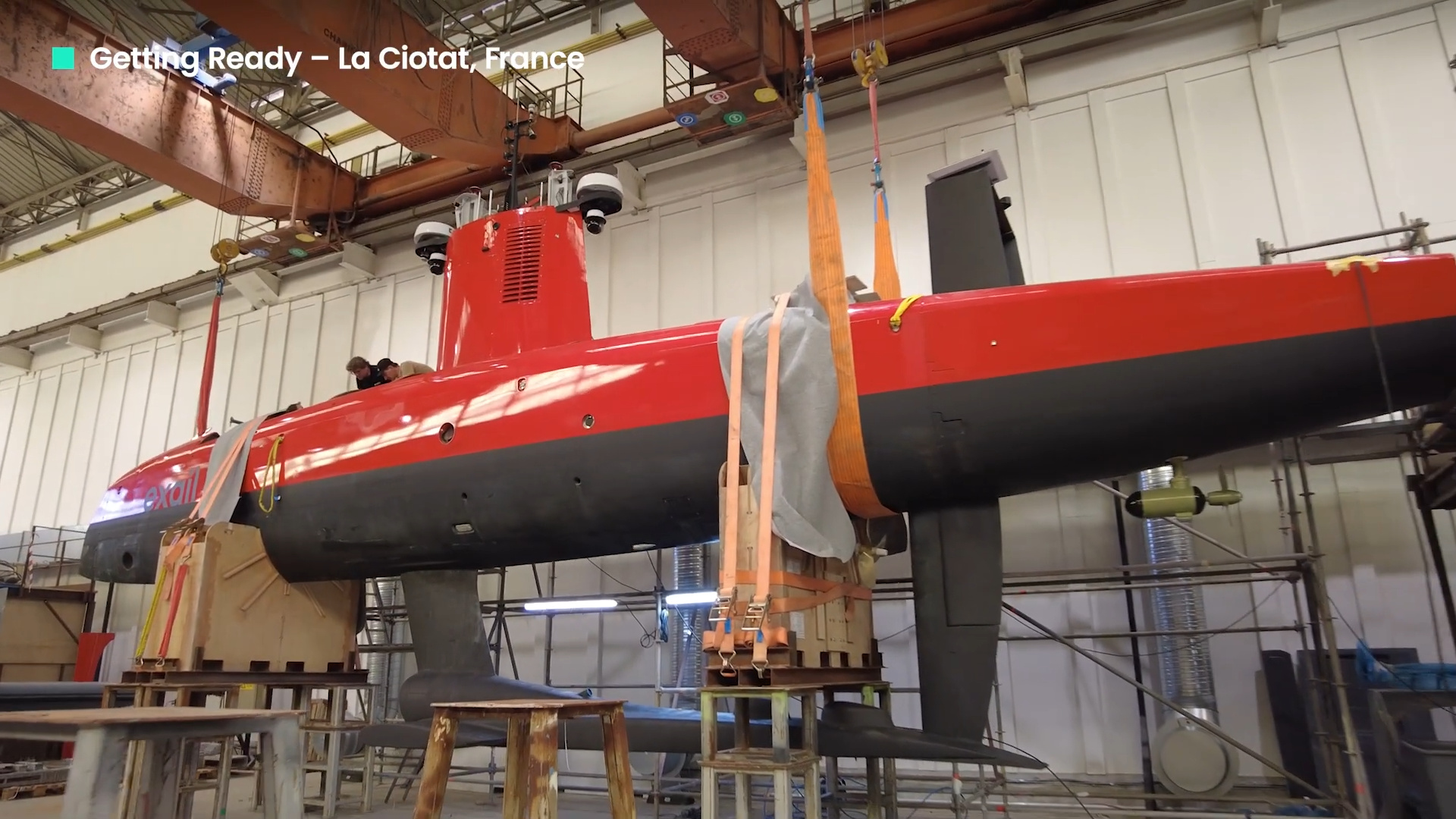

DriX O-16 is an autonomous naval drone of 15.75 meters capable of operating for up to 30 days without a crew in oceanic missions.
Amid the global race for autonomous maritime systems, European companies have begun developing vessels capable of crossing entire oceans without sailors on board. One of the most advanced projects of this new generation is the DriX O-16, a transoceanic naval drone created by the French company Exail to operate alone for up to 30 days in open sea. The vehicle measures 15.75 meters, displaces about 10.5 tons, and was designed to navigate up to 3,500 nautical miles without needing to return to base, executing surveillance missions, underwater inspection, ocean mapping, and operations related to maritime defense.
The project gained international attention after the first maritime tests conducted in 2024 at the port of La Ciotat, in southern France. Exail presented the system as a new standard for long-duration maritime operations without human crew on board.
Unlike traditional ships, the DriX O-16 does not have a conventional command bridge, dormitories, kitchen, or structure for sailors. Much of the internal space was allocated to fuel, sensors, communication systems, and autonomous navigation modules.
-
World’s First Lithium-Sulfur Battery Factory Launches, Promising to Double Range Without Relying on China

-
AI Data Centers Now Feature Built-In Nuclear Power Plants and Have Ordered Non-Existent Reactors
-
In India, thousands earn about $2.50 an hour cooking and cleaning with a phone strapped to their heads, as every move is recorded to train humanoid robots for jobs they might one day replace.

-
Nuclear Fusion Study Proposes Transforming Mercury into Gold Using Tokamak Neutrons, but Real-World Application Remains Uncertain




DriX O-16 was created to navigate thousands of kilometers without sailors on board
The DriX O-16 belongs to the category of so-called USVs, an acronym for Uncrewed Surface Vehicle, a term used to define unmanned surface vessels. These systems function similarly to aerial drones but operate in open sea.
According to Exail, the DriX O-16 was specifically developed for transoceanic missions and “Over The Horizon” operations, a term used when the vessel continues to operate far beyond the visual range of human operators.


For this, the system uses an autonomous architecture called CortiX, an onboard intelligence platform responsible for navigation, energy management, obstacle avoidance, and supervision of internal systems. The company claims that the solution has already accumulated over 100,000 hours of maritime operation in different models of the DriX family.
Naval drone does not require human interaction, but can also be operated manually
The naval drone can operate both in remote mode and in supervised autonomous mode. In this second model, the vehicle executes almost the entire mission on its own while human operators only monitor the route and critical parameters from a distance.

Exail reports that the system has multiple redundant communication channels, including Starlink, 4G networks, maritime radios, and Iridium Certus satellite communication. The system itself automatically selects the best available channel according to maritime environmental conditions.
This allows the DriX O-16 to be monitored from virtually anywhere on the planet as long as there is a secure internet connection between the remote operations center and the vessel.
French naval drone measures 15.75 meters, weighs 10.5 tons, and operates for up to 30 days
According to the official specifications released by Exail, the DriX O-16 is 15.75 meters long, 1.83 meters wide, and has a draft of 2.55 meters. The approximate displacement reaches 10.5 tons.
Although much smaller than conventional military ships, the vehicle was designed to withstand severe ocean conditions during prolonged missions. The company claims the vessel uses a monohull hull built from epoxy composite materials, E-Glass fiber, and structural PVC.

One of the main differentials is the hybrid diesel-electric propulsion system. The DriX O-16 uses a 120 kW diesel engine combined with a 20 kW auxiliary Azipod electric propulsion.
According to Exail, this configuration allows for improved energy efficiency, increased operational redundancy, and reduced consumption during long missions. The fuel tank has an approximate capacity of 2,300 liters.
The company claims that the system can remain on mission for up to 30 days and travel approximately 3,500 nautical miles before needing to return for maintenance or refueling.
This autonomy places the DriX O-16 among the naval drones with the highest operational endurance of the new generation of oceanic USVs.
Sensors enable submarine surveillance missions, anti-submarine warfare, and inspection of ocean cables
The DriX O-16 was designed as a modular platform capable of accommodating different sensors and equipment according to the type of mission executed. According to Exail, the vehicle supports multibeam sonars, sub-bottom profilers, underwater acoustic systems, oceanographic sensors, and scientific equipment.

Additionally, the naval drone has a rear area prepared to transport launch and recovery systems for other underwater robots, including ROVs, ROTVs, and AUVs.
This means that the DriX O-16 does not operate alone. In certain operations, it can function as a mother platform for other smaller underwater drones.
Among the applications officially listed by Exail are hydrographic missions, inspection of underwater pipelines, monitoring of offshore energy infrastructure, oceanography, environmental monitoring, and operations related to maritime defense.
In the military area, the company mentions applications in military bathymetry, rapid environmental assessment for naval forces, anti-submarine warfare, and response to maritime disasters.
DriX O-16 can be used for submarine cable inspection
Another important point involves submarine cable inspection. In April 2026, Exail confirmed a new sale of the DriX O-16 to OMS Group, a company linked to the digital infrastructure and submarine cables sector.
According to the company, the system will be used in bathymetric surveys, route verification, and monitoring of submerged telecommunications infrastructure.
The growing interest in this type of mission occurs in a context of international concern with the protection of submarine cables responsible for most of the global internet data traffic.
Autonomous system uses radar, cameras, LiDAR, and sonar to avoid collisions in open sea
One of the biggest technical challenges for autonomous ships involves safe navigation in busy maritime environments. To address this, the DriX O-16 uses an advanced obstacle avoidance system integrated with the CortiX platform.
According to Exail, the naval drone combines optical cameras, infrared sensors, LiDAR, maritime radar, AIS, and Forward-Looking Sonar to detect objects both on the surface and partially submerged.

The data is processed by a sensory fusion system capable of automatically calculating alternative routes when obstacles appear in the path.
The company claims that this architecture is one of the first on the market capable of simultaneously combining surface obstacle management and submerged objects in a single autonomous system.
Furthermore, the DriX O-16 has “Over The Horizon” operational capability, allowing missions to be monitored remotely without the need for direct visual contact between operators and the vessel. In practice, this transforms the system into a kind of “ghost ship” digitally supervised by remote operation centers.
Naval drones begin to replace traditional vessels in oceanic missions
According to Exail, one of the main objectives of the DriX O-16 is to replace part of the missions currently carried out by large manned maritime support vessels. Hydrographic survey operations, submarine inspection, and ocean monitoring typically require large ships, numerous crews, and high fuel consumption.
The company claims that the use of autonomous systems can drastically reduce operational costs, energy consumption, and carbon emissions.
In a statement released in April 2026, Exail stated that operations using the DriX O-16 can reduce the carbon footprint by up to 99% compared to conventional vessels used in the same type of mission.
Another important factor involves human safety. Long oceanic missions often expose crews to severe maritime conditions, operational fatigue, and environmental risks. With naval drones, part of these activities is carried out without people being directly on-site at the operation.
According to Exail’s own data, the DriX family has already accumulated more than 1 million nautical miles of autonomous navigation in over 25 countries.
The growth of this market occurs alongside the expansion of military autonomous systems, unmanned submarines, and robotic ocean monitoring platforms used by governments and private companies.