






 Portuguese
  Spanish


The journey of Jéssica Cristina Soares Fernandes shows how a homemade sweets production in Guarujá gained structure, team, app delivery, and commercial presence until it became Cacau Love, a business approaching R$ 2 million in revenue
Jéssica Cristina Soares Fernandes did not master confectionery when she decided to try selling sweets in Guarujá, on the coast of São Paulo. According to Exame, she didn’t even know how to make a simple cake at the beginning of her journey.
Even so, the resident of the São Paulo coast transformed a homemade production into an operation with a factory, store, delivery, and a brand that reached almost R$ 2 million in revenue in 2025. The story matters because it shows how a home business, common in thousands of Brazilian homes, can become a structured company when it finds demand, organization, and commercial persistence.
The beginning came before the factory, the store, and the million-dollar revenue

Before Cacau Love gained structure, Jéssica worked at Atacadão Guarujá. An institutional publication from Atacadão states that she joined the company at 16 as a cashier and met her husband, Edson, there.
-
Brazilian Startup Sells Nearly 9 Million Surprise Bags of Near-Expiry Food, Prevents Thousands of Tons of Waste, Aiming for $42 Million Revenue by 2026

-
How to Prevent Brown Recluse Spider Bites: Common Hiding Spots and Free Tips to Reduce Risks

-
Natto: The Unusual Japanese Superfood Gaining Popularity on Social Media and Driving Record Exports
-
Brazilian Mayor Goes Undercover as Homeless for 24 Hours to Assess Public Services





The routine in wholesale also brought Jéssica closer to the world of ingredients. Seeing customers buying chocolates and items used in sweets, she began to observe a market that, later, would enter her own home.
Exame reports that, without a budget for courses, she sought learning on her own. She watched videos on the internet, participated in social media groups, and tested recipes until she managed to sell the first bonbons and small sweets.
Her daughter’s first birthday also played a part in this turnaround. While organizing the party, Jéssica started experimenting with more recipes and realized that it could become more than just a domestic solution and turn into a source of income.
Days of R$ 100 show that growth did not come ready-made
The journey of Cacau Love did not start with a full store or large-scale production. According to Exame, there were changes in commercial locations, attempts that didn’t work out, and phases when the operation had to return home.
On some days, revenue did not exceed R$ 100. There were also criticisms from close people and doubts about the project’s ability to sustain itself.
The decision to professionalize the business gained momentum during a period of family instability. According to Exame, Edson was facing a difficult time at work, and the couple decided to invest their resources in the sweets operation.
This choice paved the way for the creation of Cacau Love, a brand that moved from domestic informality to a structure with production, direct sales, and delivery.
Cacau Love underwent expansion, delivery, and reorganization
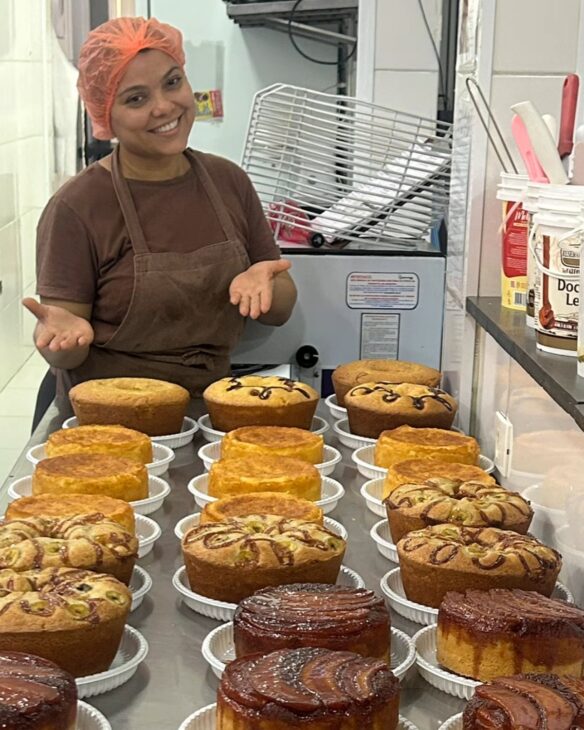
With the increase in sales, Cacau Love operated with three units simultaneously, including two stores and a factory, along with a team of up to 14 registered employees, according to Exame.
The pandemic also played an important role in the company’s trajectory. With more consumption at home, products like cakes and sweets gained strength, and the delivery operation became a significant part of the business.
Today, the strategy described by Exame is more concentrated. The brand maintains two main units: the headquarters with a factory and industrial kitchen, and Store 1, renovated as the main sales point.
The store is also set to receive a mini internal kitchen, designed to speed up part of the production and improve service. The company currently works with about seven employees, mostly women and mothers.
According to Exame, Jéssica also sought to adapt the work routine to the team’s reality, with a reduced six-hour workday, meal assistance via iFood Benefits, and internal goals.
Homemade cake market helps explain the size of the opportunity
The case of Cacau Love is not isolated. Data from Sebrae-SP shows that the state of São Paulo has 134,000 individual micro-entrepreneurs in the sweets, cakes, and snacks segment.
The same research indicates that the average initial investment in this type of business is R$ 5,345.16. It also shows that 58% of these entrepreneurs work from home, 40% use social networks as their main sales channel, 84% use iFood, and 66% sell simple or traditional cakes.
This context helps to understand why Jéssica’s story has the potential for identification. The home kitchen, homemade cake, and sales by order are part of a broad market, but they do not always reach a professionalized operation.
Agência Brasil, with data from the Institute for the Development of Food Companies and Abip, also reported that the bakery sector earned R$ 153.3 billion in 2024, an increase of 10.9% compared to the previous year.


Business registration confirms the brand’s presence in Guarujá
Econodata registers the company Cacau Love under the corporate name Jessica Cristina Soares Fernandes, CNPJ 23.848.067/0001-86, founded on December 15, 2015, active in Guarujá and classified as EPP.
The registration indicates the main activity as a bakery and confectionery with a predominance of resale, in addition to an address on Rua Manoel Marques Nabeto, in the Boa Esperança neighborhood.
There are also records of branches at addresses in Guarujá, but one specific unit has been closed since March 2024. Therefore, the safest information is to treat the current operation according to Exame’s description, focusing on the headquarters, factory, and Store 1.
Solutudo also registers Cacau Love Bolos Gelados linked to Edson Francisco Santos Lopes, the husband mentioned in Jessica’s trajectory, but without directly confirming the current operational situation between this CNPJ and the main company.
Case goes beyond a cake story
The strength of Cacau Love lies in the contrast between the simple beginning and the current structure. A woman who didn’t know how to bake a cake found demand in an everyday product, learned to produce it, tested sales channels, and transformed her home kitchen into a well-known brand on the São Paulo coast.
More than an individual story, the case shows how the small-scale food market can grow when it combines a popular product, digital presence, delivery, and management. In a country where thousands of people start by selling sweets at home, Jessica’s journey reveals the size of the opportunity that exists between a recipe tested in the kitchen and a company capable of earning almost R$ 2 million.







