Portuguese
  Spanish




Company uses drones, seed balls, and data analysis to accelerate environmental restoration projects in degraded areas, with tests in the Peruvian Amazon, California, and plans for expansion to other countries.
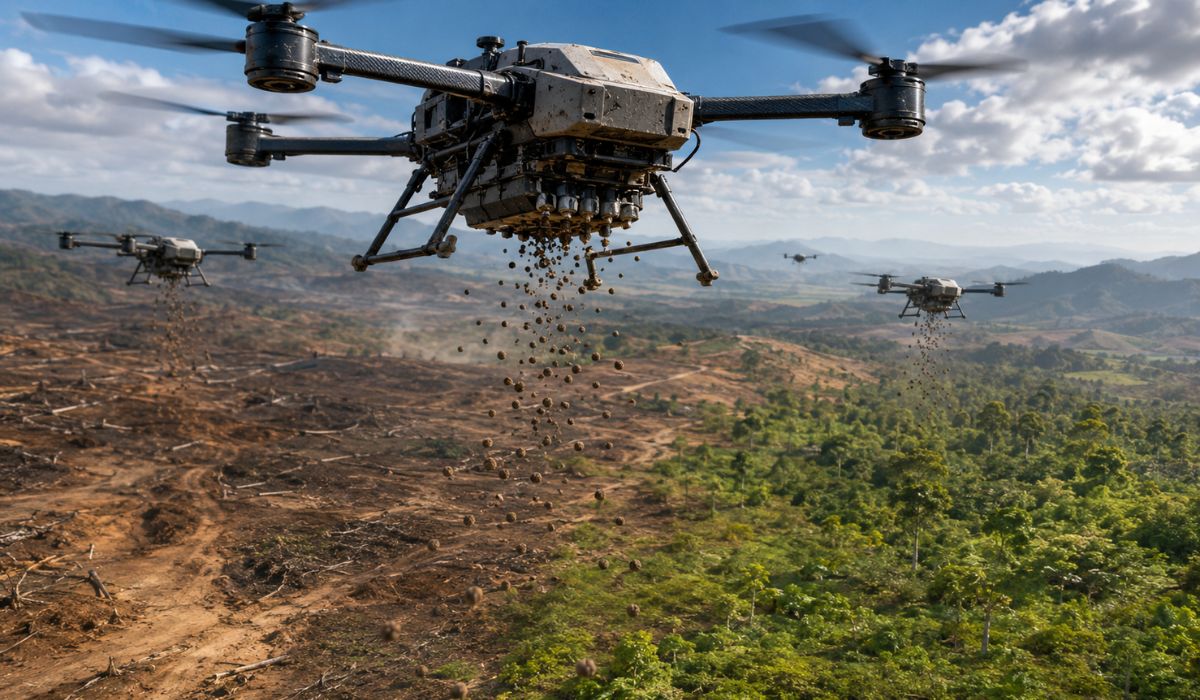
The restoration of degraded areas is incorporating drones capable of launching hundreds of seed balls per minute in terrains where manual planting may require more time, larger teams, or difficult physical access.
The technology is developed by Flying Forests, a company from Reno, in the U.S. state of Nevada, founded by former NASA engineer Lauren Fletcher and Irina Fedorenko-Aula.
In a publication dated January 8, 2026, NASA Spinoff reported that the system can fire 300 seed balls per minute, with an accuracy of about half a yard, equivalent to just under half a meter.
-
Canada Makes Historic Decision to Purchase New German Submarines in $70 Billion Defense Program, Replacing Aging Victoria-Class Fleet by 2033

-
4,000-Year-Old Stone Circle Discovered Near Belfast, Unveiling Prehistoric Ritual Complex in Irish Countryside

-
Brazilian Innovator Transforms 1962 Mercury Comet with Nissan Leaf Electric Motor, Achieving 125 km Range for Under $6,000
-
China Tests Giant 582-Ton Magnets to Contain Plasma Hotter Than the Sun’s Core, Aiming to Cut Superconductor Costs and Generate First Electricity from “Artificial Sun” by 2030


The company’s proposal is to use aerial planting as a complementary alternative in projects for the recovery of impoverished soils, mined areas, regions affected by fires, and small rural properties.
According to Fletcher, four drones could plant up to 40 million trees per year, if they operated on a sufficient scale.
The estimate is presented as operational potential, not as a result already achieved in the field.
The use of the technology reappeared in restoration projects in 2026.
In March, the Sugar Pine Foundation, an organization focused on forest recovery in California, reported a planting action with Flying Forests drones in an area affected by the Loyalton fire, using native Jeffrey pine seeds.
According to the entity, the drones carry 500 to 700 seed balls when fully loaded, with a total weight of about 15 kilograms.
The most detailed case cited by NASA occurred in early December 2024, in the Peruvian Amazon, near Puerto Maldonado, in the Madre de Dios region, close to the border with Bolivia.
After a week of heavy rain, 20 soldiers from the Peruvian Army helped Fletcher prepare 20,000 seed balls to recover an area degraded by gold mining.
When there was a break in the rain, the aerial planting took about an hour and a half.
A single drone equipped with a rapid launcher spread the 20,000 capsules over an area of 25 acres, equivalent to just over 10 hectares of sandy and impoverished soil.
The balls contained seeds of Crotalaria, a hardy legume used as an initial cover to protect and improve the soil before the introduction of other native species.
Reforestation technology combines drones and NASA expertise
Fletcher’s journey helps explain the combination of environmental science, robotics, remote sensing, and biology in the project.
During about 20 years of a career linked to NASA, he worked on life sciences programs at the Ames Research Center in Silicon Valley, California.
According to the American space agency, his work included projects related to the study of plants and animals in space environments.
Fletcher states that the development of this type of technology starts with understanding the organism you intend to cultivate.
“You need to understand the biology first and then design the engineering to match the biology you are trying to support,” he told NASA Spinoff.
This logic appears in the design of the seed balls.
They are not just seeds dropped from above.
Each capsule combines a clay-like base, nutrients, and components to reduce predation by animals, such as garlic or cayenne pepper, depending on the environment.
The concept of wrapping seeds in small clay balls is old, but Flying Forests’ model combines this technique with drones, digital maps, and data analysis.
Before the flights, the company cross-references satellite images, drone records, soil surveys, and information about terrain and water availability.
Artificial intelligence is used to identify patterns in large volumes of data and assist in creating planting maps.
The choice of species, capsule size, and launch density depend on ecological conditions and the objective of each area.
Aerial planting aims to reach hard-to-access areas
Traditional reforestation usually depends on nurseries, seedling transport, field teams, and physical access to the land.
This model continues to be used in different projects, especially when plant survival requires close monitoring.
In remote areas, burned, flooded, contaminated, or degraded by mining, however, the work may require higher logistical costs.
Flying Forests tries to operate in this segment with an aerial planting system.
The drone allows reaching difficult access areas, quickly spreading seeds, and reducing some of the initial implementation stages.
Fletcher states that there are competing systems with greater precision, but says his priority is to expand distribution and reduce costs through launch speed.
“My system seeks greater distribution and lower cost by increasing the planting rate,” he said.
The business model was also presented by the company as a differentiator compared to large-scale centralized projects.
Flying Forests claims to work with a franchise logic, training local organizations that are already involved in environmental restoration.
The proposal includes training drone operators, technicians, remote sensing analysts, seed ball manufacturers, and managers in the regions served.
Forest restoration, however, does not depend solely on the equipment.
Experts in the field often point out that the choice of suitable seeds, local ecological knowledge, maintenance, and monitoring directly influence the results of recovery projects.
Therefore, the company claims to seek partnerships with teams that know the territory, the species, and the relationship with local governments.
Flying Forests tests expansion in reforestation projects
In the first five years, Flying Forests conducted demonstrations in Panama, Peru, and Kenya, with about 200,000 trees planted, according to NASA Spinoff.
The company also reported that larger projects are underway in Peru, Brazil, Indonesia, and the Bahamas, in addition to talks with other partners.
Fletcher said he expects full commercial operations in at least two countries by the end of 2026.
The statement indicates a business goal, not a confirmation that all projects are already operating on a large scale.
Funding can come from carbon credits, governments, foundations, landowners, and other sources, according to the model described by the company to NASA.
Tree planting is often associated with carbon capture, but Fletcher presents the technology within a broader concept, that of ecosystem services recovery.
The expression refers to environmental functions such as rain regulation, soil protection, nutrient cycling, support for agriculture, and preservation of rivers and coastal areas.
In the Peruvian Amazon operation, the initial goal was not to form a complete forest from a single flight.
The first stage consisted of rebuilding a minimal ecological base on soil degraded by mining.
In this context, Crotalaria was used as a pioneer species to cover the ground and improve conditions before the introduction of more demanding native plants.
The comparison with a “seed helicopter” helps describe the visual functioning of the technology, but the result depends on factors after the launch.
Among them are rain at the appropriate time, correct choice of species, quality of capsules, protection against predators, technical monitoring, and participation of organizations that operate near the restored areas.
The expansion of this type of aerial planting still depends on proof in different biomes, competitive costs, and monitoring of plant survival over time.