






 Portuguese
  Spanish
  5 min of reading
  0 comments


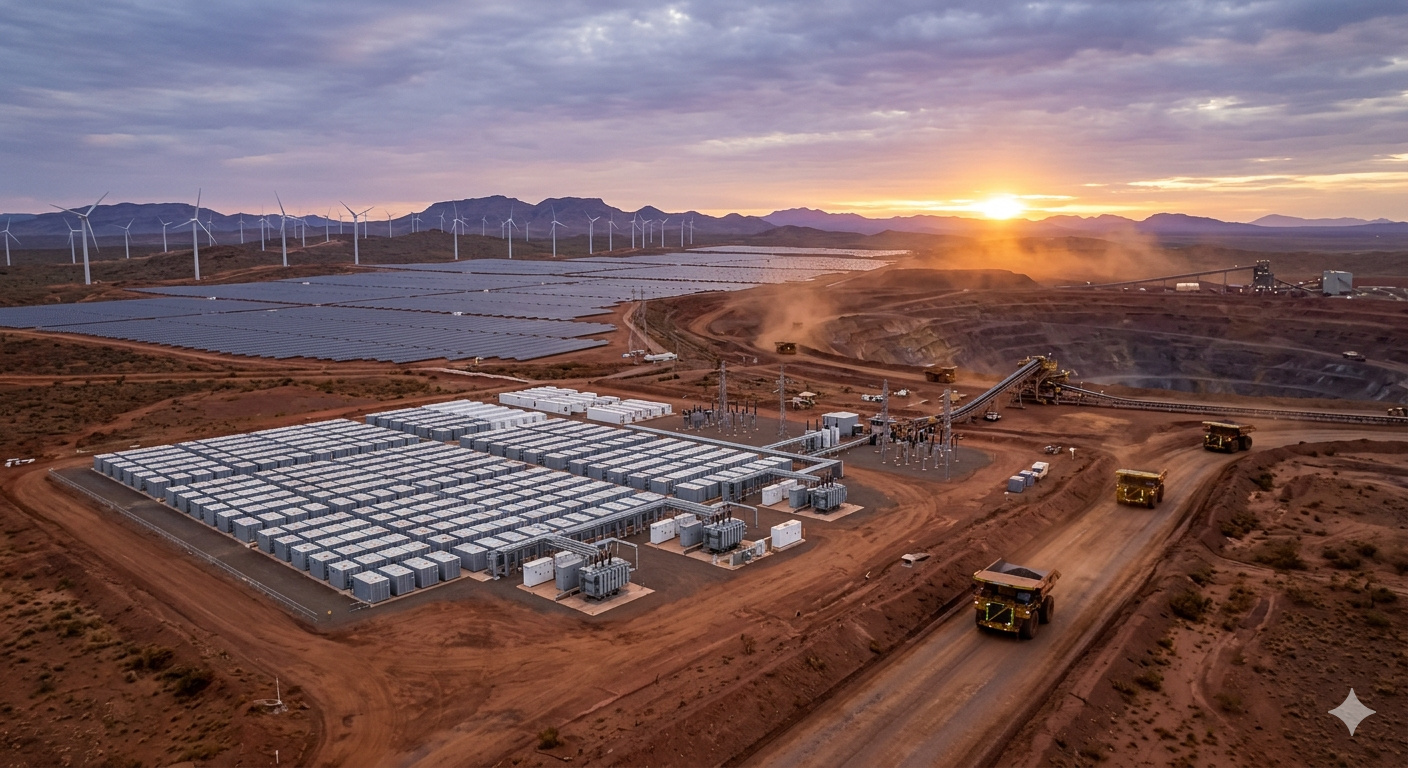
Fortescue accelerates plan to eliminate diesel with 1.2 GW solar, 600 MW wind, and up to 5 GWh in batteries, creating one of the largest renewable operations in mining.
On April 10, 2026, the Australian mining company Fortescue confirmed that it is accelerating one of the most ambitious projects in the global industry: completely eliminating the use of diesel in its mining operations in the Pilbara region of Western Australia. The plan involves deploying an industrial-scale hybrid energy system composed of 1.2 gigawatts (GW) of solar power, 600 megawatts (MW) of wind generation, and between 4 and 5 gigawatt-hours (GWh) of battery storage, forming one of the largest renewable infrastructures ever designed for the heavy mining sector.
The company estimates that replacing diesel could generate savings of up to US$ 100 million per year, in addition to significantly reducing carbon emissions from its operations, which currently rely heavily on fossil fuels to power equipment and systems isolated from the electrical grid.
Project transforms remote operations into autonomous energy systems
Fortescue’s operations in Pilbara are located in one of the most remote regions on the planet, where there is no connection to large national power grids. Historically, this has forced the company to operate with its own diesel-based generation, an efficient solution from a logistical standpoint, but highly costly and carbon-intensive.
-
Brazilian scientists are simultaneously advancing two research projects on clean hydrogen and driving solutions that could transform the energy matrix, enhance industrial competitiveness, and accelerate large-scale emission reduction targets.

-
Advancement in renewable energy: A R$ 150 million project launched by Petrobras and Finep aims to create state-of-the-art electrolyzers for green hydrogen, strengthening national research and preparing Brazil to compete in a billion-dollar energy market.
-
Illiterate or semi-literate grandmothers were trained to repair solar systems, open rural workshops, and light up homes that still depended on kerosene.
-
The world has bet on green hydrogen as the fuel of the future, but now faces the side effect: producing 1 kilogram requires about 9 liters of ultrapure water, and the largest projects on the planet are precisely in the driest regions of the Earth, where water is already scarce for people.





The new system proposes a structural shift: transforming these operations into autonomous renewable microgrids, capable of generating, storing, and distributing energy independently.
The combination of solar, wind, and batteries allows for compensation of the natural intermittency of renewable sources. During the day, solar energy plays a dominant role; at night or during periods of low radiation, wind generation and battery storage come into operation to ensure stability. This type of energy architecture has already been tested on a smaller scale, but implementation at the gigawatt level represents a significant technical leap for the sector.
Installed capacity places project among the largest in the world in mining
The numbers involved place Fortescue’s project in a category rarely seen in global mining. With 1.2 GW of solar capacity, the system is equivalent to the output of large national photovoltaic plants. The 600 MW of wind energy adds an important layer of energy diversification.
The most strategic element, however, lies in storage. A system of up to 5 GWh in batteries is capable of providing continuous energy for several hours, functioning as a kind of “energy cushion” that stabilizes the system.
For comparison, storage projects of this scale are typically associated with national power grids or large urban systems, not isolated industrial operations.
Reduction of operational costs becomes a central factor in strategy
In addition to the environmental impact, the project is driven by a clear economic logic. Diesel represents one of the largest operational costs in remote mining, especially when considering:
- Transportation of fuel over long distances
- Price fluctuations in the international market
- Complex supply logistics
- Maintenance of thermal generators
By replacing diesel with renewable sources, Fortescue reduces its exposure to these variables and gains cost predictability. The estimated savings of US$ 100 million per year reinforces that the energy transition, in this case, is not just an environmental issue, but also a strategic decision for operational efficiency.
Project is part of a global movement for decarbonization of mining
Fortescue’s initiative is aligned with a broader trend in the mining industry, which has been pressured by investors, governments, and consumer markets to reduce their carbon emissions. Companies in the sector have been seeking alternatives such as:
- Electrification of heavy equipment
- Use of green hydrogen
- Integration of renewable energies
- Reduction of dependence on fossil fuels
However, few projects reach the scale and level of integration proposed by Fortescue. The company has positioned itself as one of the most aggressive in this movement, also investing in technologies related to hydrogen and the energy transition.
Technical challenges involve stability, integration, and storage
Despite the potential, implementing a system of this magnitude involves significant technical challenges. Among the main critical points are:
- Ensuring network stability in an isolated system
- Integrating different energy sources with variable profiles
- Managing large-scale storage
- Maintaining operational reliability in an extreme environment
The Pilbara region presents severe climatic conditions, with high temperatures, dust, and weather events that can impact equipment operation. Additionally, mining requires a continuous supply of energy, without interruptions, which increases the level of demand on the system.
GWh-scale batteries become a key component in the new energy architecture
The storage component is possibly the most strategic part of the entire project. Systems of 4 to 5 GWh allow not only for the storage of excess energy but also act as a network stabilization element, ensuring a constant supply even during periods without renewable generation.
This capacity is essential to completely replace diesel, which traditionally served as a firm energy source. The technological advancement in batteries, combined with cost reductions in recent years, has made this type of solution viable on an industrial scale.
Project can redefine the energy standard of global mining
If successful, Fortescue’s project could establish a new standard for mining operations worldwide. Companies operating in remote regions, such as Latin America, Africa, and Australia, face similar challenges and may adopt similar models in the future. This could accelerate the energy transition in one of the most carbon-intensive sectors of the global economy.
The implementation of large-scale renewable systems in mining also has implications for the energy sector as a whole. Projects of this kind increase the demand for storage technologies, stimulate innovation in microgrids, create new models of distributed generation, and reduce dependence on fossil fuels.
Moreover, they reinforce the viability of decentralized energy systems capable of operating independently from the traditional grid.
Fortescue bets on scale to lead a new phase of the energy transition
Fortescue’s strategy indicates a clear bet on scale as a competitive differentiator. By investing in large-scale projects, the company aims not only to reduce costs but also to position itself as a global reference in energy transition within mining.
This move could generate significant competitive advantages, especially in a scenario where environmental criteria gain increasing weight in investment decisions.
Diesel-free mining stops being a concept and begins to gain industrial scale
The acceleration of the project shows that the idea of diesel-free mining operations is moving from an experimental concept to the phase of large-scale implementation. By combining renewable generation and advanced storage, companies are beginning to demonstrate that it is possible to maintain intensive industrial operations without relying on fossil fuels.
Fortescue’s advancement raises a central question for the future of mining: can this model of large-scale renewable energy-based operation become the new global standard, or are there still technical and economic barriers that limit its mass adoption?
The response will depend on the ability of companies to replicate this model in different contexts and the evolution of storage technologies and distributed generation in the coming years.








Be the first to react!