Portuguese
  Spanish


In Zaragoza, the aquifer linked to the Ebro maintains water at about 18°C all year round and feeds dozens of geothermal energy systems. The THERMAL method seeks to coordinate installations, save more than €7,500 annually per unit, and avoid almost 15 tons of CO₂, before incorporating artificial intelligence.
The aquifer hidden beneath Zaragoza, in Spain, has transformed an underground water layer into the centerpiece of urban geothermal energy. Located with a water table about 11 meters deep, the resource maintains a temperature close to 18°C throughout the year and has been used for nearly three decades to heat and cool large buildings.
The solution has regained attention because it has already allowed a 52% reduction in energy consumption of a public building and is now entering a new phase. Researchers from the Geological and Mining Institute of Spain, linked to the CSIC, have tested a management method capable of better coordinating existing installations and preparing the use of artificial intelligence to avoid underground interferences.
Aquifer functions as a thermal reserve beneath the city
Beneath the streets of Zaragoza extends the Ebro Alluvial aquifer, a mass of underground water connected to the river and with an estimated thickness between 20 and 30 meters. The water level appears about 11 meters below the surface, a distance sufficient to keep the resource invisible to urban routine, but accessible to climate control systems.
-
Fired during apartheid and with a little borrowed money, an electrician started with a borrowed truck and transformed electrical services into a group connected to energy, real estate, and infrastructure in South Africa.

-
Wood has ceased to be just a construction material in Yale research and has become insulation for electrical transformers that face intense heat, aging, and increasing pressure from the renewable energy-powered grid.
-
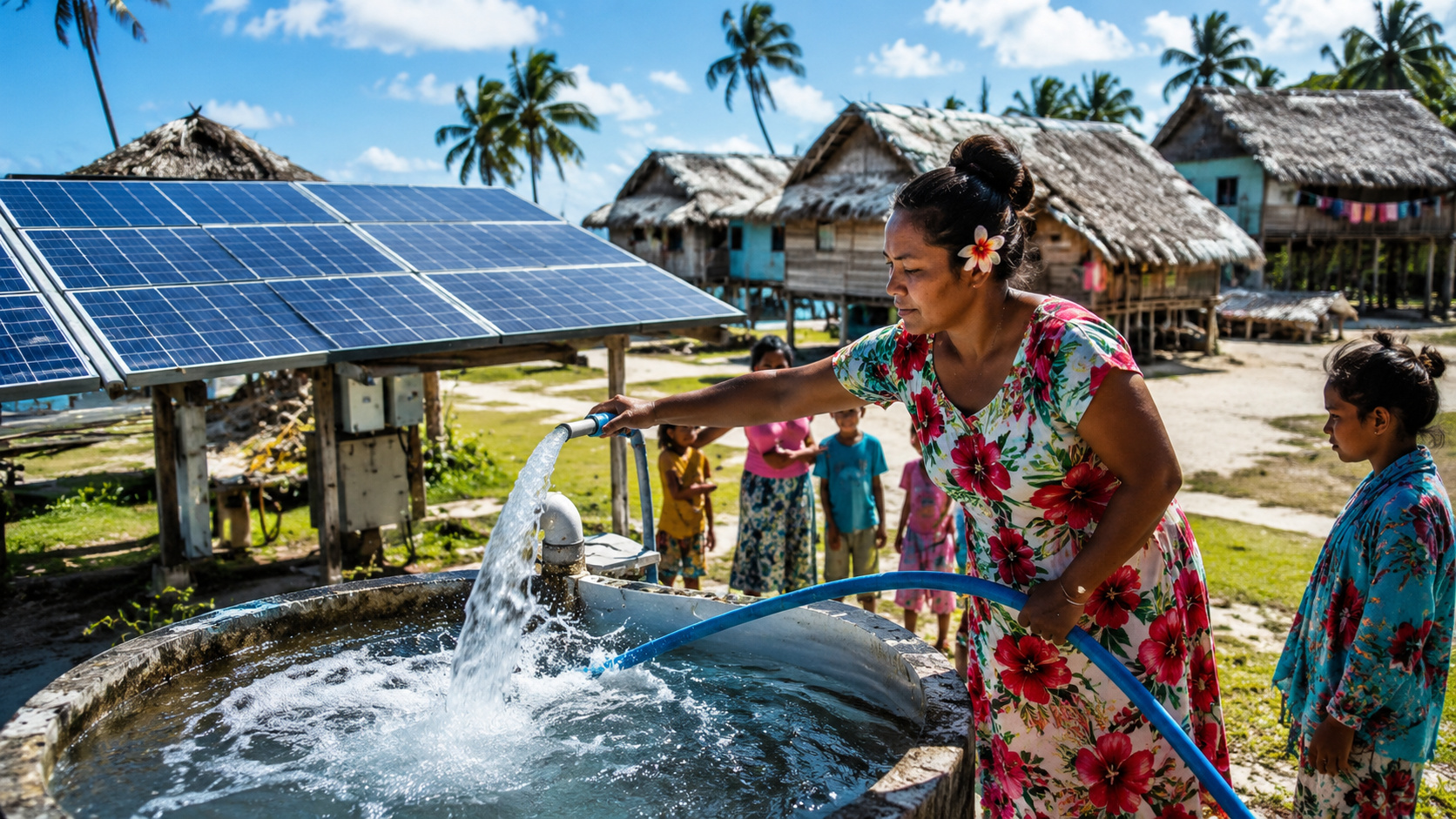
More than 1,000 residents of a remote island in Kiribati now have clean water and electricity with solar systems operated by the community itself.
-
Ceará brings together 7 giants and R$ 66 billion to transform Pecém into the largest green hydrogen hub in Brazil, with final decisions expected by the end of 2026.

The main advantage is not just the existence of the water, but its thermal stability. While the external air can exceed 35°C during the Aragonese summer or drop to approximately 2°C on cold days, the underground water remains close to 18°C throughout the year.
This consistency makes the aquifer especially useful for geothermal heat pumps. Instead of relying directly on external air subject to large temperature variations, the equipment works with a more balanced and predictable thermal source.
In practice, Zaragoza has come to rely on a kind of silent energy infrastructure. Without visible turbines or large panels on rooftops, part of the city uses the water hidden beneath the asphalt to reduce the effort needed in building climate control.
System heats in winter and cools in summer
The operation resembles the logic of a household refrigerator: the equipment does not create cold in isolation, but transfers heat from one point to another. In the Zaragoza facilities, this exchange occurs between the buildings and the aquifer.
In winter, water is drawn from the underground at about 18°C. A thermal exchange system takes advantage of part of this heat and amplifies it to heat the indoor environments. After the operation, the water, slightly cooler, returns to the aquifer.
In summer, the path is reversed. The heat accumulated inside the buildings is removed and transferred to the underground water, which remains much cooler than the outside air during periods of intense heat. The aquifer acts as a heat source in the cold and as a heat sink in the hot months.
This mechanism reduces the effort of heat pumps. To maintain a house or building at 22°C on a winter day with outside air at 5°C, an air-based system needs to overcome a much larger thermal difference than equipment starting with water at 18°C.
City accumulates almost 30 years of geothermal experience

The use of the Zaragoza aquifer did not emerge recently. The city has been using this underground source of climate control for almost three decades, during which the number of installations has gradually increased.
Currently, there are about 60 large installations, mainly in public buildings, hospitals, university campuses, shopping centers, and residential complexes. For cooling alone, the installed capacity reaches approximately 110 thermal megawatts.
According to the presented data, this capacity would be equivalent to what is needed to climate control more than 15,000 homes. The number places Zaragoza as an urban reference in the use of geothermal energy associated with aquifers.
The city not only found a favorable resource beneath its streets. It also accumulated operational knowledge about drilling, extraction, reinjection, and shared use of water in a densely occupied area.
Public building consumes 52% less energy
Among the most representative examples is the Zero Emissions Building of the Zaragoza City Hall. Using the geothermal system, the building consumes 52% less energy than a comparable conventional building.
The result shows why the solution is attracting interest in other cities. Air conditioning for large public buildings, hospitals, or commercial structures usually requires high electricity consumption, especially during periods of intense heat or cold.
When the subsoil offers water at a constant temperature, the air conditioning needs to spend less energy to achieve the desired internal comfort. This difference can reduce operating expenses and lower emissions associated with energy consumption.
Another example mentioned is in the paper industry Saica, which has a field with 12 drillings integrated into the foundations of its structure. The application shows that the use of the aquifer is not limited to administrative or residential buildings, but can reach larger operations.
Success of the aquifer also created a new risk
The more buildings use the same underground source, the greater the challenge of coordinating the system. Each installation extracts water, exchanges heat, and returns this water to the subsoil with altered temperature.
If many operations return excessively heated water to the aquifer, especially over long periods, the underground temperature may rise. In this scenario, the resource does not disappear, but loses part of the efficiency that made it so valuable.
The problem can also occur when nearby installations interfere with each other. A system that injects hotter or colder water can affect the performance of another capture point located in the same underground mass.
Therefore, Zaragoza’s current challenge is not to find more water or drill new wells. The focus is on organizing the use of existing infrastructure so that the growth in demand does not compromise the thermal balance of the aquifer.
THERMAL method attempts to organize use without opening new wells
To face this challenge, researchers from the Advanced Hydrogeological and Geothermal Systems Group of IGME-CSIC developed and tested in Zaragoza the THERMAL method, aimed at intelligent management of urban aquifers.
The proposal is to better coordinate the flows and temperatures of the installations already in operation, reducing interferences and maintaining the system’s capacity over time. The method does not depend on opening a new well to expand the energy benefits.
According to the results presented, more efficient coordination of existing heat pumps can generate savings of over € 7,500 per year at each installation. Additionally, optimized management can prevent the emission of almost 15 tons of CO₂ per unit annually.
The logic is to make better use of what already exists. Instead of indiscriminately expanding underground exploitation, the project aims to make nearby installations function as part of a coordinated network.
Artificial intelligence should anticipate demand and thermal changes


The next step planned for the system is to incorporate artificial intelligence and machine learning. The technology is expected to help predict the energy demand of buildings and monitor temperature changes in the underground.
This prediction can be important during periods of intense use, such as heatwaves, when multiple installations need to cool buildings simultaneously. By anticipating demand peaks, management can adjust extraction and reinjection before systems begin to interfere detrimentally.
AI can also help observe how the aquifer reacts to accumulated use over the years. With data on temperature, flow, and pump operation, it would be possible to identify trends and make decisions before efficiency is reduced.
The goal is not to replace geological knowledge but to enhance its control capacity. In a city with dozens of installations connected to the same resource, the combination of underground science and automated analysis can define the sustainability of the solution.
Zaragoza model already targets other European cities
The Spanish experience has begun to be observed as a potential model for other urban centers. The THERMAL method was developed with the intention of making the management of geothermal aquifers more efficient and replicable in different European contexts.
Zaragoza has a favorable condition by being over the aquifer connected to the Ebro, but it is not the only place interested in underground thermal sources. Paris uses a wide network based on the Dogger aquifer, while Vantaa, near Helsinki, is developing a large seasonal thermal storage system.
In Spain itself, Mieres, in Asturias, transformed an old flooded coal mine into a geothermal network capable of supplying a hospital, university, and hundreds of residences. These cases show that underground energy can arise from both natural aquifers and abandoned industrial structures.
The differential of Zaragoza lies in trying to collectively manage an urban resource that already operates on a large scale. The city is not only demonstrating that geothermal energy works but is tackling the more difficult issue: how to expand it without degrading its own advantage.
Invisible energy faces the barrier of lack of visibility
Despite the results, urban geothermal energy faces a communication challenge. Solar panels appear on rooftops and wind turbines transform the landscape. An aquifer working beneath the streets does not produce the same visual impact.
This invisibility helps explain why underground solutions receive less public attention, even when they present significant efficiency gains. In Zaragoza, much of the energy infrastructure is hidden, although it directly contributes to reducing consumption and emissions.
Another obstacle is the initial investment in drilling and specific systems. According to the information presented, experts estimate that this cost can be offset within a period of five to eight years thanks to continuous energy savings.
With European funds and incentives aimed at energy efficiency, this type of project can gain more ground. Even so, its expansion depends on technical planning, hydrogeological knowledge, and institutional capacity to manage a shared resource.
Aquifer places Zaragoza at the forefront of a new energy stage
For almost 30 years, the aquifer of Zaragoza has remained beneath the city, helping to climatize buildings, hospitals, and large facilities without occupying visible space in the urban landscape. Its stable water at about 18°C has allowed for reduced consumption, decreased emissions, and has consolidated the Aragonese capital as a geothermal reference.
Now, the very success of the system requires more control. With dozens of installations extracting and returning water to the subsoil, the city needs to prevent the lack of coordination from overheating the thermal reserve and reducing its efficiency.
The bet on the THERMAL method and artificial intelligence shows that the next frontier of urban energy may lie in the intelligent management of what already exists beneath cities. Instead of just seeking new sources, Zaragoza tries to preserve and enhance the value of a silent solution that has been working for decades.
And you, do you believe that Brazilian cities should also better investigate the hidden energy potential underground before expanding traditional climatization systems? Share your opinion.