Portuguese
  Spanish


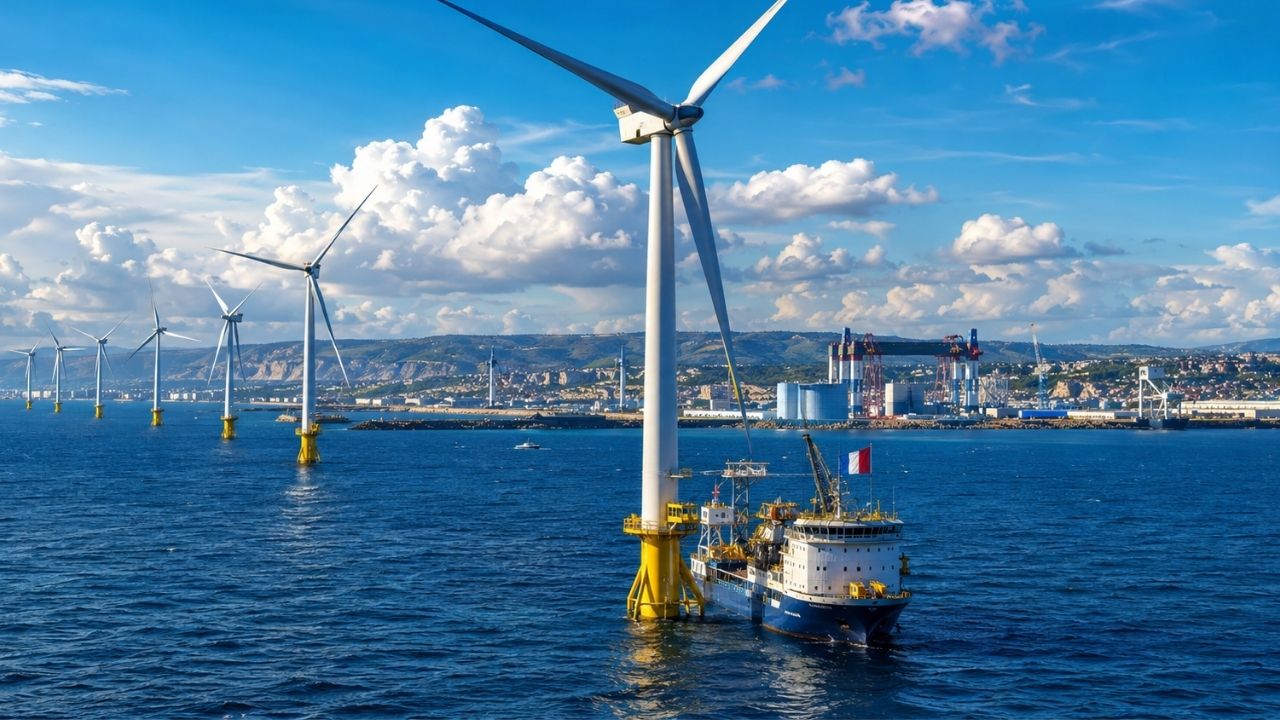


Offshore wind farms dominate the French renewable bidding package, with 10 GW in seven maritime projects, 1.2 GW solar and 0.8 GW onshore wind, while Paris limits parts from China and prioritizes European technologies to accelerate energy sovereignty and protect local industrial chains amid global pressure.
The offshore wind farms have entered the center of France’s new energy bet, which announced bids for 12 GW in renewable projects and decided to give more weight to technologies produced in Europe. The move seeks to accelerate the country’s energy sovereignty and reduce dependence on imported oil and gas.
The package includes seven offshore wind energy projects, totaling 10 GW, as well as smaller bids for 1.2 GW of solar energy and 0.8 GW of onshore wind. The decision comes amid political delays, fiscal pressure, and a growing industrial dispute over who will supply the components for the European energy transition.
France bets on offshore wind farms to accelerate renewable energy
France announced a bidding package that places offshore wind farms as the main front of renewable expansion. Of the 12 GW planned in the set, the majority is concentrated in maritime parks, considered strategic for expanding large-scale clean generation.
-
From a 12-square-meter room to leading a $4.8 billion fuel empire with over a thousand stations

-
El Niño Threatens Brazilian Food Production, Economists Predict Rising Prices for Coffee, Corn, and Rice
-
Brazil’s First Freight Railway Built from Scratch, EF-118 Connecting Espírito Santo to Rio de Janeiro, Goes to Auction in October Attracting Chinese Giant in Multi-Billion Dollar Bid for Southeast Rail Network

-
Audit in Rio de Janeiro’s State Government Uncovers Ghost Employees Across All 77 Departments, Leading to Over 4,000 Dismissals and Significant Cost Savings





The choice shows that Paris wants to transform the sea into a new base for French energy security. Offshore wind energy allows the installation of large turbines in areas with more constant winds, far from urban centers and with a high production potential.
The plan also attempts to address a political and economic need. France wants to further reduce its exposure to oil and gas imports, especially in a global scenario marked by geopolitical tension and energy prices sensitive to external crises.
According to the French government, the country entered recent energy crises more protected because of the nuclear park developed in recent decades. Now, the strategy is to also advance in renewables, without giving up on the national and European industry.
Package totals 10 GW at sea, solar and onshore wind
The core of the announcement lies in the seven offshore wind energy projects, totaling 10 GW. They represent the largest portion of the package and reinforce the French goal of rapidly expanding maritime generation.
Besides the offshore parks, the tenders include 1.2 GW in solar energy and 0.8 GW in onshore wind energy. The combination attempts to diversify the renewable matrix, but the political and industrial weight is clearly on the offshore projects.
The French energy planning law passed in February aims to reach 15 GW of offshore wind energy by 2035. Today, the country has less than 2 GW installed in this segment, which shows the size of the intended leap.
If the projects move forward on schedule, France could multiply its offshore wind capacity in a few years. The challenge will be to transform tenders into construction, grid connection, component manufacturing, and commercial operation.
Tenders arrive after a two-year delay
The tenders were delayed for about two years due to political impasses related to renewable energy financing. The delay occurred at a time when France also faces pressure on public debt.
This delay increased the importance of the announcement. By unlocking the projects, the government tries to show that the energy transition remains a priority, even in a difficult fiscal environment.
Finance Minister Roland Lescure argued that the projects help reduce France’s dependence on imported fuels. The logic is to expand domestic and European sources of electricity, reducing external vulnerabilities.
The decision also ties into the debate on energy prices. According to the French government, the country’s consumers already pay cheaper electricity than neighbors like Italy, and the intention is to preserve this advantage with more internal production.
Made in Europe enters the center of the dispute

France wants the new tenders to be carried out, as much as possible, with European technologies, factories, and workers. This orientation anticipates a “Made in Europe” principle that should gain more weight in tenders from 2030 onwards.
A change transforms the energy transition into industrial policy. It is not enough to install turbines, solar panels, and cables; Paris wants a significant part of this chain to generate jobs, technology, and productive capacity within Europe.
The government introduced a resilience criterion to prioritize proposals with more components of European origin. The measure seeks to limit dependence on Chinese suppliers, especially in sectors considered strategic.
This point is decisive because China dominates important parts of global clean energy chains. By imposing limits, France tries to reduce geopolitical risk and protect European manufacturers in a highly competitive market.
Chinese components will have a limit in offshore turbines
In offshore wind, the announced rule establishes that, at most, four of the nine strategic components can come from China. The measure tries to ensure that most critical items originate outside the Chinese chain.
There will also be a limit on the use of Chinese permanent magnets in offshore wind turbines. The participation of these components will be restricted to 50%, according to the rules presented.
These parts are important because they are part of essential systems of modern turbines. By limiting their origin, France signals that supply security will be as relevant as price and technical capacity.
The same reasoning applies to solar energy. In solar tenders, origin requirements will cover photovoltaic cells and modules, precisely two segments where Chinese production has a strong global presence.
Energy security now involves European factories
The notion of energy sovereignty no longer means just producing electricity within one’s own territory. Now, it also involves controlling industrial chains, critical components, cables, turbines, solar cells, and materials related to the energy transition.
France cited European companies and industrial hubs as part of this strategy, including manufacturers related to electrical cables, photovoltaic cells, rare earths, and wind turbines. The goal is to create a chain less vulnerable to external shocks.
This concern gained strength after recent energy crises, logistical bottlenecks, and trade tensions. For Paris, relying too much on external suppliers in strategic sectors can be as risky as depending on imported fossil fuels.
Therefore, tenders now function as an instrument of energy and industrial policy at the same time. Those competing for projects will have to consider price, technology, component origin, and chain resilience.
Sustainability and Cybersecurity Also Enter the Radar
Future French tenders should also include sustainability and cybersecurity criteria. This broadens the scope of requirements beyond the industrial origin of the equipment.
In modern energy projects, digital security has become part of critical infrastructure. Wind farms, power grids, and control systems rely on sensors, software, remote communication, and integration with operators.
A cyberattack or failure in connected systems can affect production, operation, and network stability. Therefore, cybersecurity is now treated as a relevant condition in strategic energy projects.
Sustainability also becomes a criterion because the energy transition is not limited to clean generation. Governments want to assess industrial footprint, material origin, supply chain, and environmental impact of the equipment used.
France Tries to Balance Nuclear, Renewables, and Sovereignty
France has an electricity matrix historically supported by nuclear, which helped the country reduce dependence on fossil fuels in generation. The new package does not replace this base but seeks to complement energy security with expanding renewables.
Offshore wind appears as a key piece because it offers significant volume and can integrate into a matrix already less dependent on coal and gas. The French bet is to combine nuclear, offshore wind, solar, and European industry in one strategy.
This balance, however, is not simple. Offshore projects require high investment, licensing, maritime works, network connection, public acceptance, and industrial capacity.
Even so, the government treats the advancement as necessary. The message is that Europe needs to produce clean energy and, at the same time, keep a larger part of the technology that makes this generation possible within the continent.
Renewable Dispute Becomes Industrial and Geopolitical Dispute
France’s 12 GW package shows how renewable energy has ceased to be just an environmental agenda. It has become a dispute for sovereignty, industrial jobs, supply chains, and technological influence.
By prioritizing offshore wind and limiting Chinese components, Paris tries to accelerate the transition without transferring most of the industrial value of the projects outside Europe. This is the most sensitive frontier of clean energy: who builds, who sells, and who controls the technology.
For European companies, the new rules may open competitive space. For Chinese suppliers, they represent a greater barrier in a strategic market.
And for consumers, the outcome will depend on the ability to balance cost, safety, and delivery speed. A more sovereign transition can protect the industry, but it also needs to keep energy affordable.
Offshore wind farms become a central piece of France’s future
Offshore wind farms now play a central role in France’s plan to accelerate renewable energy, reduce external dependency, and protect European factories. With 10 GW at sea within a total package of 12 GW, France signals that it wants to grow quickly in this segment.
The restriction on Chinese components makes it clear that the dispute will not only be for megawatts. It will also be for industrial control, supply security, and strategic autonomy within Europe.
The challenge will be to take projects off the drawing board, meet deadlines, and prove that the preference for European chains can deliver scale without stalling the energy transition.
And you, do you think France is right to limit Chinese components to protect the European industry, or could this increase costs and delay the expansion of renewables? Share your opinion.