Portuguese
  Spanish


Keiko played Willy in the cinema, moved millions of people, and became a global symbol of the debate on captive orcas
The story of Keiko, the orca that starred in the movie Free Willy, went beyond the screens and became one of the most emblematic cases about marine animals in captivity. Captured in Iceland in 1979, when he was about two years old, he went through parks in Canada and Mexico before becoming world-famous.
The success of the movie, released after filming began in 1992, provoked an unexpected reaction. While the character Willy moved the audience by returning to the ocean, the real orca lived with poor health in an inadequate tank at Reino Aventura in Mexico City.
The mobilization was so intense that more than 300,000 people demanded Keiko’s release. From there, Warner Brothers, Reino Aventura, experts, and financiers began to organize an unprecedented operation: preparing a captive-raised orca to return to its native waters.
-
15-year-old Palestinian girl who fled Gaza war learns Portuguese in Brazil and wins gold at São Paulo Math Olympiad, inspiring teachers and classmates on social media.

-
“Vampire Deer” Rediscovered in Remote Afghan Forest After Nearly 60 Years, Highlighting Urgent Conservation Efforts

-
Historic Living Hedge in Brazil, Over 300 Years Old and 13 Meters Tall, Enters Guinness World Records
-
Couple Trades Wedding Celebration to Invest in Therapeutic Gym for Seniors in Brazil, Now Earning $2 Million Annually


Keiko became a global symbol after the success of Free Willy
The movie Free Willy grossed about US$ 154 million at the box office and inspired a generation committed to animal defense. However, the fame also revealed the concerning situation of the film’s own star.
In Mexico, Keiko lived in a heated, chlorinated tank with artificial saltwater, a structure made for dolphins. Additionally, he had stomach ulcers, skin warts, and was significantly underweight.
Public outcry changed his fate. Warner Brothers and Reino Aventura agreed to retire the orca, while Ken Balcomb, founder of the Whale Research Center, was consulted to plan his repatriation.
Free Willy Keiko Foundation funded the orca’s departure from Mexico
The operation gained momentum with Craig and Wendy McKaw, who donated US$ 2 million to create the Free Willy Keiko Foundation. Without this financial support, Keiko’s removal from Mexico would have been unlikely.
In 1996, he was taken to the Oregon Coast Aquarium in the United States. There began a decisive stage of recovery. Keiko started eating live fish, lived in seawater, and gained approximately 907 kg.
During this period, more than 1 million people visited the orca. Even so, after negotiations, Keiko was finally transferred to Iceland in 1998.
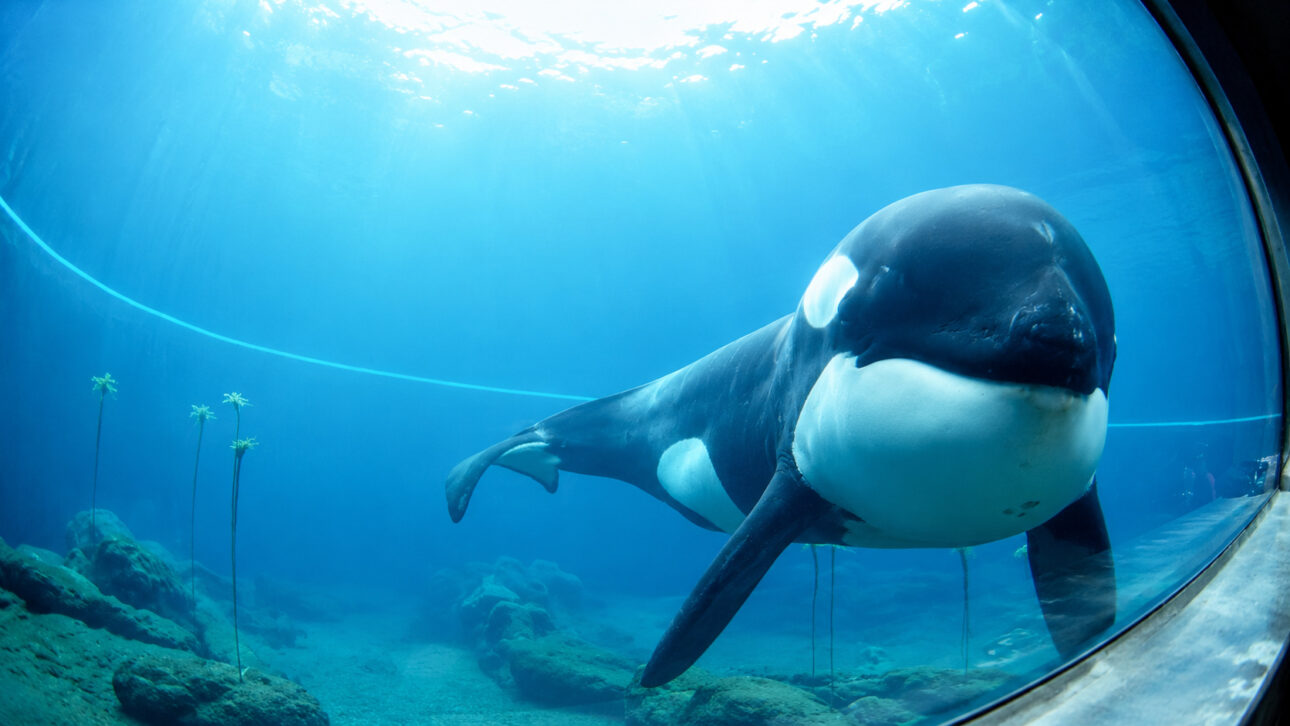
Return to Iceland marked the most important phase of readaptation
In Iceland, Keiko began living in a marine enclosure in Klettsvik Bay, near Vestmannaeyjar. The environment allowed contact with natural water, cold climate, and ocean sounds.
Gradually, he learned to catch live fish. He also began to take supervised outings, called “ocean walks.”
Researchers tried to identify his family through acoustic and genetic studies. However, this connection was never confirmed. In the following years, Keiko interacted with wild orcas, but the contacts did not last long.
Trip to Norway showed the limits of reintegration
In 2002, Craig and Wendy McKaw made a final donation of US$ 800,000 and stepped away from the foundation. After that, the Humane Society took over the project and adopted a stricter protocol, reducing speech, visual contact, and human interaction.
The strategy did not yield the expected result. In July 2002, Keiko disappeared and was not seen for almost two months. Later, he was found in Norway, after traveling more than 1,300 kilometers.
When he was recognized by the collapsed dorsal fin, he sought to approach people again. According to the podcast Tokitae, by Bonnie Swift, it became evident that Keiko would choose humans over whales if he had that possibility.
Keiko’s death reignited debate about captivity and freedom
In December 2003, Keiko died of pneumonia. His death expanded a discussion that already divided experts, activists, and critics of the project.
The New York Times classified the attempt as a failure, mainly because Keiko was never fully reintegrated into a group of wild orcas.
On the other hand, the Huffington Post described the experience as a phenomenal success. The evaluation highlighted that Keiko lived five years in natural waters, away from the small tank where he was getting sick in Mexico.

For advocates, Keiko had freedom and well-being in recent years
David Phillips, executive director of the Free Willy Keiko Foundation, defended the project. For him, the operation took the “most difficult candidate” from a near-fatal condition in Mexico to contact with landscapes, marine sounds, and wild whales.
The favorable analysis does not ignore that Keiko did not form a fully wild life. Even so, it highlights that he had freedom, a natural environment, and basic needs met during his last years.
World Animal Protection also uses stories like Keiko’s to reinforce a position against dolphin captivity. The organization reminds that orcas are the largest species of dolphin and advocates that these animals be seen in nature.
Keiko’s legacy goes beyond the movie Free Willy
Keiko’s journey remains strong because it unites cinema, popular mobilization, science, ethics, and animal welfare. His story does not offer a simple answer, but poses an essential question: what to do with animals that have spent almost their entire lives in captivity?
The case showed that returning to nature can be complex, expensive, and uncertain. Even so, it also revealed that more natural environments can offer a quality of life superior to that of artificial tanks.
Keiko did not return to live fully as a wild orca. However, he ceased to be just an attraction in a park and spent his last years in contact with the ocean, in waters close to the place where he was born.
Therefore, his story continues to be remembered as a global milestone in the discussion about orcas in captivity, coastal sanctuaries, and the future of marine animals used in shows.