Portuguese
  Spanish


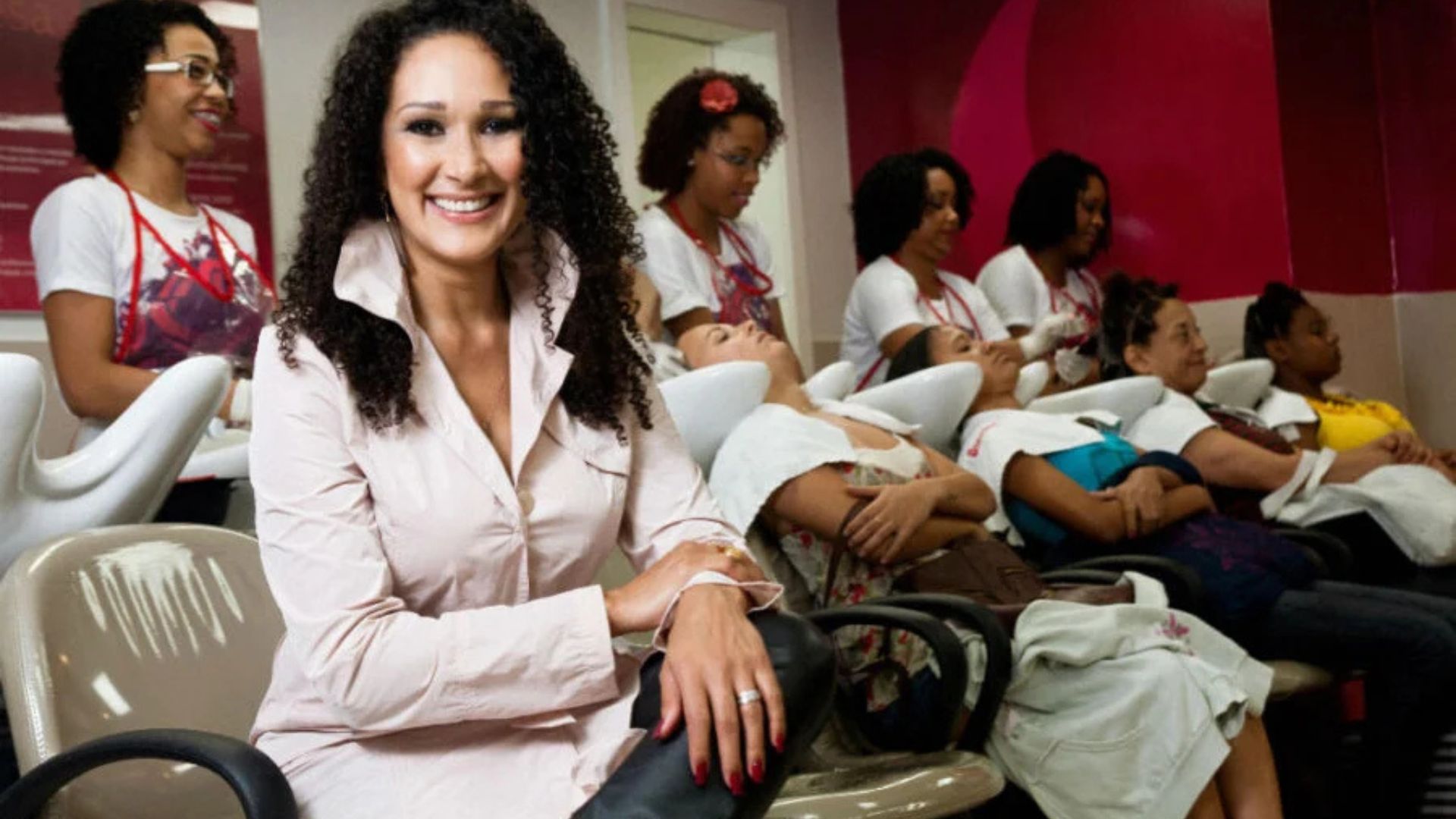

Leila Velez started at McDonald’s at 14 years old and brought discipline, standards, and management to Beleza Natural, a network that became a reference in Brazil.
Leila Velez was born in Rio de Janeiro and grew up in a low-income family, daughter of a domestic worker and a doorman. Before becoming one of the most well-known entrepreneurs in the beauty sector in the country, she started working early, studied in a public school, and joined McDonald’s as a teenager, an experience that would later influence her way of thinking about management, efficiency, and scale.
The learning accumulated at the beginning of this journey was decisive for the creation of Beleza Natural, a network founded in 1993 to serve women with curly, coily, and wavy hair in a market that, at the time, offered few specific solutions for this audience. The company grew supported by process standardization, high-volume service, and a positioning centered on self-esteem and appreciation of natural beauty.
Leila Velez started at McDonald’s at 14 years old and brought standardization, control, and service to Beleza Natural
Americas Quarterly states that Leila worked as a cashier at a McDonald’s unit at 14 years old and absorbed lessons there on task division, standardization, quality control, and operational efficiency. Five years later, at 19, she applied this repertoire to her own business.
-
Whale with Scoliosis Spotted in Spain, Baffling Experts After Being Mistaken for Entangled Animal

-
Son of Poor Farmers Fled Home Four Times Seeking Work, Founded Hyundai, and Transformed It into a Global Industrial Giant in Over 190 Countries
-
13-Year-Old Raises Funds to Build Well, Transforming Lives in Cambodian Community Lacking Clean Water

-
Man with Metal Detector Finds Medieval Silver Seal in England, Uncovers 2,000-Year-Old Roman Gem with ‘Richard’s Secret’





In an interview with UOL Universa, the entrepreneur herself reported that she had her first formal job at McDonald’s, starting by frying potatoes and making hamburgers, and went on to study even managerial function manuals. According to her, she was promoted at 16 years old and became the youngest manager in the network at that time.


This period helped shape the logic that would later be replicated at Beleza Natural. Instead of setting up a salon based solely on artisanal service, Leila began to see the business as an operation capable of growing with repeatable processes, training, and service consistency.
Beleza Natural was born in 1993 to serve an ignored market of curly, wavy, and coily hair
Americas Quarterly reports that Leila founded Beleza Natural in 1993, alongside Zica Assis, Rogério Assis, and Jair Conde. At that time, products aimed at the large number of Brazilian women with coily or very curly hair were largely limited to aggressive straighteners and relaxers.
The company’s proposal was to fill precisely this gap. The business was created to offer specific treatment for this type of hair and, at the same time, to work on the customer experience in a more structured way, focusing on results, service, and boosting self-esteem.
The initial capital came from within the partners’ own circle. Americas Quarterly notes that, before GP Investments entered in 2013, the company grew without external financing, and that one of the partners sold his taxi to raise funds for the first unit in the Greater Tijuca area in Rio.
Management model inspired by fast-food helped scale a beauty network aimed at the market base
One of Beleza Natural’s differentiators was adapting operational principles typical of large service networks to a segment poorly structured for scale. AQ itself describes the salon as an operation that sought to deliver a spa experience but with operations organized like a production line, adjusted to the reality of the beauty sector.
In UOL Universa, Leila directly linked the business’s growth to lessons she brought from fast-food, such as organization, control, standardization, and a constant quest for improvement. This combination helped transform a small salon into a nationally recognized network.
The focus on a historically underserved audience was also central to the expansion. AQ states that much of the company’s success came from the decision to serve low and middle-income women who were, in Leila’s words, “invisible” to most consumer companies.
Hour-long lines, customer caravans, and expansion without external investment marked the network’s initial advance
The expansion of Beleza Natural began with strong word of mouth. Americas Quarterly reports that after the opening of the first unit, buses with customers from other areas of the city started arriving at the salon, signaling pent-up demand for services aimed at curly and coily hair.

Endeavor recorded that, in the following years, women in Rio would wait between four and six hours for service. The growth of the line became one of the most visible signs that the company had found a large, underexplored, and highly engaged market.
This initial advance occurred before the entry of external capital. Only in 2013, according to AQ, did the company start partnering with GP Investments, after consolidating its expansion with its own resources and operational reinvestment.
Beleza Natural gained national scale, thousands of employees, and revenue of hundreds of millions of dollars
The company’s numbers varied over time, according to the expansion phase. In 2017, Americas Quarterly reported that Beleza Natural served 130,000 clients per month in 30 salons across Brazil and had already surpassed the mark of 3,000 employees.

In the same year, Endeavor described the group as a national company with more than 6,000 employees and revenue exceeding US$ 250 million, a result that consolidated the network among the most significant cases of impact entrepreneurship related to the beauty sector in the country.
UOL Universa reported the existence of 40 salons, presence in five states, and the opening of a first international unit in Harlem, New York, showing that the business had comfortably surpassed the stage of a regional network.
Leila Velez helped change the market’s perception of curly hair and transformed beauty into a strategy for self-esteem
The growth of Beleza Natural was not limited to the size of the operation. AQ highlighted that the company began to work with beauty as a tool for personal empowerment, in an environment where many clients sought not just a hair service, but a way to recognize and value their own identity.
The Endeavor reinforced this interpretation by stating that the salons had a mission to elevate the self-esteem of women with curly and kinky hair. The effect of the business, therefore, was commercial but also cultural, by increasing visibility for an audience that for many years received limited attention from the industry.
Leila Velez’s journey shows how a first job in a highly standardized operation helped build a scalable business model in an underserved segment. From the McDonald’s counter to the leadership of Beleza Natural, she transformed operational repertoire into one of the most well-known business stories in the Brazilian beauty market.