






 Portuguese
  Spanish


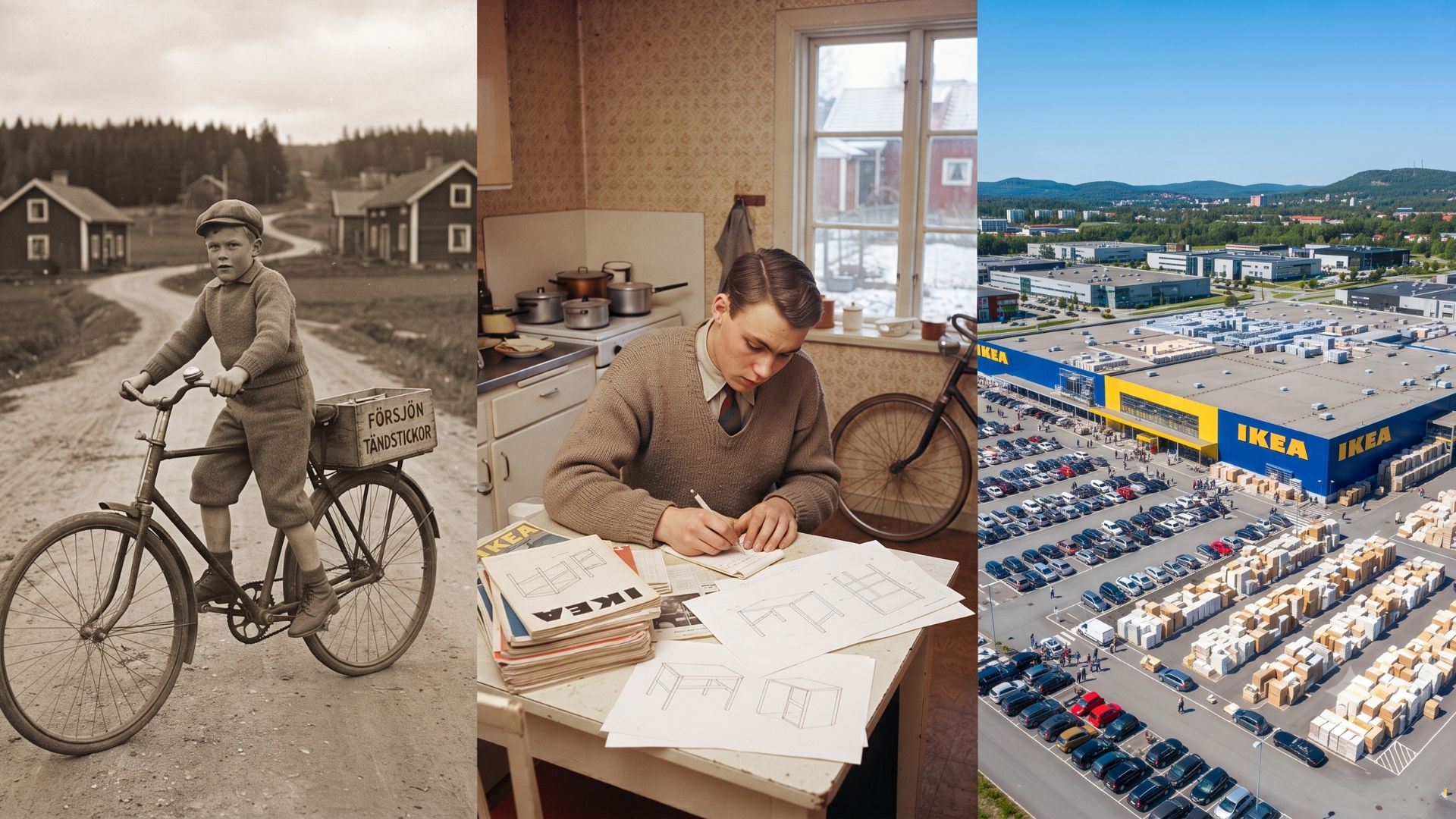

From matchstick seller to founder of IKEA, Ingvar Kamprad created at the age of 17 a global brand of affordable furniture, functional design, and self-assembly.
In 1943, the Swede Feodor Ingvar Kamprad founded IKEA at the age of 17, in a region marked by rocky soil, resource scarcity, and a strong culture of reuse. In the company’s official history, IKEA itself links this origin in Småland to the philosophy of simplicity, low cost, and efficiency that later defined the brand.
Long before selling shelves, sofas, and kitchens to millions of consumers, Kamprad already showed a knack for commerce. According to IKEA’s official page about the founder’s journey, he started as a child traveling through villages selling matches, belts, pens, and other items, an experience that early on shaped his vision on price, margin, scale, and service.
School reward became the capital that gave rise to IKEA in 1943
IKEA itself states that Kamprad received a small amount of money from his father as a reward for good performance in school and used this amount to start his company.
-
The mansion in Flamengo, built in 1865 for the Baron of São Clemente and closed for 20 years, has become a spa, event hall, and gym for “Symphony,” a luxury condominium that sold 70% of its gross development value in the first month on the R$ 60 million land of the former Bennett College.

-
The Ipiranga convent, a 1924 building adjacent to the Museum that remained vacant for a decade and became home to dozens of cats, is reborn as “Alma Mater,” a luxury development worth R$ 130 million with a pool in the courtyard and a clubhouse in the former nuns’ chapel.

-
An empty pool of almost 3 meters turned into tilapia farming in the backyard after a family transformed the dangerous space for children into an urban greenhouse with eggs and organic food.

-
Danger of Technological Hyperstimulation: USP specialists warn that intense use of multiple screens and digital stimuli can gradually reduce essential cognitive abilities, while scientists analyze how technological overload affects memory, concentration, and intellectual performance over the years.



The company was born as a mail-order business for small products, such as pens and wallets, long before entering the furniture sector.


The name IKEA was formed by the initials of Ingvar Kamprad, the farm Elmtaryd, and the nearby village Agunnaryd. This detail became one of the most well-known brands in global retail and still serves as a direct link between the company and the founder’s rural origins.
Furniture entered the catalog in 1948 and changed the course of the company
IKEA did not start as a furniture manufacturer or retailer. According to the company’s official history, the entry into this segment occurred in 1948, when Kamprad began selling tables, chairs, and other pieces, initiating what the company describes as the beginning of the portfolio that would make it famous worldwide.
Shortly after, the brand consolidated the catalog as the main tool for expansion. IKEA notes that the first annual furniture catalog was published in 1950, strengthening the strategy of bringing products to consumers in different regions of Sweden with direct, simple, and visually accessible communication.
First store in Älmhult opened in 1958 and transformed catalog into physical experience
Before the great international expansion, Kamprad tested a decisive step: bringing the consumer physically closer to the products. In 1953, the first showroom was opened in Älmhult, allowing customers to see and experience the furniture before buying it, something that helped strengthen trust and sales.
The major turning point came on October 28, 1958, when the first IKEA store was inaugurated in Älmhult. The company describes this moment as the first step towards the model of large stores that would later spread across dozens of markets.

This movement changed the scale of the business. What began as a lean catalog operation started to gain the structure of physical retail, a permanent showcase, and direct contact with the consumer, expanding IKEA’s ability to test products, prices, and display formats.
Flat-pack furniture and flat boxes helped redefine the industry
One of the most important leaps in IKEA’s history occurred when the company adopted the flat-pack model, with furniture disassembled and packed in flat boxes. In the official history, the company states that this change was adopted in 1953 to tackle high costs and frequent damage during product transportation.

The logic was simple and powerful: reduce logistical space, lower storage costs, and transfer part of the assembly to the consumer. This concept helped reduce costs and became one of the pillars of IKEA’s identity, combining more affordable prices, more efficient transportation, and international scale.
It was also from this search for balance between low price and good quality that the cultural foundation of the company emerged. IKEA itself states that this vision remains alive today and continues to be one of the central foundations of the brand.
Accessible design philosophy transformed IKEA into a global phenomenon
Kamprad argued that well-designed furniture should not be a privilege for a minority. In the company’s institutional material, IKEA presents this vision as part of the mission to create a better everyday life for as many people as possible, combining function, form, quality, sustainability, and low price.
This philosophy helped consolidate a model based on functional design, large-scale production, and extreme cost control. Instead of competing only at the top of the market, IKEA grew by offering accessible and visually appealing home solutions to much broader audiences.
International expansion gained momentum in the 1960s, when the company opened stores in Norway and Denmark, and continued in the following decades with entry into markets outside Scandinavia. This process transformed the Swedish brand into a global powerhouse in the furniture and decoration retail sector.
Decades later, the company founded by a teenager became a global giant
More than 80 years after its founding, IKEA continues to operate on a global scale. In its FY25 report, the company reported 44.6 billion euros in retail sales, 222,000 employees, and 66 new sales locations in the fiscal year, reinforcing the scale achieved by a business that began with a teenager selling small items by catalog.
In another institutional text, IKEA states that today it has more than 500 stores in 63 markets. This data helps to measure the extent of the transformation brought about by Kamprad, who left the rural reality of Småland to create one of the most recognized brands on the planet in the furniture and decoration sector.
The trajectory of Ingvar Kamprad shows how an initial obsession with cost, simplicity, and scale ended up changing the way the world buys furniture. The boy who started reselling matches ended up creating a business model that influenced design, logistics, retail, and consumer behavior across different continents.


