Portuguese
  Spanish


An old forgotten leisure area gained a new function when Dennis and Danielle McClung created an aquaponics system in the backyard, combining fish, chickens, hydroponic beds, rainwater harvesting, and solar energy to produce food year-round.
It turned into food in the backyard.
When Dennis and Danielle McClung bought the family’s first home in 2009, the pool didn’t seem like a luxury. It was empty, deteriorated, and had become an expensive problem to solve.
In a hot city in Arizona, USA, that 9-foot deep hole carried another weight: the couple had young children, aged 2 and 4. The abandoned pool was a risk, expense, and waste of space.
-
Danger of Technological Hyperstimulation: USP specialists warn that intense use of multiple screens and digital stimuli can gradually reduce essential cognitive abilities, while scientists analyze how technological overload affects memory, concentration, and intellectual performance over the years.

-
After three years living in a van, a couple bought an abandoned historic house and had to deal with mold, damaged plumbing, raccoons, and heavy cleaning before moving in.
-
In the city that the market called “road cockroach,” between Balneário Camboriú and Florianópolis, he launched a planned neighborhood worth R$ 1 billion with a marina for 90 boats and sold 80% of the lots in the first phase in 1 week.

-
At a depth of 5,000 meters, where there is no sunlight, researchers found ancient DNA preserved in the mud of the South Atlantic and discovered signs of organisms that did not match known records.




The unlikely decision changed everything. Instead of renovating the pool or burying it, the family transformed the site into an urban greenhouse with aquaponics, capable of producing eggs, tilapia, fruits, vegetables, and herbs year-round.
The deteriorated pool turned into a backyard greenhouse
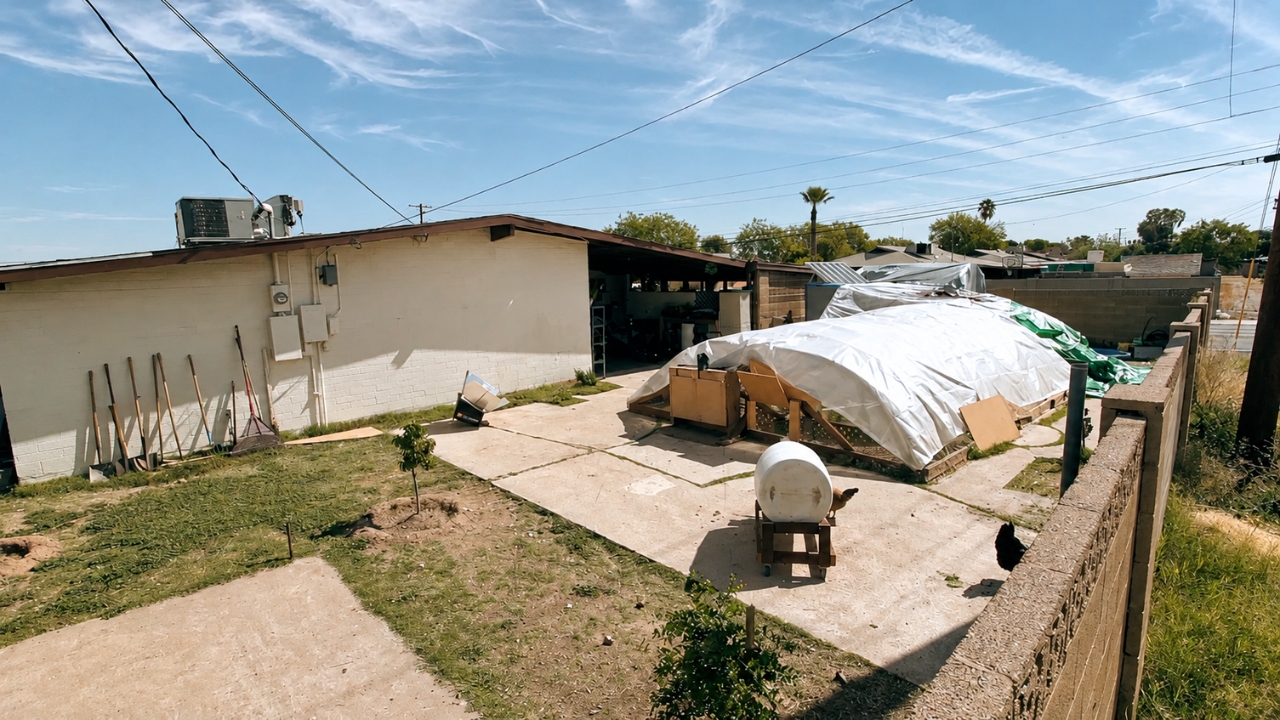
The case happened in Mesa, Arizona, and was reported by Wired, an American magazine specializing in technology and innovation. The pool measured 16 x 30 feet, about 4.9 x 9.1 meters, enough space to house something very different from a common home garden.
What was once a problem turned into the Garden Pool. The structure was covered with plastic and tarp, creating an underground greenhouse adapted to the region’s dry climate.
In the deepest part, a tank for tilapia emerged. Around and above, hydroponic beds, chickens, and cultivation areas appeared. The old pool stopped requiring maintenance and started providing food.
Tilapia, chickens, and plants entered the same cycle
The central idea was to use aquaponics, a system that combines fish farming and plant cultivation. The nutrient-rich water from the tank fed the plants. After passing through the beds, it returned to the system.
The project also used duckweed, known as water lentil, and coconut fiber as a growing medium. Among the cultivated foods were wheat, sweet potatoes, broccoli, and sorghum.
The chickens completed the routine with fresh eggs. According to ABC News, the family reported a production of about 8 eggs per day, in addition to tilapia and organic foods grown in the backyard.
The system also included solar panels to power the pump and rainwater harvesting to help supply the tank. Reports on the project indicated that the structure operated with about one-tenth of the water used by traditional agriculture.
The economy appeared along with the food
The change was not just in the curious image of an empty pool transformed into an urban farm. ABC News reported that the system helped reduce the family’s grocery bill by at least 75%.
This number strengthens the case but requires caution. Other subsequent publications mentioned a reduction of about half. The safest point is that the pool started to provide an important part of the family’s food and reduced dependence on external purchases.
Dennis was not a professional farmer. The experience came from previous jobs, internet research, and many tests. Danielle had grown up on a small farm in Ohio. The project was born from a practical attempt to solve a real problem.
The backyard turned into a project with volunteers in various countries


What started as a domestic response took on another dimension. In 2012, the Garden Pool was transformed into a non-profit organization. According to Microsoft News, the project began offering workshops, seed libraries, solar water sterilization, and actions related to resilient agriculture.
Years later, the initiative already gathered about 20 employees, more than 1,600 volunteers, and projects in approximately 40 countries.
Dennis and Danielle’s pool did not just become a sustainable curiosity. It showed how an abandoned space, seen as a cost and danger, can be reorganized to address larger issues: food, water, energy, urban reuse, and domestic autonomy.