Portuguese
  Spanish


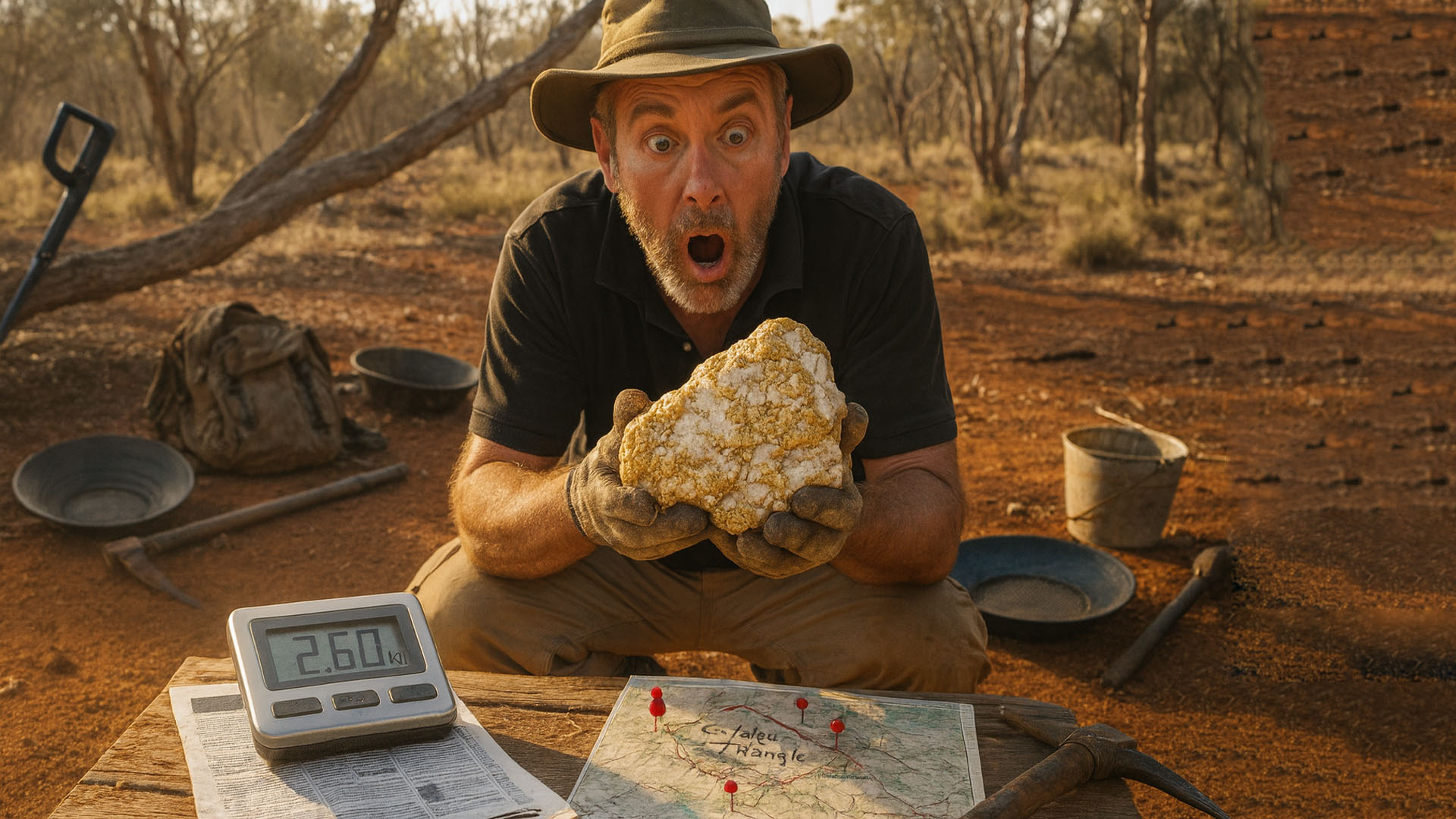


Find Occurred Between Bendigo, Ballarat, and St Arnaud, Historical Gold Region in Victoria. Evaluation Was Done by Specialized Store in Geelong.
An amateur prospector found a 2.6 kg nugget in the so-called “Golden Triangle” of Victoria, in southeastern Australia. The piece was valued at A$ 240,000 by a local gold buying and selling company. The discovery, revealed in March 2023, returned to the spotlight for keeping the recreational gold search alive and raising discussions about the costs and rules of the hobby.
According to ABC News (Australia), the find was a 4.6 kg rock with 2.6 kg of gold embedded in it, extracted from an area between Bendigo, Ballarat, and St Arnaud, hotspots of the 19th century Victorian gold rush. The material was taken for evaluation in Geelong and surprised the appraisers with its weight and gold content.
ABC News (U.S.) detailed that the man was using a detector model Minelab Equinox 800, popular among amateurs, and that the estimated value in U.S. dollars at the time was around US$ 160,000. In such cases, large nuggets tend to receive a premium over the market price due to their rarity.
-
Orphaned Youth Turns Dismissed Idea into Global Prestige with Innovative Wristwatch

-
English Skills Boost Career Opportunities in the Oil and Gas Industry

-
Brazil Secures Second Place at WorldSkills 2024 in Lyon, with 64 Young Professionals and 8 Medals, Including Gold from a Rio de Janeiro Hairdresser

-
3,000 Military Personnel from 10 Countries, Including US and Chinese Marines, Train Together in Brazil’s Savanna: Operation Formosa Becomes Largest Naval Ground Exercise Before First Cancellation Since 1988



Beyond curiosity, the episode rekindles interest in recreational prospecting in Victoria, a state that maintains specific licenses and often publishes safety and access guidelines for public and private lands.
Where Was the Find and How Much Is It Worth: “Golden Triangle” and Evaluation
The Golden Triangle is the gold belt that connects Bendigo, Ballarat, and St Arnaud. The region is known for producing large and high-purity nuggets since the 19th century, and still holds potential, according to the local geological agency. This tradition helps explain why detectorists remain active in the area.
The valuation of A$ 240,000 was conducted by Lucky Strike Gold, in Geelong. Appraisers reported that the piece, initially covered by quartz matrix, was split in two before analysis, revealing that the gold permeated the rock throughout. In terms of international reference, this amount was equivalent to about US$ 160,000 during the same timeframe. Large nuggets can achieve prices above the metal value due to collector interest.
At the time of the discovery, ABC Australia also highlighted the level of gold price per troy ounce in the local market and cited state government estimates regarding the remaining potential in the Victoria mines, indicating that even after 170 years, the region can still yield sporadic finds.
How an Amateur Prospector Found the Nugget
According to ABC News (U.S.), the prospector was sweeping an area of bush when the Minelab Equinox 800 detector signaled with unusual strength. He collected the rock, put it in his backpack, and took it for specialized evaluation, a procedure recommended to accurately identify content and value. Proper equipment and knowledge of the terrain are factors that increase the chances of success.
ABC (Australia) emphasized that, although the region receives hundreds of amateurs, finding a nugget of this size is rare and depends on luck, reading geological maps, and patience. Local prospector associations report that most daily finds are in grams, not kilograms.
For those looking to test the hobby in Australia, it is essential to respect local legislation, obtain licenses, and check the access limits to private properties, parks, and environmentally sensitive areas. Good practices prevent conflicts and preserve heritage.
Do you think governments should raise the prospecting license fee to reduce environmental impact and curb abuses, or do affordable fees encourage tourism and responsible finds like this one? Comment below on which model better balances preservation and recreational activity.