






 Portuguese
  Spanish


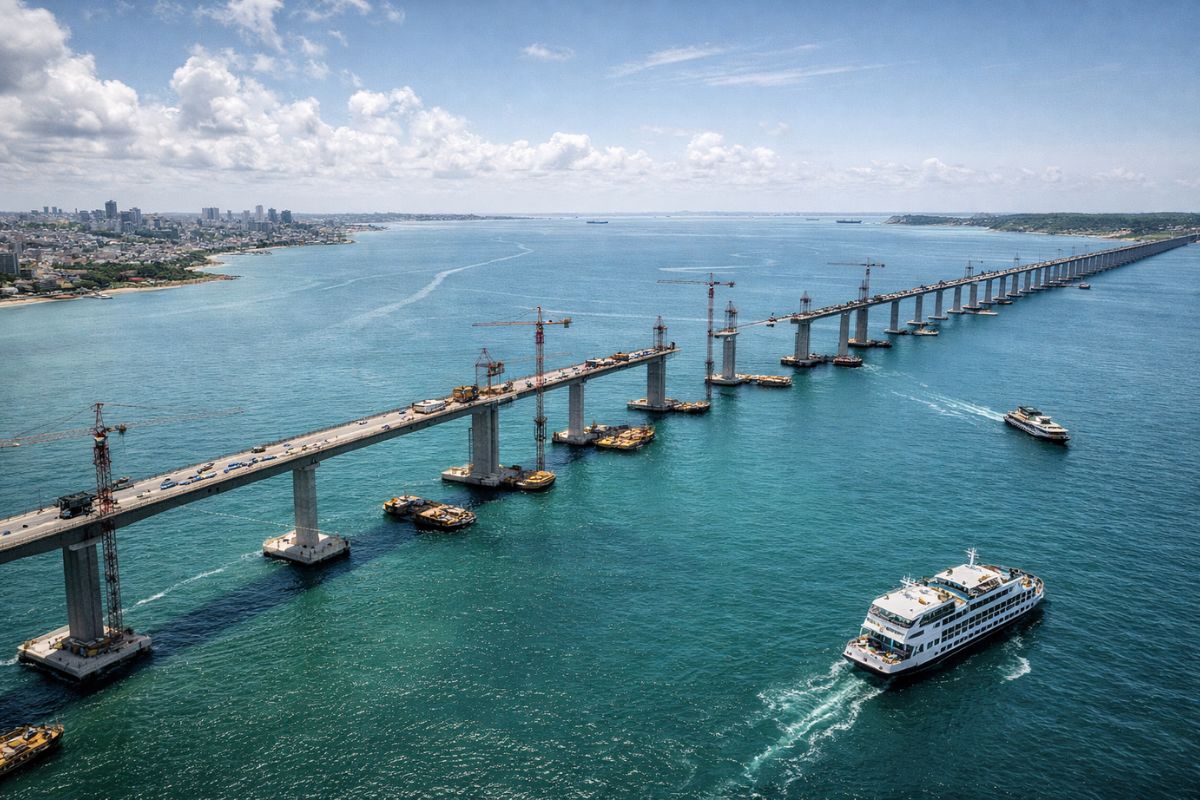


With 12.4 km over the sea and R$ 11 billion in investment, the Salvador-Itaparica Bridge will be the largest bridge in Latin America, a symbol of the Brazil–China partnership in Brazilian infrastructure and the future replacement of the ferry-boat between Salvador and Itaparica.
As a result of a partnership between the Bahia government, Brazil, and Chinese giants in heavy construction, the Salvador-Itaparica Bridge will be the largest bridge in Latin America, with 12.4 km over the sea and an investment of R$ 11 billion, definitively connecting the capital to the Island of Itaparica and opening a new front for development in the state.
With construction scheduled to begin in June 2026 and a promised delivery by 2031, the Salvador-Itaparica Bridge is being conceived as a strategic infrastructure project, designed to replace the ferry-boat system, shorten distances, unlock tourism, and profoundly change the logistics of people and goods in Bahia. More than just a road connection, it is treated as a symbol of the Brazil–China rapprochement in large-scale projects.
How the Salvador-Itaparica Bridge Will Be
According to the project, the Salvador-Itaparica Bridge will have a length of 12.4 kilometers over the sea, which will give it the title of the largest bridge in Latin America when completed.
-
France Revamps 530 Social Housing Units with Large Balconies and Glass Facades Without Demolishing Existing Buildings

-
Facing high rent, couple transforms parents’ garage into a fully functional apartment, creating a complete home at a fraction of the market cost.

-
MIT Scientists Develop Method to Transform CO₂ into a Construction Ally, Boosting Cement Strength by 13% in 24 Hours for More Sustainable Infrastructure
-
Canadian City Builds 8 Tiny Homes in 72 Hours for Homeless Youth, Plans 40 Affordable Houses for Female-Led Families Amid Housing Crisis


The structure will surpass international references such as the Vasco da Gama Bridge in Portugal and will join the select group of megastructures that combine large spans, depth, and a challenging maritime environment.
The design outlines three main fronts. In the central stretch, the Salvador-Itaparica Bridge will be cable-stayed, with a span of 900 meters and a clearance height of 85 meters, equivalent to a building of about 28 floors.
This elevation is crucial to allow the passage of large oil tankers and transatlantic ships without compromising navigational safety.
On the roadway aspect, the Salvador-Itaparica Bridge will have dual lanes and two traffic lanes in each direction, in addition to a third lane initially dedicated to the shoulder, creating room for future adaptations, such as reversible lanes or exclusive corridors, without the need for significant structural changes.
The land connections are also part of the package. The project envisions about 4.6 km of accesses on the Itaparica side and 6.9 km on the Salvador side, integrating the Salvador-Itaparica Bridge with the existing road network and redesigning the entry and exit flows of the Bahia capital.
It is not just an isolated bridge but a complete corridor, articulated with the surrounding infrastructure.
Replacement of the Ferry-Boat and Impact on Mobility
Today, those who depend on the transit between Salvador and Itaparica rely on the ferry-boat as the main link. The system has served its purpose for decades but faces capacity limitations, queues, varying schedules, and direct interference from weather conditions.
The arrival of the Salvador-Itaparica Bridge promises to change this scenario by offering a permanent, predictable, and continuous link between the two shores.
With the Salvador-Itaparica Bridge operating from 2031, the trend is that the ferry-boat will lose its prominence and become complementary or residual, rather than the central axis of the crossing.
Drivers who today need to schedule trips based on boarding and disembarking times will simply be able to cross the bay by land, with greater control over travel times and alternative routes.
This new dynamic is expected to directly reflect in the daily lives of those who work, study, or provide services between Salvador and the Recôncavo/low south.
By shortening the path and reducing transport bottlenecks, the Salvador-Itaparica Bridge is likely to bring labor markets, service networks, and business opportunities closer that currently still depend on a slow crossing conditioned to the sea.
Brazil–China Partnership and Economic Weight of the Project
One of the central aspects of the Salvador-Itaparica Bridge is the institutional arrangement that makes the project feasible. The endeavor involves the Bahia government, the federal government, and a consortium led by two Chinese construction and infrastructure giants, CCECC and CCCC, with an estimated investment of R$ 11 billion.
This format consolidates the Salvador-Itaparica Bridge as a showcase for Brazil–China cooperation in strategic infrastructure.
After the 3rd Bahia–China Forum held in November 2025, the project gained political and financial momentum, transitioning from a mere plan to a defined schedule, with construction scheduled to begin in June 2026.
In practice, the bridge becomes a calling card for Chinese engineering in the country and a laboratory for Brazil’s capacity to attract capital and technology for large projects.
For the Bahia economy, the expectation is for a cycle of impact in stages. First, in the construction phase, with the generation of direct and indirect jobs, demand for supplies, specialized services, and mobilization of the infrastructure supply chain.
Then, in the operational phase, with the Salvador-Itaparica Bridge reducing logistical costs, bringing productive zones closer to the port of Salvador, and strengthening tourism and commercial hubs that currently cannot fully explore their potential due to accessibility difficulties.
What Changes for Bahia with the New Link
The Salvador-Itaparica Bridge is not merely a geographic shortcut, but a structural change in the way Bahia organizes itself around its capital and coast.
Territories that once depended almost exclusively on maritime transport are likely to gain new road centers.
Regions currently considered “end of the line” may transform into corridors of passage and investment starting from the direct connection created by the Salvador-Itaparica Bridge.
From a symbolic perspective, the project repositioned the state on the map of Brazilian infrastructure, placing Bahia at the center of one of the largest engineering enterprises on the continent.
At the same time, it reinforces the country’s image as a relevant partner in global projects with China, especially in works that combine high technical complexity and significant regional impact.
By 2031, the bridge remains in the planning stage and preparation to break ground. But the layout, engineering, and investment already indicate a scenario in which the Salvador–Itaparica crossing will cease to be synonymous with waiting at the ferry terminal and will become just another car trip on the Bahia road network.
And you, do you believe that the Salvador-Itaparica Bridge will deliver all the promised transformation and really retire the ferry-boat as the main link between Salvador and the Island of Itaparica?





I’ve taken the rusty old ferries and queued for hours just to get on and off the island. That’s exactly why I’m ready for this to happen. A real estate boom is already underway, and it will transform the island’s economy. Big infrastructure projects take time, but too many people expect them to be finished overnight.
Uma ponte de concreto que vai custar mais de 140 ferrys novos bo meio de uma das baías mais linda do mundo. Coisa de sindicalista mesmo
Uma ponte de concreto em uma da mais bela baía do mundo. Coisa brega, só sindicalista para fazer uma **** dessa.