






 Portuguese
  Spanish
  4 min of reading
  0 comments


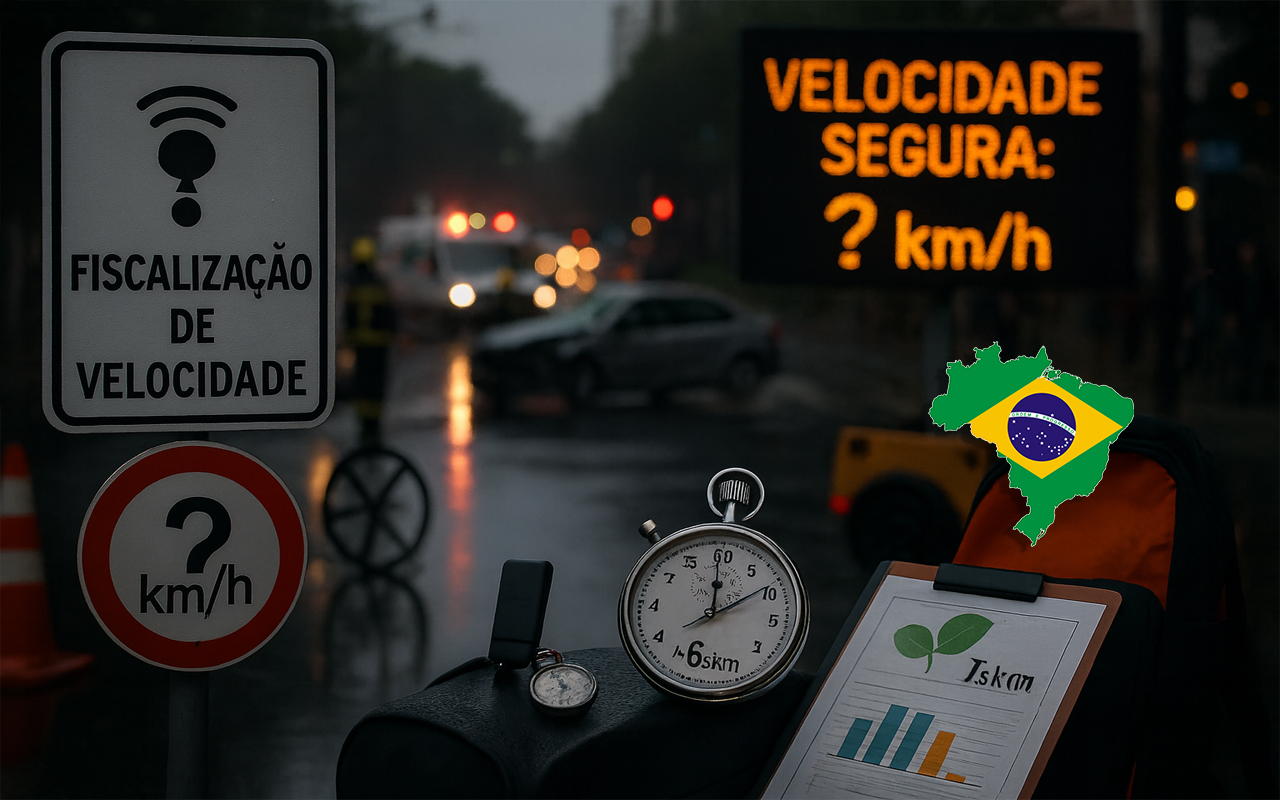
Public Consultation Reviewed the Speed Management Guide in the Urban Context. Central Proposal: Standardize Lower Limits in Urban Areas to Reduce Deaths Without Significantly Increasing Travel Time.
Last week, the Ministry of Transport concluded a public consultation to update the Speed Management Guide, a technical document that guides how the Union, states, and municipalities can define urban speed limits aligned with road safety. Senatran states that the review aims to save lives with speed management based on evidence. According to the official government page, the consultation was opened on July 22, 2025, and closed on August 21, 2025.
At the center of the debate is the adoption of lower limits on roads with high pedestrian and cyclist traffic and the harmonization of speeds by road type (local, collector, arterial, and expressways). The text of the guide, available in PDF, compiles national and international studies, as well as Brazilian cases.
The review does not change the law automatically, but serves as a technical reference and can underpin future regulatory measures from Contran. Meanwhile, the limits set by the CTB continue to apply when there is no specific signage.
-
Uber Faces Shareholder Scrutiny as Board Accused of Ignoring Safety, Compliance, and Harassment Warnings Amid Over 3,500 U.S. Lawsuits

-
Ferrari’s First Electric Car Divides Fans, Priced at $630,000, Amid Concerns Over Limited Editions; Brand Clarifies It’s Not Just for Future Perks
-
BYD Dolphin Mini: The Electric Car That Defies Depreciation, Losing Only 3.58% in a Year and Becoming the Best-Selling Retail Model Under $22,000

-
Electric Car JAC E-JS4 Loses $19,000 in Value in One Year, Leading Record Depreciation of Used Cars in Brazil Due to Expensive Battery and New Models


What the Government is Studying to Change Maximum Speeds on Urban Roads
The proposal assesses speed standards by road function and urban context, focusing on reducing accidents and pedestrian injuries. The federal guide integrates the Collection of Good Practices and was constructed within the scope of the Pnatrans (National Plan for Reducing Deaths and Injuries in Traffic).
In the consultation, there were suggestions such as dynamic limits (real-time adjustments by electronic panels) and the creation of a national accident map to guide local decisions. The discussion was reported by the specialized press on September 1st, detailing that the government sees minimal delay in travel against a backdrop of significant safety gains.
Why Talk About 30 Km/h?
The World Health Organization recommends 30 km/h where there is a mix of pedestrians, cyclists, and vehicles, as a strategy for safer, healthier, and more livable cities. The campaign “Streets for Life” summarizes the logic, slow streets save lives.
The PAHO/WWHO also emphasizes that excessive speed accounts for about one third of traffic deaths in high-income countries, rising to half in low and middle-income countries, a warning that resonates with the Brazilian context of vulnerability for non-motorized users.
On a technical level, the World Bank/GRSF consolidated a Safe Speeds guide in 2024, reinforcing that the limit should reflect risk, road design, and the presence of vulnerable users, within the Safe System approach.
Evidence in Brazil, Fortaleza Shows Little Delay and Great Safety Gains
In Fortaleza (CE), the AMC analyzed six arterial roads that had their maximum speed reduced from 60 to 50 km/h. The travel time increased by only 6.08 seconds per kilometer, a result based on pre/post-enforcement data. In other words, minimal delay.
The capital of Ceará had already recorded a 63% reduction in pedestrian injuries and a 54% decrease in victim accidents after speed readjustment accompanied by other interventions on Avenue Leste-Oeste. Lower speed, fewer injuries.
There is also an environmental benefit, the Speed Management Guide (2025) cites a case study on Avenue Jovita Feitosa showing a significant 7% reduction in CO₂ emissions during freer traffic periods after reducing speed from 60→50 km/h, a result associated with less aggressive driving and reduced speed variability.
Travel Time and the “Myth of Delay”
According to a report published on September 1st, GPS data from volunteers in Curitiba (PR) indicated that exceeding the limit saved only ~3 seconds per kilometer. The practical advantage is minimal compared to the added risk.
Academic studies with naturalistic data in the capital of Paraná follow the same direction; a recent study estimated an average savings of 7.81 s/km when exceeding the limit, yet still, a few seconds per kilometer. You gain little time, greatly increasing the risk.
WHO manuals on speed management remind us that the severity of a pedestrian injury increases sharply with impact speed, which is why 30–50 km/h in densely populated urban areas are considered safe limits from a biomechanical perspective.
What Currently Applies in the CTB and Who Can Change the Limits
When there is no signage, the CTB (art. 61) sets standard urban limits: 80 km/h (expressways), 60 km/h (arterial roads), 40 km/h (collector roads), and 30 km/h (local roads). On highways, the limits vary depending on double/single lane and vehicle type (with more recent adjustments by Law 14.440/2022). These rules remain valid.
The review of the Speed Management Guide does not directly alter the CTB; it guides decisions and may underpin resolutions from Contran. According to the Constitution (art. 22, XI), it is the exclusive competence of the Union to legislate on traffic and transport — the basis for any potential national regulatory changes.
In parallel, municipalities can signal different limits based on technical characteristics and traffic conditions, as long as they are backed by studies and current regulations.
The government promises to analyze the contributions gathered between 07/22 and 08/21/2025 and, if necessary, publish updates to the guide. Transparency and technical basis are expected to accelerate the local adoption of 30–50 km/h where it makes sense, especially in areas with pedestrians and cyclists.





Be the first to react!