






 Portuguese
  Spanish


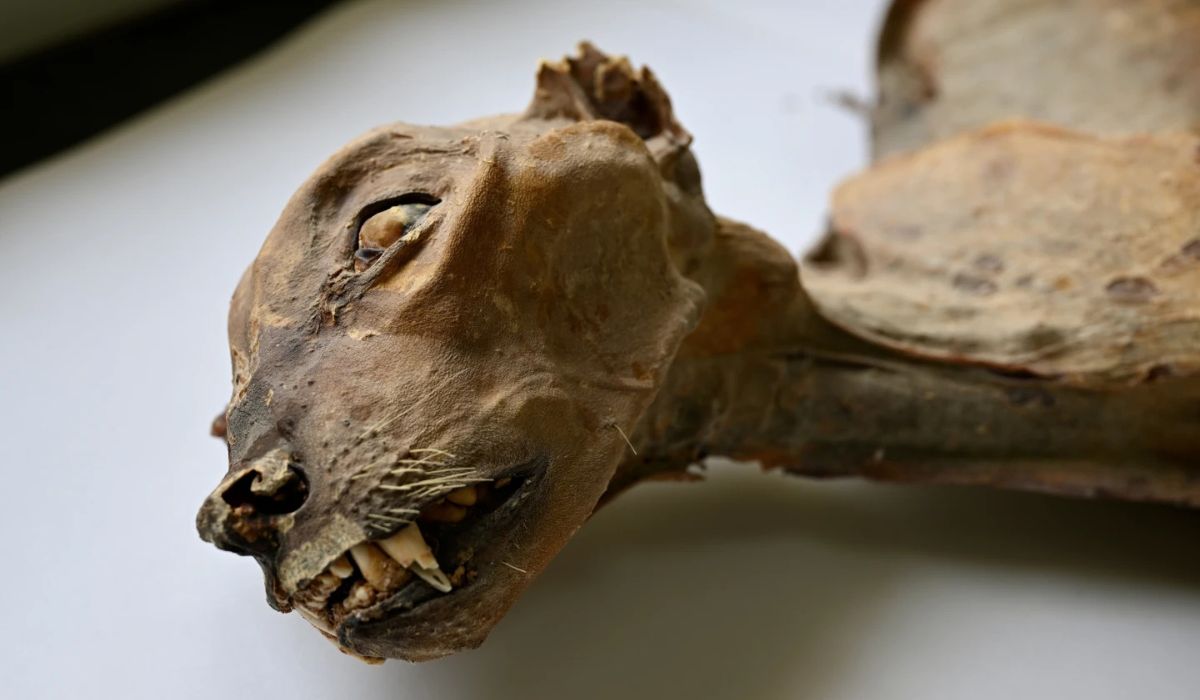


Preserved Remains Of Big Cats Have Been Located In Caves In Northern Saudi Arabia And Help Reconstruct The Historical Presence Of The Species In The Region, Now Absent From The Local Fauna, As Well As Raise New Scientific Questions About Conservation And Environmental Past.
Researchers identified, in caves in northern Saudi Arabia, preserved remains of cheetahs in an unusual state, including seven individuals with partially preserved tissues and bones attributed to another 54 animals.
According to the portal AP News, the material was located in a set of caves in the Arar region, near the border with Iraq, and provides new data on the historical presence of the species in an area where it has not been recorded for decades.
According to the study, the excavations took place in underground caves distributed over a large area of the Saudi desert.
-
A Brazilian city dredged sand from the seabed, extended 2 km of the Beira-Mar, and created a new 80-meter landfill on one of the most famous coastlines in Brazil; years later, what seemed like a bold project turned into an expanded boardwalk, bike path, standardized kiosks, and a new leisure hub in the state.

-
Friends turn paper into ‘bubble wrap’ without plastic to protect products inside cardboard boxes, win an innovation award in the UK, and join a 13 million euro European project to bring the packaging to industrial scale.
-
Mechanics remove the engine from a used Fiat Fiorino, install an electric kit with WEG and FuelTech, place batteries in the cargo area, and prepare the van to run 100 km per day in Brazil.
-
Old fridge turns to gold: project transforms rigid foam from discarded refrigerators into raw material for new plastics and paves the way to also recycle building insulation, in an ambitious and surprising initiative against one of the most difficult industrial wastes to reuse.


The analyses were conducted by researchers linked to the National Center for Wildlife of Saudi Arabia, who investigated over a hundred caves during two years of fieldwork.
Findings In Northern Saudi Caves

During inspections, scientists found carcasses with varying levels of preservation, from isolated bones to bodies with dried tissues still adhered.
In some cases, the remains exhibited cloudy eyes and contracted limbs, characteristics consistent with natural mummification processes described in the scientific literature.
According to the authors of the study, the set of findings includes individuals of different ages, suggesting that the caves were used over time by more than one generation of cheetahs.
However, the work emphasizes that it is not possible to determine, with the available data, whether the site had a specific function, such as a recurring shelter or breeding area.
Paleontologist Joan Madurell-Malapeira, from the University of Florence, who did not participate in the research, stated in an interview: “It’s something that I’ve never seen before”.
The statement was made in response to the images and descriptions presented by the authors of the study.
Environmental Conditions And Preservation
Mummification is defined as the preservation of bodies by interruption or strong slowdown of the decomposition process.
Although it is best known for historical examples associated with ancient Egypt, scientific literature describes natural occurrences in specific contexts, such as glacial regions, desert areas, and environments with little thermal variation.
In the case of the Saudi caves, researchers indicate that the dry climate and the relative stability of temperature and humidity inside the cavities may have contributed to the preservation of tissues.
Still, the study makes it clear that there are not enough elements to point to a single mechanism responsible for the process.
In addition to the environment, preservation also depends on factors such as the absence of scavengers and the rapid dehydration of the body after death.
According to specialists cited in the research, these conditions are rare in large mammals, which explains the scarcity of similar findings.
Dating And Age Discrepancies
The age estimates of the remains vary according to the source analyzed.
Reports based on the study mention a range from about 130 years to over 1,800 years for part of the material found.
Meanwhile, the scientific article published in the journal Communications Earth & Environment presents radiocarbon dating results that indicate a broader range.
According to calibrated data, some samples are estimated to be between approximately 127 years and over 4,200 years before present.
The authors highlight that these differences reflect both the limited set of dated samples and the use of distinct methodologies throughout the analysis.
The study does not claim that all individuals found belong to the same historical period.
Why Are There So Many Cheetahs In The Same Location
One of the main questions raised by the work concerns the unusual concentration of cheetah remains in the same cave system.
So far, researchers state that there is no conclusive evidence explaining this accumulation.
Among the hypotheses considered is the possibility that the caves served as a temporary shelter or puppy rearing area, a practice known in some felines.
This interpretation, however, is presented as a possibility rather than a conclusion by the authors of the study.
Analyses of skulls and bones allowed for the identification of adult, subadult, and puppy individuals among the remains.
Still, the researchers themselves emphasize that this data alone does not clarify the reason for the recurring presence of the animals in the location.
Ancient DNA And Scientific Implications
In addition to physical preservation, part of the material enabled DNA extraction and analysis, something uncommon in cases of natural mummification of big cats.
According to the study, the genetic profiles obtained indicate affinities with modern populations of cheetahs from Asia and Northwest Africa.
The authors explain that the most recent specimens analyzed are genetically close to the Asiatic cheetah.
Meanwhile, older individuals show a greater similarity to African populations.
These results are described as relevant for reconstructing the population history of the species in the region.
According to the researchers, such information may contribute, in the future, to discussions about conservation and possible reintroduction programs.
The study, however, does not propose practical actions nor establish deadlines or concrete plans in that regard.
Regional Disappearance And Current Context
Historical records and zoological studies indicate that cheetahs once occupied a vast area of Africa and Asia.
Currently, the species lives in a reduced fraction of its original distribution, estimated by specialists at around 9% of the historical area.
In the Arabian Peninsula, there have been no confirmed records of cheetahs in the wild for several decades.
Previous research associates this disappearance with factors such as habitat loss, hunting pressure, and decreased prey.
For Ahmed Al Boug, a researcher at the National Center for Wildlife of Saudi Arabia and author of the study, the discovery of remains so well preserved in that part of the world is “entirely without precedent.”
The assessment was made in communication via email to journalists.


