






 Portuguese
  Spanish
  7 min of reading
  0 comments


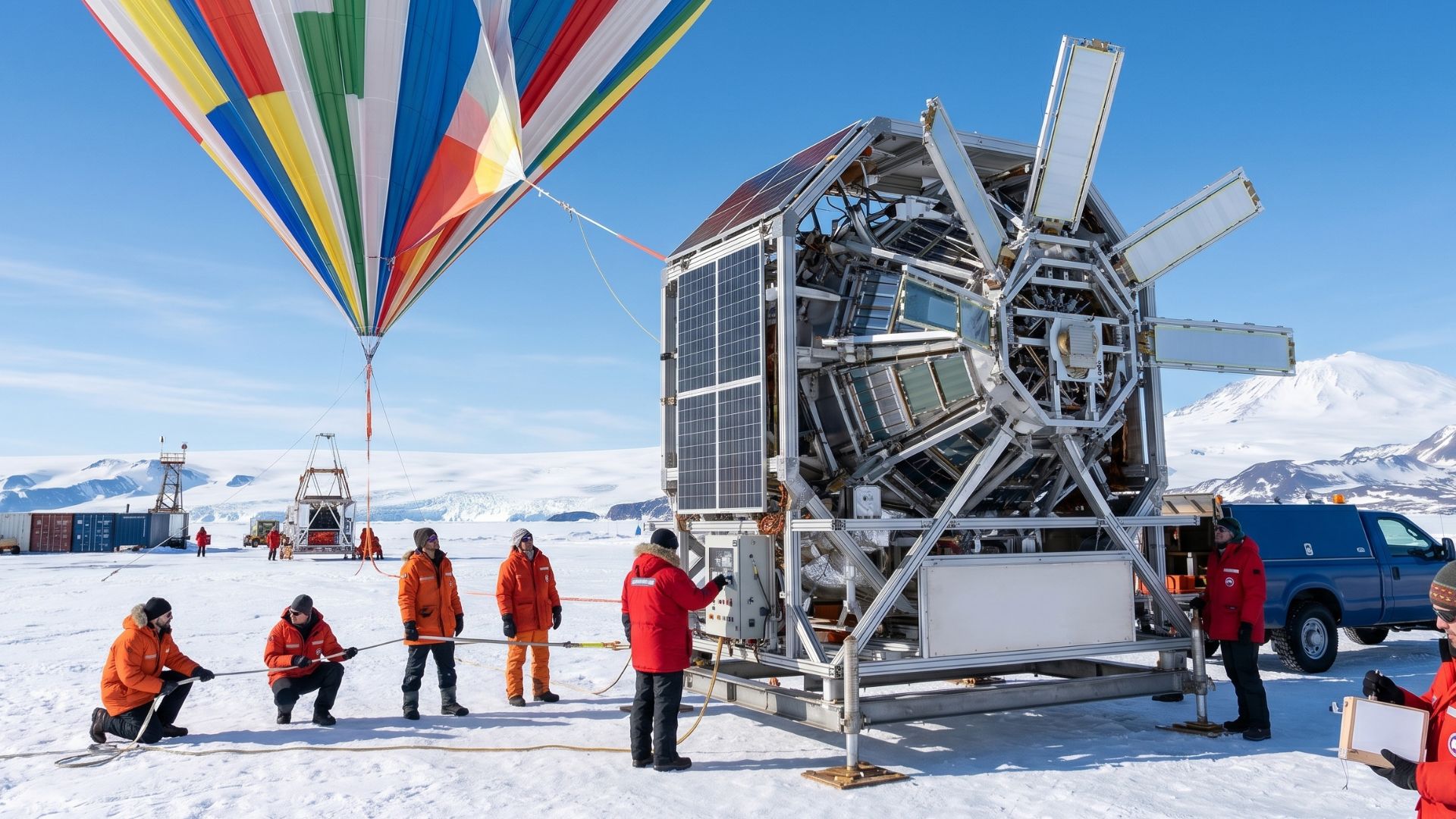
GAPS Experiment in Antarctica collects 16 TB of cosmic antimatter data and may reveal the first direct signature of dark matter.
According to the UCLA Division of Physical Sciences, the GAPS experiment, acronym for General AntiParticle Spectrometer, landed on the Ross Ice Shelf, 100 km from McMurdo Station, on January 10, 2026, after 25 days flying two complete circles around Antarctica in the stratospheric polar vortex. The balloon carrying the instrument was the size of an American football field, while the detector suspended below it was the size of a house.
The instrument was launched on December 16, 2025 from the NASA Long Duration Balloon base at McMurdo Station and reached a cruising altitude of 37 kilometers, above 99% of Earth’s atmosphere, where cosmic antimatter arrives without being destroyed by collisions with air molecules. During the flight, part of the data was transmitted via satellite, but the majority, 16 terabytes of raw readings, was stored in the equipment’s own memory system for later retrieval.
Cosmic antimatter and dark matter: why the GAPS experiment looks for this signature
Cosmic antimatter is the mirror of common matter. Each particle has an antiparticle with the same mass and opposite charge.
-
Brazilian family creates machine that transforms seawater into fresh water, produces up to 130 liters per hour, facilitates routine on vessels, and boosts family business along the country’s coast.

-
A doctor from Minas Gerais warns that sleeping with the fan pointed at the body all night is not as harmless as you think; it dries out the respiratory tract, causes mucus buildup, spreads dust mites, and can even irritate the cornea of the eyes.

-
Ecuadorian volcano at 6,268 meters is more than 2,000 meters closer to space than Everest, which is 8,848 meters, because the Earth is wider at the equator.
-
Public school students in the hinterlands of Maranhão create a bioinsecticide with neem and castor to protect corn crops, transform rural waste into biogas and biofertilizer, and bring sustainable technology to producers at ExpoSertão.




The electron has the positron, the proton has the antiproton, and the deuterium nucleus has the antideuterium. When particle and antiparticle meet, they annihilate each other and convert mass into energy.


The observable universe is composed almost entirely of common matter. The natural antimatter present in space is produced by known processes, such as collisions of high-energy cosmic rays with interstellar gas. These processes generate antimatter in energy ranges predicted by already established particle physics models.
The problem is that dark matter may produce antimatter differently. Since it does not emit, absorb, or reflect light, its presence can only be inferred by gravitational effects.
If there is production of low-energy antideuterons in quantities above expected, the signal may indicate a new physical process and a possible direct signature of dark matter.
Dark matter, WIMPs, and low-energy antideuterons: the range of interest to GAPS
If dark matter is composed of particles called WIMPs, two of these particles can collide, annihilate, and produce, among other products, low-energy antideuterons.
The decisive signature is precisely in the energy of these particles, and this is the central point of the search conducted by the GAPS experiment in Antarctica.

The antideuterons produced by dark matter should have kinetic energy below 0.25 GeV/n, a range where conventional cosmic ray collision processes produce much smaller quantities.
This makes this region of the spectrum especially valuable for those trying to distinguish a common signal from a possible indication of new physics.
Detecting a single antideuteron with the right energy in this range would already have enormous scientific relevance. This is because conventional physics finds it difficult to explain this type of event without resorting to a new source. In this scenario, dark matter would no longer be just inferred by gravity and would have a measurable physical signature.
How the GAPS experiment detects antimatter with the exotic atom technique
The GAPS does not use the conventional method of antimatter detection. Previous large detectors work with magnetic spectrometers, which use intense magnetic fields to curve the trajectory of particles. From this curvature, scientists infer charge and momentum.
For very low-energy antinuclei, like the antideuterons sought by GAPS, this method loses efficiency.
A very intense magnetic field and a much heavier instrument would be necessary, which would make the mission unfeasible on a stratospheric balloon platform. Therefore, the project had to follow a different technological path.

The experiment uses the exotic atom technique. When an antideuteron enters the detector, it slows down and replaces an orbital electron of an atom in the detector material. A temporary exotic atom is then formed.
Next, the antideuteron falls to more internal orbital levels, emitting characteristic X-rays, and then annihilates in the nucleus of the host atom, producing a shower of pions that the detector records.
GAPS Flight in Antarctica: 25 days in the polar vortex at minus 35°C
The reason GAPS flies over Antarctica is due to the stratospheric polar vortex, a stream of circular winds that rotates around the South Pole between 15 and 45 km altitude during the austral summer, between December and February. This atmospheric system creates a natural loop that keeps the balloon circulating around the continent.
During the flight, the experiment completed two full laps around Antarctica in 25 days, covering tens of thousands of kilometers.
The altitude of 37 km placed the instrument above more than 99% of Earth’s atmospheric mass, which is essential because low-energy antimatter would be destroyed if the detector flew in denser atmospheric layers.

The temperature in the detector remained around minus 35°C, an important condition to keep the 160 silicon detectors operational.
This thermal control was ensured by a multiphase heat transfer capillary tube system, without a pump, specifically developed for this high-altitude scientific mission.
16 terabytes of data on antimatter and what GAPS analysis can reveal
The most concrete data already released about the flight’s result is the volume of information collected. GAPS stored 16 terabytes of raw data during the 25 days of the mission. This material will require months of analysis before any definitive scientific results are published.
To size the volume, 16 terabytes is equivalent to about 16 million high-resolution photos or approximately 8,000 hours of HD video. Each recorded event, each detected particle, each emitted X-ray, and each pion generated by annihilation needs to be individually reconstructed from the readings of the silicon detectors and scintillators.
The team will have to determine if each event is compatible with the signature of an antideuteron, an antiproton, or even an antihelium, in addition to separating real signals from background noise. This noise mainly includes cosmic ray protons, which are billions of times more abundant than any antimatter nucleus.
Antiprotons, antideuterons, and the chance of finding a direct dark matter signature
GAPS was designed to detect about 500 cosmic antiprotons per flight, enough to produce the most precise energy spectrum ever measured for low-energy antiprotons. These antiprotons will be essential to validate the instrument’s operation before the team advances to the search for the much rarer antideuterons.
If no antideuteron is found, the result will still have enormous scientific value. In this case, researchers could establish an upper limit for the amount of dark matter compatible with the properties predicted by WIMP models, constraining hypotheses and refining theoretical physics.
But if one or more antideuterons are found in the expected energy range, the impact will be much greater. This would mean the first observation of a type of antimatter that conventional physics cannot produce in compatible quantity, paving the way for the first direct dark matter signature.
Why Antarctica was chosen instead of the International Space Station
The most obvious comparison is with the International Space Station. After all, if the goal is to capture antimatter before it collides with the atmosphere, it seems natural to imagine a detector in orbit. But the answer mainly involves cost and instrument mass.
The AMS-02, the largest cosmic ray detector ever sent to space and installed on the ISS in 2011, cost about US$ 2 billion and weighs 8.5 tons.

The GAPS project costs are in the tens of millions of dollars, a difference of two orders of magnitude, making the mission much more accessible for universities and national agencies.
The balloon at 37 km does not offer the same conditions as space, because there is still residual atmosphere that can slightly degrade low-energy measurements. Even so, the environment is sufficiently favorable, as less than 1% of the atmospheric mass remains above the instrument. This makes Antarctica a technically efficient and economically viable solution.
Upcoming GAPS flights and what the data can show about dark matter
The team of the GAPS experiment plans to conduct at least two more Antarctic flights after this first mission.
Each new flight means more data, more statistics, and more sensitivity to identify extremely rare events in the low-energy spectrum of cosmic antimatter.
The first flight, with its 16 terabytes of data, its 25 days in the polar vortex, and its operation at 37 km altitude, represents just the beginning of the project. The scientific value of this initial stage lies precisely in opening an observation range that no other instrument had explored with this type of approach.
Now, everything depends on the analysis. If the data reveal only antiprotons and known background, GAPS will have already produced an unprecedented measurement.
But, if the right signal appears at the right point in the spectrum, the experiment may deliver something physics has sought for decades: an observable and direct evidence of dark matter.


Be the first to react!