






 Portuguese
  Spanish


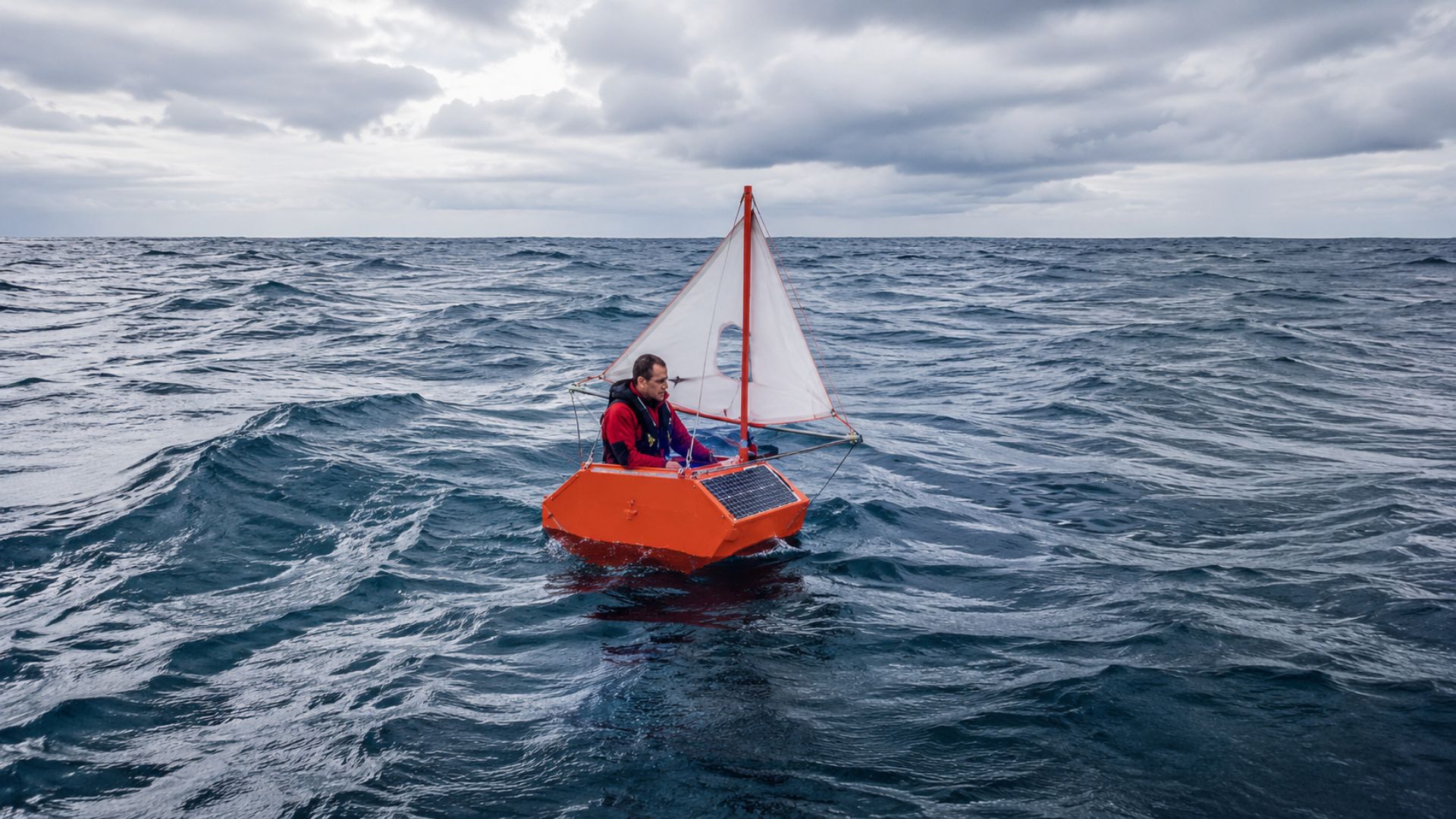

The name of the vessel, Big C, is English slang for cancer, the disease that killed his father, mother, and the friend who designed the hull. The first attempt sank in 2023, two days after his father died. Now, in a boat smaller than the length of a human step, he tries again the feat that has already taken the life of those who dreamed of it before.
In a boat only 1.19 meters long, smaller than many leisure kayaks, the Briton Andrew Bedwell wants to cross alone nearly 3,000 kilometers of the North Atlantic and spend more than two months at sea without being able to lie down or stand up. The goal is twofold: to break the world record for the smallest vessel to complete the ocean crossing and, at the same time, to pay a moving tribute to cancer victims, a disease that profoundly marked his life.
The departure is scheduled for the coming weeks, depending on a safe weather window, from St. John’s, in the Canadian province of Newfoundland and Labrador, in eastern Canada. The destination is the south coast of England, after about 1,900 miles, equivalent to approximately 3,000 kilometers, through the unpredictable and dangerous North Atlantic. The crossing is expected to last about 60 days, but the boat has been stocked for up to 90 days, if necessary.
A boat the size of a step

The Big C, as the boat was named, is slightly larger than a bathtub and shorter than many recreational kayaks, being compared by British media to a wheeled trash bin. At about 1.19 meters long, the vessel is so small that Bedwell, who is approximately 1.80 meters tall, cannot stand up or lie down completely inside, having to rest sitting or curled up.
-
Bruno Guimarães, 28, Misses Crucial Penalty Against Norway in World Cup After Replacing Vinicius Jr.

-
Inspired by a school lesson on Africa’s water crisis, a young boy raised money through chores to fund a well that transformed a Ugandan community.

-
Brazilian Construction Worker Moves to France, Earns Up to €2,500 Monthly with Home Renovations, Gains Social Media Attention

-
US Navy Sinks USS Oriskany with 230 kg of C-4, Creating World’s Largest Artificial Reef in 37 Minutes




Despite its tiny size, the boat is an engineering masterpiece designed for survival. It features about a dozen watertight compartments to ensure buoyancy and safety, an A-shaped mast, two rudders in case one breaks, and side floaters for stability. The keel can store drinking water, and the navigator reviewed the stability and storage systems after the problems of the first voyage.
Version 2, rebuilt from scratch

The current boat is a second version, named Big C V2, rebuilt after the failure of the first attempt. The most important change was in the material: the original version was made of fiberglass, while the new one is made of aluminum, with internal reinforcements and changes in the hull design. About 70% of the original concept, however, was maintained in the new vessel.
A clarification of precision is worth mentioning: although Bedwell still cannot lie down completely, the aluminum version gained about 90 millimeters more internal space compared to the first. This difference, which seems small, is significant in such a cramped boat, as it now allows him to at least stretch his legs, something impossible in the previous version. Every centimeter was calculated to save space and weight.
The story behind the name Big C


The name of the boat hides the most emotional and painful part of this story. Big C is an expression used in English to refer to cancer, and it also works as a sound pun with Big Sea. The choice is no coincidence: it is a tribute to the sailor Tom McNally, from Liverpool, who designed the original boat and was the inspiration for the entire project.
McNally once held the record for the smallest vessel to cross the Atlantic in 1993, but lost it a few months later. He planned to reclaim the title with the Big C, but died of cancer in 2017, without realizing the dream. Bedwell, who is a boat builder and repairer, obtained permission from McNally’s family to resume the project, turning the crossing into a way to honor his friend’s memory and carry forward a dream interrupted by the disease.
The grief that crosses the journey
Bedwell’s connection with cancer, unfortunately, goes far beyond his friend. Both his father and mother also died from the disease, making the expedition a deeply personal tribute. The most painful episode occurred in 2023: the navigator’s father, Tony, died just two days before the first crossing attempt, and he admits that it left him emotionally shaken and unfocused at the time of departure.
Perhaps that’s why the first attempt, in May 2023, ended frustratingly. Shortly after leaving the Canadian port, Bedwell realized there was water entering the hull and was forced to return to land. As if that wasn’t enough, when removed from the sea, the vessel fell from a crane on the dock and was completely destroyed. The navigator thought that was the end of the project, but decided that his story with the challenge was not yet over.
The record he wants to break
The record Bedwell is trying to surpass belongs to the American Hugo Vihlen, who in 1993 crossed the Atlantic in a vessel about 1.62 meters long, named Father’s Day. Vihlen’s crossing, also made from Newfoundland to England, lasted more than a hundred days and remains, to this day, the officially recognized mark of the smallest vessel to complete the feat.
Since then, several attempts to break this record have failed, falling victim to structural problems, storms, and the physical limitations imposed by the reduced space. Crossing the North Atlantic in a tiny boat is extremely dangerous, as the ocean is known for its unpredictable weather and rough seas, requiring extraordinary physical and psychological preparation, along with a huge dose of courage and, of course, luck with the weather.
Life within a minimal space
The routine aboard the Big C will be one of extreme deprivation. Without a conventional bathroom and no separate area for supplies, every detail was designed to save space. The food, for example, was planned to occupy as little space as possible, with some of it molded into improvised compartments within the hull and a diet based on highly caloric foods, capable of withstanding moisture and temperature variations at sea.
For Bedwell, comfort was never the goal. According to him, the boat exists only to survive the crossing, and everything on board was designed to save centimeters and kilograms, teaching him to quickly distinguish what is essential from what is superfluous. An experienced sailor, he has already circumnavigated Great Britain alone and even sailed to the Arctic Circle, showing that despite the almost suicidal appearance of the challenge, there is a lot of experience behind the boldness.
Andrew Bedwell’s new attempt to cross the Atlantic in the tiny boat Big C is much more than an adventure in search of a record. It is a story of mourning, overcoming, and tribute, where every meter navigated carries the memory of a father, a mother, and a friend taken by cancer. While waiting for the ideal weather window to set sail from Canada, the British navigator prepares to face the ocean in the name of those who have departed and those still fighting the disease.
Would you have the courage to face the Atlantic Ocean alone in a boat where you can’t even lie down or stand up? What impresses you most about this story: the boldness of the feat or the tribute to cancer victims? Leave your comment, tell us what you thought of Andrew Bedwell’s adventure, and share the article with those who admire stories of courage, overcoming, and great challenges.





