






 Portuguese
  Spanish


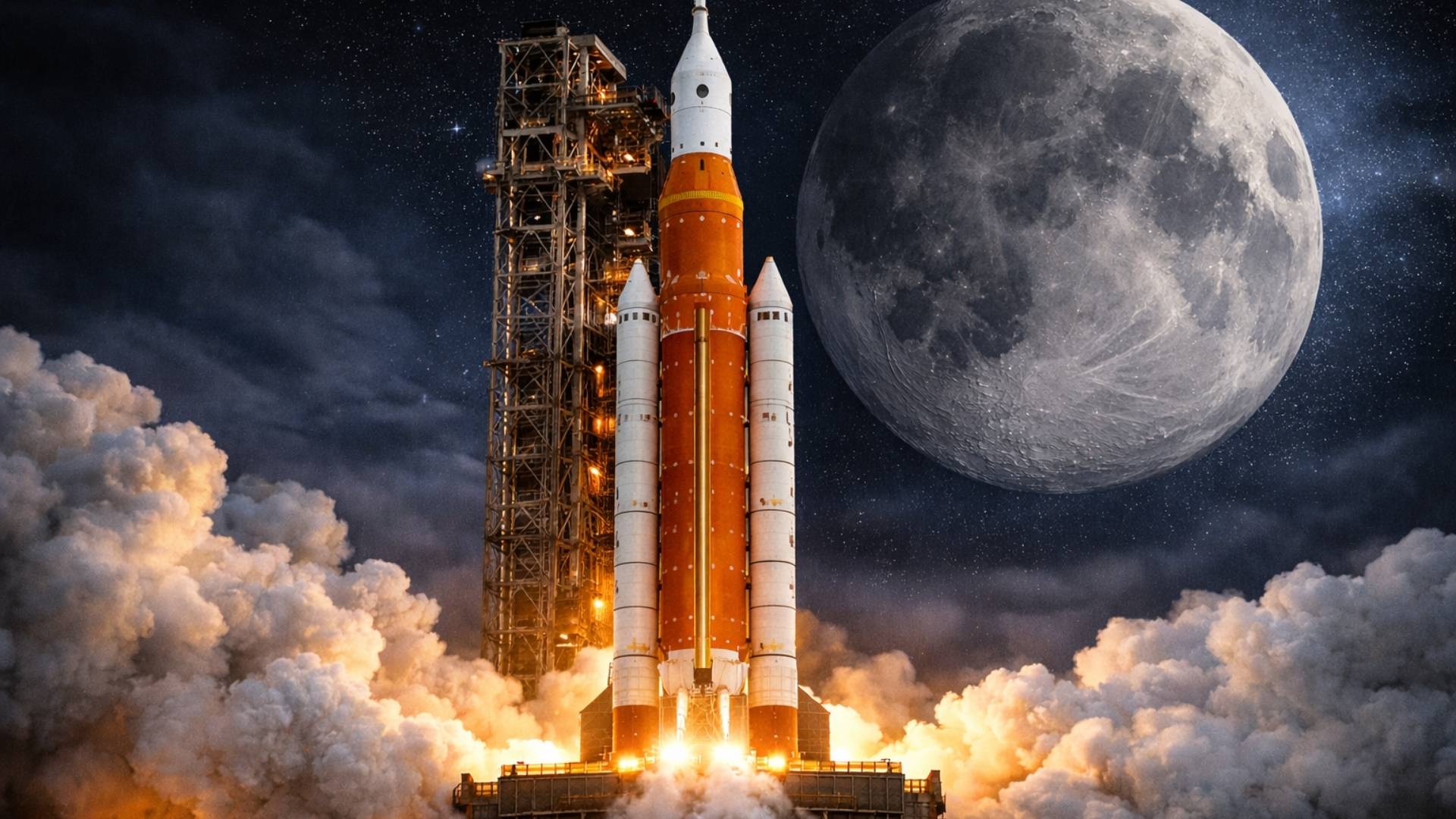


Artemis II Mission Marks Human Return to Lunar Neighborhood After More Than Five Decades, with Giant Rocket, Deep Space-Tested Capsule, and International Crew on NASA’s Strategic Flight That Precedes Future Moon Landing Missions.
NASA plans for 2026 the Artemis II mission, which will take astronauts back to the vicinity of the Moon after more than half a century without human flights beyond low Earth orbit.
The flight will mark the return of human presence to the lunar neighborhood since the Apollo 17 mission, which ended in 1972, and will last approximately 10 days.
The launch will occur from Florida and will utilize the Space Launch System (SLS) together with the Orion capsule, designed for deep space missions.
-
São Paulo Unveils Latin America’s Largest Underground Reservoir, Holding 900 Million Liters, in the Greater São Paulo Area

-
Chinese Teen Wins Gold in Germany for Invention Turning Air Moisture into Underground Irrigation in Drought-Stricken Areas

-
Desertification Threatens Brazil’s Caatinga: 85% of Semi-Arid Region Affected, 30 Million at Risk, and Efforts Underway to Restore 10 Million Hectares by 2045
-
Few People Realize Earth Spins at 1,670 km/h Unnoticed: Explained by Gravity and Brain Perception





The information and analyses on the program’s status were presented by science communicator Sergio Sacani on the Space Today channel on YouTube, publicly commenting on the progress of the U.S. agency’s lunar project.
According to NASA’s most recent official planning, Artemis II is scheduled for sometime in 2026, with the final date contingent upon the completion of ongoing testing and technical reviews.
Although more specific estimates circulate in promotional materials and independent analyses, the agency adopts a conservative stance and keeps the timeline tied to the total readiness of the systems.
Human Return to Lunar Neighborhood After More Than Five Decades
Unlike the Apollo missions, Artemis II does not plan to land on the lunar surface.
The flight will be the first crewed mission of the Artemis program and also the first mission with humans to leave low Earth orbit since the end of the Apollo era.
In this operational profile, the Orion capsule will follow a free-return trajectory, looping around the Moon and returning directly to Earth, without lunar orbit insertion maneuvers.

As explained by Sergio Sacani on his channel, the mission’s central goal is to validate, with astronauts on board, all critical systems of the spacecraft in a deep space environment.
Among the points evaluated are life support, communications, navigation, thermal control, operational procedures, and overall capsule performance.
The high-speed reentry into Earth’s atmosphere, one of the most sensitive phases of the mission, will also be closely monitored.
Artemis II Crew Includes Astronauts from the U.S. and Canada
The Artemis II crew will consist of Reid Wiseman, Victor Glover, Christina Koch, and Jeremy Hansen, as officially announced by NASA.
Wiseman will serve as the mission commander, while Glover will be the pilot responsible for the spacecraft’s main maneuvers.
Koch and Hansen will complete the team as mission specialists, participating in operations and planned tests throughout the flight.
Hansen, a Canadian astronaut, represents the international cooperation of the Artemis program and will be the first citizen of Canada to travel to the Moon.
In the original content that led to this article, names appear informally or with inaccurate spellings, something common in live broadcasts and spontaneous comments.
Nevertheless, the composition of the crew is correct and has been officially confirmed by the U.S. space agency.

SLS Rocket and the Visual Impact of the Launch
To launch the mission, NASA will use the SLS in Block 1 Configuration, the same employed in the unmanned Artemis I mission conducted in 2022.
The rocket features a core stage equipped with four RS-25 engines, along with two large solid rocket boosters inherited from the Space Shuttle program.
During his analysis, Sergio Sacani highlighted the visual impact of this type of launch.
According to him, the use of solid rocket boosters “creates that giant smoke tower,” a characteristic effect of this propulsion system.
This phenomenon typically marks launches visually, impressing both those who watch in person and the audience watching the official broadcasts.
NASA describes the SLS as the most powerful rocket ever developed by the agency, designed for missions beyond Earth orbit.
Comparisons with other large vehicles vary according to technical criteria and stages of development, but the SLS is among the largest operational rockets today.
Weight of the SLS and Correction of Technical Information
The original title mentions that the SLS exceeds 4,000 tons, information that does not have direct support in NASA’s official technical specifications.
According to the agency’s public data, the SLS Block 1 weighs about 5.75 million pounds when fully fueled, equivalent to approximately 2,600 metric tons.
There is no confirmation in the available technical documents of a mass exceeding 4,000 tons for this configuration of the rocket.
What can be safely stated is that it is a large vehicle designed to generate high thrust and carry payloads and crews on deep space missions.
Orion Capsule and Mission of Approximately 10 Days
The central element of the mission, the Orion capsule, was developed to take astronauts beyond low Earth orbit and endure long periods in deep space.
The spacecraft is designed to operate in intense radiation environments and withstand extreme speeds during atmospheric reentry.
In the Artemis I mission, Orion completed an uncrewed flight around the Moon, providing data considered essential for engineering adjustments and system validation.
The estimated duration of about 10 days, mentioned by Sergio Sacani, aligns with the profile officially released by NASA.
During this period, the crew will conduct operational tests, performance evaluations, and verification activities that will serve as the foundation for subsequent missions in the Artemis program.
Mission Timeline and Preparation Stage
In the referenced video, it is mentioned that the rocket would be ready to be taken to the launch pad, as well as references to an upcoming launch.
So far, however, there is no public official confirmation detailing the exact stage of integration of the SLS and Orion at the time described.
What NASA consistently informs is that the mission has undergone technical reviews and schedule adjustments over the past few months.
These changes reflect the complexity of the project and the priority given to system reliability, especially as this is the first crewed flight of the Artemis program.
More than half a century after the last Apollo mission, the human return to the lunar neighborhood raises a central question in the debate about space exploration.
Will this flight be merely a symbolic milestone or the concrete beginning of a sustainable human presence beyond Earth orbit?





Es importante la información de los trabajos y esfuerzos de ciertas empresas o instituciones para lograr avances a nivel espacial. Reconocemos el liderazgo de SpaceX p q somos sus auditores al permitirnos ver cada lanzamiento a través de sus videos. Seguimos con agrado cada lanzamiento q permite observar los trabajos para obtener cohetes confiables, con calidad y cuido científico para poder alcanzar la vida multiplanetaria. Confiamos y creemos en Elon Musk su inteligencia, capacidad, perseverancia para lograr este ambicioso, importante y magestuoso proyecto q nos permita buscar condiciones de vida ante cualquier amenaza de extinción del hombre en nuestro planeta. Q Dios derrame abundantes bendiciones hasta q sobreabunden para permitir lograr este objetivo q va en beneficio de la humanidad en el nombre poderoso de Jesús amén
E nós aqui, com a Base Alcântara produzindo fiasco em cima de fiasco, pior ainda o ministro no NINE dizendo que foi promissor SÓ PARA A CABEÇA DESSE **** TONTO do PT