





 Portuguese
  English
  Spanish
  4 min of reading
  0 comments


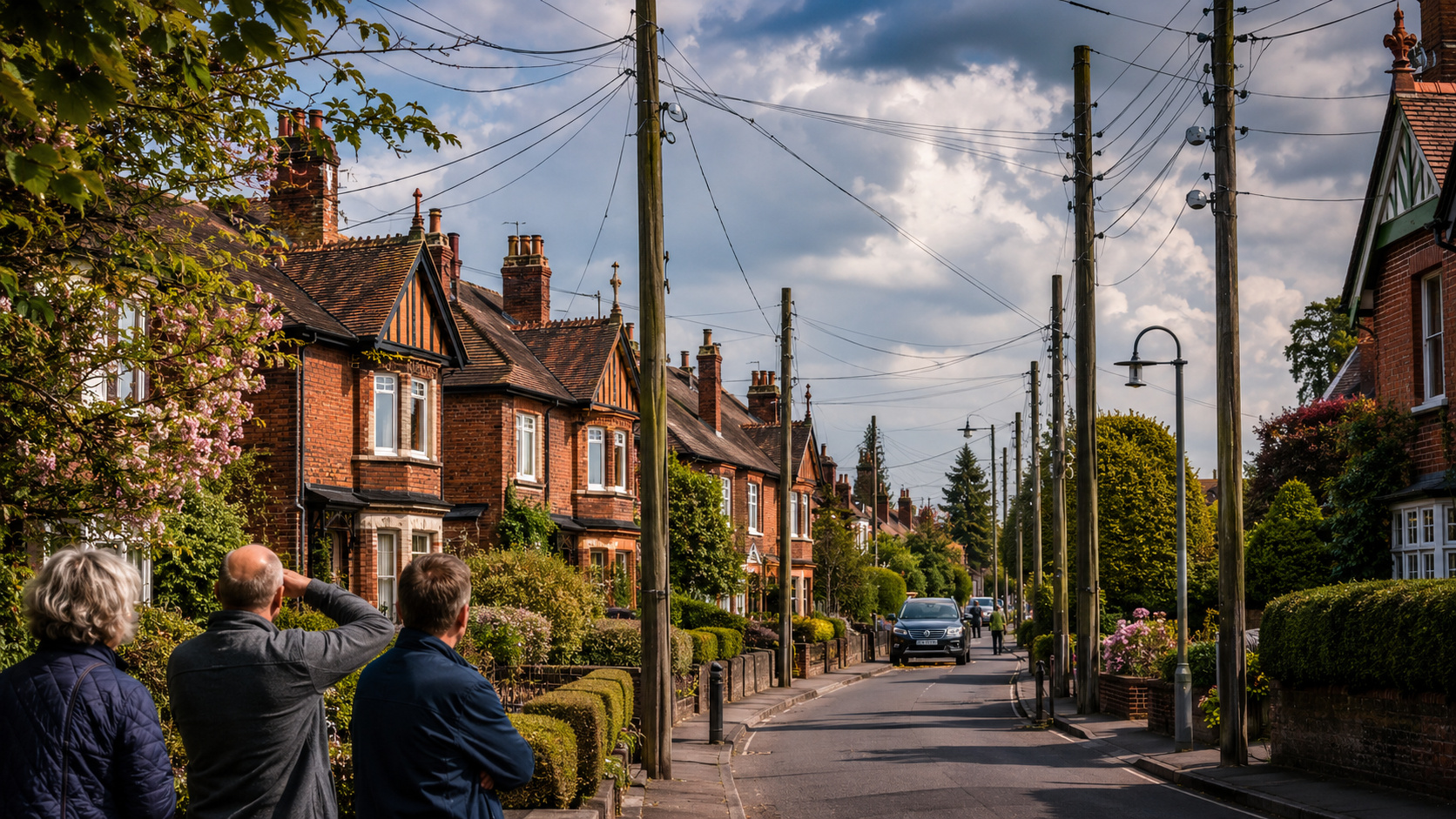
In Bournville, near Birmingham, the arrival of broadband sparked street protests, residents complain about internet poles in a historic village created to preserve beauty, trees, and residential appearance
A historic village built by the Cadbury family clashed with telecommunications companies after more than 100 internet poles appeared on its streets. The promise of fast connection turned into a reason for revolt in Bournville, near Birmingham, United Kingdom.
The investigation was published by The Guardian, a British newspaper reporting on public affairs. The case gained traction because residents claim that the installation of the poles created visual pollution in an area known for beautiful streets, tree-lined avenues, and a preserved residential appearance.
The discomfort grew due to a contradiction difficult to ignore. Residents need to ask for permission for small changes to their homes, but companies managed to install large broadband structures with less local control.
-
22-carat gold may be hidden in household items treated as scrap, while Swiss scientists use whey to recover the precious metal and pave the way for new sustainable urban mining.

-
With a gigantic arch of 106 meters and the largest stadium swing in the world, the Moses Mabhida Stadium accommodates up to 54,000 people, offers a panoramic tour with views of the Indian Ocean, and has become an architectural symbol of South Africa by combining soccer, tourism, and extreme attractions at the top of its monumental structure.
-
The Amazon faces an invisible problem beyond deforestation: an open-air landfill near Manaus threatens water, agriculture, and tourism, while a sanitary landfill emerges as a solution to replace irregular disposal and protect communities in Iranduba.
-
For the first time in over a century, the Klamath River is flowing freely in the United States after the demolition of four hydroelectric dams, and within a few weeks, salmon have already reappeared in sections that had been blocked since 1918, in the largest river restoration project in American history.




Cadbury family’s historic village became a battleground against internet poles
Bournville is not just an old village. It was planned by the Cadbury family with a clear idea of urban organization, pleasant streets, and care for the appearance of homes. This visual is part of the place’s identity.
Therefore, the internet poles were received as a threat to the local landscape. Fast connection, usually seen as an improvement, began to be treated by residents as a problem on sidewalks and streets.
The revolt shows that technology also changes the landscape. Fiber optics require physical infrastructure, but in historic areas, each pole can generate discomfort, discussion, and public pressure.

Over 100 broadband poles pitted fast internet against postcard-perfect streets
The installation of over 100 poles changed Bournville’s visual routine. For those living in the village, the problem is not just the existence of the internet, but how it arrived.
Residents began to complain that broadband invaded streets known for their postcard aesthetic. The local sentiment is that the infrastructure was installed without the same care required of the residents themselves.
This point strengthened the case. The village tries to preserve a historic image, while companies advance with telecommunications equipment. The clash between these two interests turned the poles into a symbol of conflict.
The Guardian detailed residents’ revolt and threat of legal action
The Guardian, a British newspaper reporting on public affairs, detailed the central points of the dispute in Bournville. Residents’ reaction included a threat of legal action and pressure on companies responsible for installing the poles.
The Bournville Village Trust, an entity linked to the area’s management, began to evaluate ways to protect local rules. The main concern involves the village’s appearance, the impact of the structures, and respect for the region’s visual standard.
The threat of legal action escalated the fight. What began as a neighborhood nuisance turned into a discussion about who decides the future of historic streets when digital infrastructure arrives.
Residents see contradiction between strict rules for homes and freedom for telecommunications
Residents’ irritation didn’t just come from the poles. It grew because those living in Bournville must follow rules to preserve facades, gardens, and residential details.
This requirement creates a sense of permanent care for the local appearance. When companies installed large internet poles, many residents saw an unequal rule.
For residents, the question became evident. If a small change to a house can require permission, why can a telecommunications structure alter entire streets with less resistance?


Fiber optic became a symbol of visual pollution in a village trying to preserve its identity
Fiber optic often appears in campaigns as a synonym for progress, speed, and modernization. In Bournville, it became a symbol of visual pollution because it arrived accompanied by poles considered invasive.
The case shows that a technical improvement can face rejection when it visibly affects daily life. Fast internet can improve connections, but it can also change the landscape of sensitive neighborhoods.
In places with historical value, the discussion goes beyond technology. It involves memory, urban rules, a sense of belonging, and respect for the visual appeal that residents help preserve.
Debate in the United Kingdom exposes the conflict between digital advancement and street preservation
The controversy in Bournville ignited a larger debate in the United Kingdom. Broadband expansion relies on infrastructure, but the installation of poles without what is considered sufficient consultation generates resistance.
For residents, the central point is simple. Technology needs to arrive, but it cannot ignore the place where it will be installed. In a planned village with a strong visual identity, each pole carries more weight than on a common street.
The conflict also offers a lesson for other cities. Modernizing doesn’t just mean installing equipment. It also means listening to those who live there and seeking solutions that respect the landscape.
The dispute in Bournville transformed over 100 internet poles into an unexpected symbol. Broadband, seen as progress, came to represent a loss of control over a historic village built to maintain beauty and order.
Ultimately, the case leaves an important question for any city that wants to modernize without losing its identity.
When fast internet improves everyone’s life but changes the landscape of a historic place, who should have the final say: the companies installing the network or the residents who live there every day? Share your opinion and share this post with others who follow technology, cities, and infrastructure.


Be the first to react!