Portuguese
  Spanish




Superconducting Niobium Qubit Is Much More Stable Than Any Other Built Before Because It Does Not Require Other Metals and Metal Oxides to Conduct Current.
Atsushi Kobayashi and his colleagues from the University of Tokyo, Japan, have created a new type of quantum bit, the superconducting niobium qubit – a technology that reduces errors, integrates electronic computing, and promises to revolutionize quantum computers worldwide!
Over the past few decades, the techniques used to manufacture silicon electronic processors have been improved while quantum computing has been designed from scratch. The biggest and most promising challenge would be to find ways to integrate quantum logic units with current electronic computers.
To the delight of the tech world, this feat has just been discovered by Atsushi Kobayashi and his colleagues from the University of Tokyo, Japan.
-
Brazil Develops Its First Locally-Made 5G Radio Unit, Achieves Over 1.5 Gbps in Lab Tests, Paving the Way for Interoperable Equipment

-
El Niño Intensifies: Over 90% Chance of Persisting Until 2027, Raising Ocean Temperatures and Increasing Severe Weather Risks in Southern Brazil, Warns Federal Report

-
NASA Prepares Trio of Small Satellites to Track Tropical Storms and Capture Rapid Rainfall Development from Above the Clouds
-
$7,999 Isaac 1 Robot Aims to Tackle Household Chaos: Folds Clothes, Makes Beds, and Organizes, but Raises Privacy and Cost Concerns with Camera Reliance and Remote Human Assistance



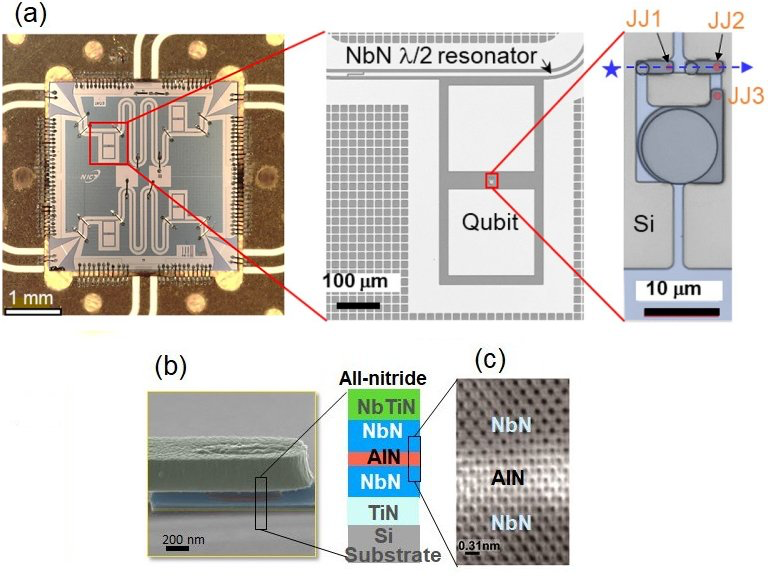
The researcher discovered how niobium nitride (NbNx) can be added to a traditional semiconductor substrate based on aluminum in the form of a flat and crystalline layer, creating a fully functional qubit directly connectable to silicon chips.
The team synthesized thin films of niobium nitride directly onto a layer of aluminum nitride (AlN).
The detail is that niobium nitride is a superconductor and its integration with aluminum creates a structure called Josephson Junction, which transforms it into a fully functional qubit.
“The structural similarity between the two materials facilitates the integration of superconductors into semiconductor optoelectronic devices,” said Kobayashi.
[Image: NICT/Nagoya University]
New Superconductor That Dispenses With Other Metals and Metal Oxides to Conduct Current
The superconducting niobium qubit is much more stable than any other built before because it does not require other metals and metal oxides to conduct current. Until now, aluminum and aluminum oxide have been used for this purpose, but they are the largest sources of noise even when the material is brought close to absolute zero.
In the new qubit, all the elements used are nitrides (compounds containing nitrogen). The main element is niobium nitride (NbN), which has a superconducting transition temperature of 16 K (-257 ºC), while the insulating layer is made with aluminum nitride (AlN), both epitaxially grown on a silicon substrate.
“This is the first time in the world that someone has managed to observe coherence times in the tens of microseconds in superconducting nitride qubits, reducing dielectric loss by epitaxially growing them on a Si substrate. The superconducting qubit made from this nitride is still in the early stages of development, so we believe that it is possible to further improve the coherence time by optimizing the qubit design and manufacturing process,” said Professor Kouichi Semba from the National Institute of Information and Communications Technology in Japan.
Article: Advanced Materials Interfaces
Authors: Atsushi Kobayashi, Shunya Kihira, Takahito Takeda, Masaki Kobayashi, Takayuki Harada, Kohei Ueno, Hiroshi Fujioka
Journal: Advanced Materials Interfaces
DOI: 10.1002/admi.202201244
I Would Love to Know What You Think About This Technology. Let Us Know in the Comments Section If You Enjoy Reading This Kind of News. Don’t Forget to Turn on CPG Notifications to Keep Up with All the News from the Tech World. See You Next Time!