






 Portuguese
  Spanish
  3 min of reading
  0 comments


Declared War: Elon Musk’s Starlink Responds to Moraes Blockade with Free Service Promise for Customers in Brazil
The company Starlink, owned by Elon Musk, sent a statement to its customers in Brazil informing them about the blockage of their accounts by a decision from the Supreme Federal Court (STF) minister, Alexandre de Moraes. In the statement, Starlink expressed its commitment to continue offering its services, including the possibility of providing free internet to users while the situation remains unresolved.
Context of the Decision
The blockade order, issued by Alexandre de Moraes on August 18, is based on the attempt to collect fines imposed against the social network X, formerly known as Twitter, for noncompliance with court orders.
X, also owned by Musk, has been subject to various penalties for failing to remove specific accounts, including that of Senator Marcos do Val (Podemos-ES) and six other individuals, as determined by Moraes on August 13.
-
Helicopter Drops 180 Tons of Sand and Gravel on Swedish River to Revive Ecosystem Damaged by Decades of Exploitation

-
Brazilian Company Launches Retro Smartphone with 48 MP Camera, T9 Keyboard, and Privacy Features for Social Media-Free Use

-
Self-Taught Chinese Farmer Builds 5-Ton Submarine from Scrap, Launches It in Anhui River
-
Invisible Induction Technology Enables Wireless Power for Blenders, Coffee Makers, and Air Fryers, Reducing Countertop Cables





Moraes established a daily fine of R$ 1.4 million if X did not comply with the court order. According to social network employees, the fines have already exceeded R$ 20 million. The blockage of Starlink’s accounts was justified by the minister on the grounds that, despite being separate companies, Starlink and X are part of the same economic group, with Musk as the owner.
Response from Starlink – Free Internet
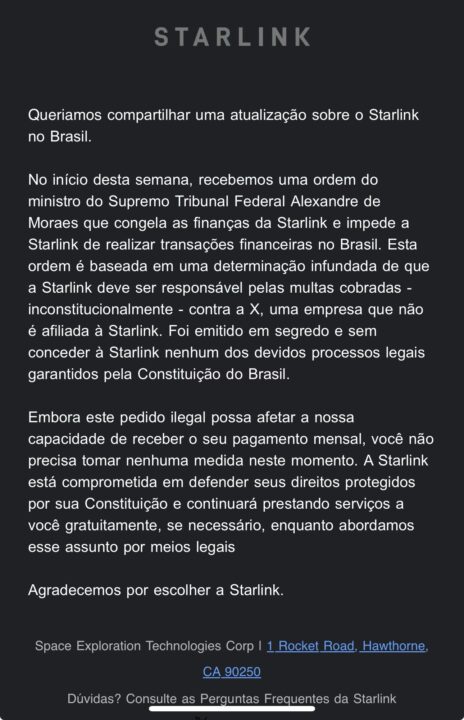
Starlink, in its statement, sharply criticized the decision, describing it as unfounded and unconstitutional. The company argues that the blockade order was based on a determination without legal grounds, as Starlink has no responsibility for the fines imposed on X.
“This order is based on an unfounded determination that Starlink must be responsible for the fines imposed —unconstitutionally— against X, a non-affiliated company with Starlink,” the company stated in the announcement.
Furthermore, Starlink claims that the order was issued secretly and without granting the company due process, which, according to the company, constitutes a violation of the constitutional rights guaranteed by the Constitution of Brazil.
With the blockage of accounts, Starlink declared that its finances in Brazil have been frozen, preventing any financial transactions in the country. However, the company assured that consumers should not take any action even if payments are not credited to Starlink’s accounts.
In an attempt to reassure users, Starlink emphasized its commitment to continue providing its services, ensuring that if necessary, it will provide free internet while seeking to resolve the issue through legal means. “Starlink is committed to defending its rights protected by the Constitution and will continue to provide the service for you —for free, if necessary— while we deal with this issue through legal means,” the statement highlighted. See the complete statement below.
The decision by Alexandre de Moraes and the blockage of Starlink’s accounts generated a strong reaction from Elon Musk. On his official account on X, Musk harshly criticized the minister, calling him a “criminal of the worst kind, disguised as a judge” and accusing him of supporting “dictatorships around the world.”
Musk’s statements reflect the tension between the entrepreneur and the Brazilian judiciary system, in a context where freedom of expression and governance of digital platforms have been central themes of debate.





Be the first to react!