






 Portuguese
  Spanish
  6 min of reading
  0 comments


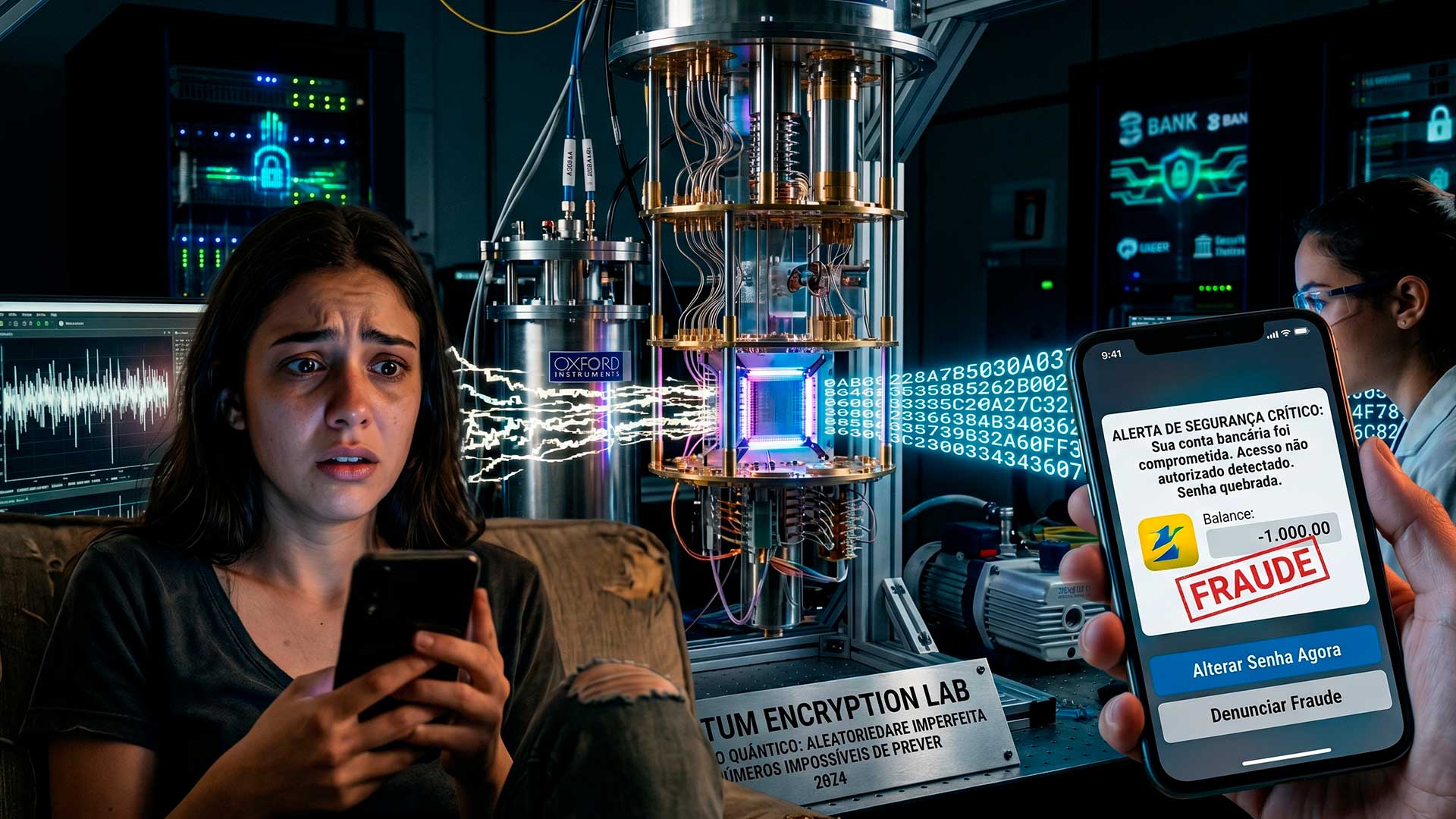
Experiment with superconducting qubits managed to transform imperfect randomness into numbers certified as perfectly unpredictable
Scientists from ETH Zurich announced a breakthrough that could change the foundation of digital security, cryptography, and quantum computing. For the first time, a team managed to produce random numbers considered perfectly unpredictable, using a quantum physics experiment.
The discovery is noteworthy because the modern internet relies on random numbers to protect passwords, messages, bank transactions, digital certificates, and authentication systems. When this randomness fails, even in an almost invisible way, the protection can become weaker.
The study shows that it is possible to take a source of imperfect randomness and, through a quantum protocol, transform it into a sequence of zeros and ones without detectable bias. The research was published in the scientific journal Nature on May 27, 2026, and disclosed by ETH Zurich.
-
Oil Company Robots Discover 3,300-Year-Old Canaanite Shipwreck in the Mediterranean, Proving Ancient Mariners Navigated Open Seas Using Stars Long Before Historians Thought

-
Helicopter Drops 180 Tons of Sand and Gravel on Swedish River to Revive Ecosystem Damaged by Decades of Exploitation

-
Brazilian Company Launches Retro Smartphone with 48 MP Camera, T9 Keyboard, and Privacy Features for Social Media-Free Use

-
Self-Taught Chinese Farmer Builds 5-Ton Submarine from Scrap, Launches It in Anhui River




In practice, this does not mean that cell phones, banks, and computers will start using this technology tomorrow. But the result paves the way for a new generation of quantum random number generators, capable of providing a more reliable foundation for systems that require maximum security.
Why random numbers are so important for digital security
Most people associate random numbers with lotteries, games, temporary passwords, or verification codes. But, in the digital world, they have a much deeper and strategic function.
When a system creates a cryptographic key, it needs to generate a sequence that no one can predict. This key can protect a private conversation, a financial transfer, bank access, or communication between servers.
The problem is that traditional computers are not naturally random. They follow mathematical instructions and, therefore, tend to produce pseudorandom numbers, which appear random but are born from formulas and initial values.
For common use, this is often sufficient. For critical systems, however, any hidden pattern can become a vulnerability. If an attacker discovers how the sequence was created, they can try to reconstruct keys, predict tokens, or exploit flaws in security protocols.
The hidden problem in current random number generators
Even the most advanced physical and quantum generators are not free from small imperfections. A real device may have noise, measurement errors, unbalanced sensors, thermal interferences, or calibration deviations.
These flaws can make certain results appear slightly more than others. In a simple comparison, it would be like rolling an almost perfect die that still slightly favors one of the faces.
This difference seems small, but that’s precisely where the risk lies. In cryptography, almost random is not the same as perfectly unpredictable. A small statistical tendency can weaken a key or open the door to very sophisticated attacks.
Therefore, ETH Zurich’s advancement is not just in generating random numbers, but in certifying that this randomness truly does not rely on blind trust in the equipment used.
How quantum physics became central to the discovery
The experiment used two superconducting chips, each representing a qubit. Unlike a common bit, which assumes 0 or 1, the qubit belongs to the world of quantum mechanics and can be associated with states that are only defined at the moment of measurement.
The two chips were connected by a tube approximately 30 meters long, cooled to extremely low temperatures. Microwave photons circulated between them, creating a phenomenon called quantum entanglement.
In entanglement, two particles or quantum systems exhibit very strong correlations, even when they are separated. The measurement on one side is related to the result on the other in a way that cannot be explained by simple classical models.
This structure allowed for a type of test known as the Bell test, used to verify if the observed correlations truly follow the behavior predicted by quantum mechanics. In the case of the new study, this test was essential to certify the origin of the randomness.
What randomness amplification means
The most important point of the work is a concept called randomness amplification. The idea is to start from a weak, biased, or imperfect source and extract from it a final sequence with much stronger randomness.
In classical systems, this type of transformation has limits. If the initial source carries bias or predictability, traditional mathematics alone cannot guarantee perfect randomness in a strong sense.
The Swiss team used quantum behavior to overcome this limitation. The protocol does not need to rely completely on the internal details of the equipment because the certification comes from the result observed in the Bell test.
This is important because a security system should not depend solely on the promise that a device was well manufactured. Ideally, it should be able to demonstrate, through physical and statistical evidence, that the numbers generated are truly unpredictable.
Why the discovery can impact cryptography, banks, and digital identities
The most evident application is in cryptography. Banks, governments, tech companies, cloud services, and communication platforms rely on secure keys to protect sensitive data.
When the random base of a key is strong, the system becomes more resilient. When this base is weak, the entire protection can be compromised, even if the cryptographic algorithm is advanced.
The advancement may also interest systems of digital identity, electronic signatures, internet infrastructure, blockchain, public audits, and services that need verifiable technical draws. The central idea is to create a source of randomness that is not only reliable but also certifiable.
In the long term, this technology could function as a kind of high-precision reference for randomness, just as atomic clocks have become a reference for measuring time with extreme accuracy.
The advancement is still far from becoming a common product
Despite the scientific impact, the experiment still requires a complex structure. Superconducting chips, extreme cooling, cryogenic connection, and high-precision quantum control are not part of the reality of common devices.
This means that the discovery is more of a laboratory milestone than a product ready for mass use. It will still be necessary to reduce costs, simplify operation, and prove that the method can work stably in environments outside academic research.
Even so, the importance of the result lies in showing that perfect randomness is not just a theoretical idea. It can be produced experimentally, provided the system correctly explores the resources of quantum physics.
This type of advancement also gains relevance at a time when digital security faces new challenges, including more automated attacks, artificial intelligence applied to system invasion, and the future arrival of more powerful quantum computers.
The new battle for trust in digital systems
The discovery reinforces an increasingly important discussion. In a world where almost everything depends on passwords, codes, authentication, and cryptography, digital trust begins in invisible parts of the system.
The average user does not see the random number generator working. They just expect the banking app, messaging service, or shopping site to be protected. But behind this trust, there is a technical chain that can be strong or vulnerable.
By achieving a certified form of perfect randomness, researchers take a step towards more transparent and mathematically secure systems. The promise is not to eliminate all digital risks, but to strengthen one of the most important foundations of modern protection.
The big question now is who will have access first to this type of technology when it matures. Will it be restricted to governments, banks, and large tech companies, or could it become a public infrastructure for digital security?
Do you think such an important technology for encryption and data protection should be controlled by large institutions or offered as an open service to society? Leave your comment and say if this new era of quantum randomness increases your confidence in the future of digital security.





Be the first to react!