






 Portuguese
  Spanish


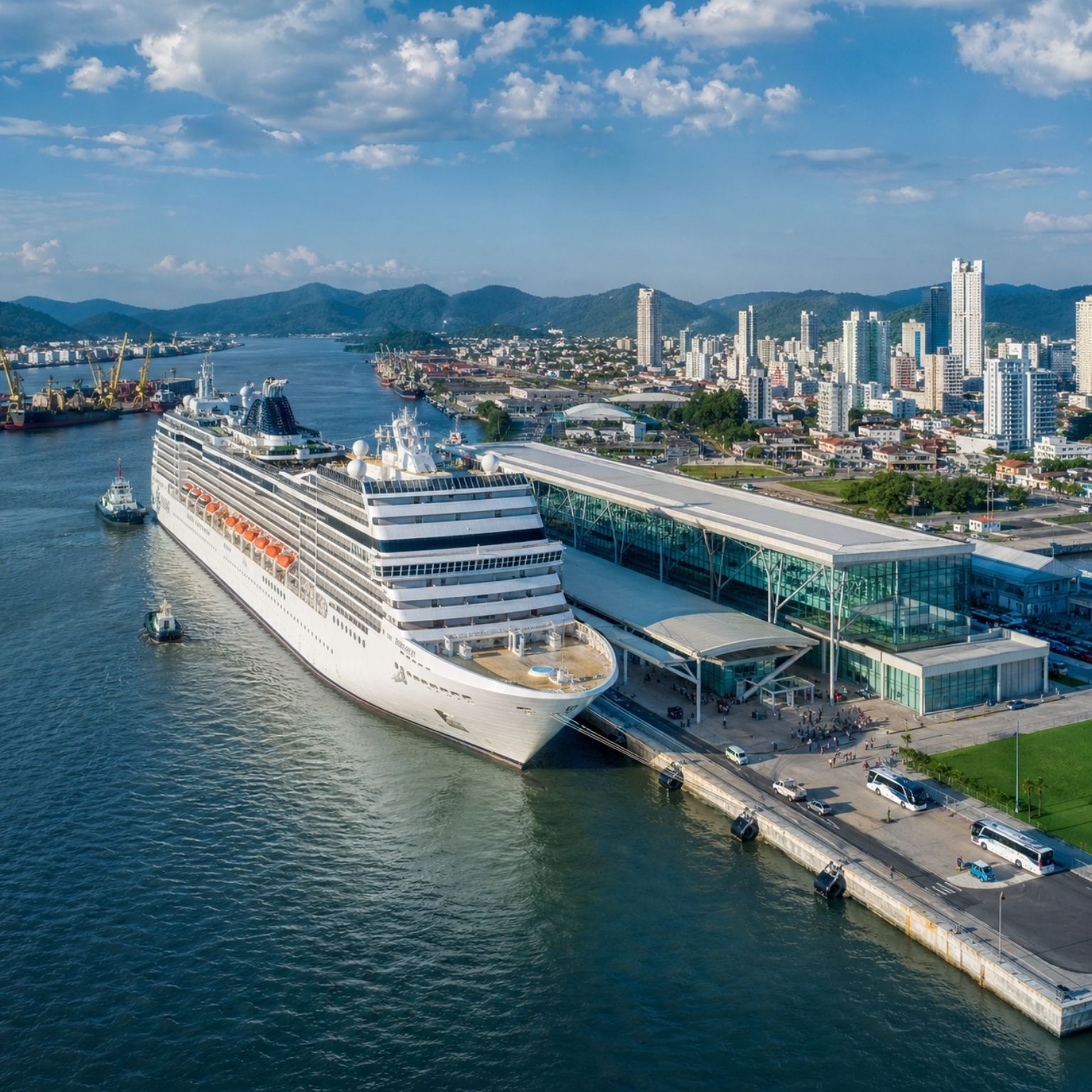

Itajaí presented an international standard cruise terminal to strengthen maritime tourism, receive transatlantic liners, and relieve pressure on the city’s port operations.
Itajaí presented the project for a new international standard cruise terminal with a millionaire investment to boost maritime tourism in the municipality. The proposal was shown as a strategic solution to receive transatlantic ships in future seasons without compromising the operation of cargo ships that currently use the city’s port.
The project stands out for its scale and ambition. The structure is to be installed next to the Itajaí Centreventos, in an area designed to function as a new docking point for tourist ships. The complex will have over 20,000 m² and was designed to accommodate the world’s largest transatlantic liners, in an attempt to consolidate Itajaí as one of the main maritime tourism hubs in Brazil.
Itajaí wants to solve a bottleneck that currently hinders part of the port operation
Today, cruise ships end up docking at the port of Itajaí, sharing space with other operations. According to the information presented, this disrupts the dynamics of cargo ships, which stop using the area occupied by transatlantic liners during the season.
-
Brazilian Innovator Develops Concrete Blocks from Recycled Plastic, Eliminating Mortar and Reducing Construction Costs

-
Brazilian Woman Builds House with Recycled Plastic Bottles, Halving Construction Costs in the Process
-
Couple Sold Their Home to Live in a Trailer While Converting a Granite Tower into an Award-Winning 11-Meter Residence in Cornwall
-
Sustainable Building Solutions Enhance Durability, Long-Term Savings, and Comfort in Home Construction and Renovation



This is precisely why the terminal is treated as a strategic necessity. The idea is to create a specific structure for tourist ships, better separating operations and providing more efficiency to the city’s functioning during periods of greater maritime traffic.
The numbers that explain the project’s scale
The latest data helps show why Itajaí is investing so much in this new structure. In the 2025/2026 season, the city recorded 37 calls and over 160,000 passengers, reinforcing its importance in the cruise sector.
In addition to the already consolidated flow, Itajaí appears as one of the main cities for embarking transatlantic passengers in the country, second only to Santos. This performance helps explain why the municipality began advocating for its own terminal, with international standards and the capacity to receive large vessels.
What the cruise terminal presented in Itajaí will be like

The project foresees a modern complex of over 20,000 m², designed to cater from passenger arrival to the internal operation of the terminal. The proposal includes check-in areas, screening, baggage handling, and a waiting room.
The space will also feature VIP areas, administrative sectors, retail, and restaurants, following the international standard of the cruise industry. The structure was designed to receive the world’s largest transatlantic liners, which places Itajaí on a different level within national maritime tourism.
Why the project attracts so much attention in the cruise sector
One of the most highlighted points in the presentation is that the Itajaí terminal was designed to meet international market demands. The masterplan was developed by a global engineering company with operations in ports worldwide, which reinforces the attempt to create a structure above the standard usually seen in the country.
Another factor that increases the proposal’s significance is the contrast with the current reality of other boarding points. The new structure was presented as something innovative in Brazil, focusing on improving the experience of those embarking and disembarking, as well as making tourism-related port operations more organized.
Where the terminal will be installed and what changes in practice
The new structure will be set up next to the Itajaí Centreventos, where events such as Marejada and The Ocean already take place. The chosen location aims to integrate the terminal into an already well-known area of the city, reinforcing the space’s vocation for large public movements.
In practice, this could represent an important change for local maritime tourism. Instead of relying on the traditional port structure, Itajaí would have a dedicated cruise facility, with areas planned for embarkation, disembarkation, baggage circulation, and passenger reception.
Who is behind the project and how it was structured


Mayor Robson Coelho highlighted the terminal’s potential, but the project had already been under development by Instituto Mais Itajaí, formed by over 60 local companies. The group participated in the construction of the proposal and the private investment linked to the presented master plan.
This detail helps show that the initiative was not born merely as an isolated idea. It already gathers participation from the local business sector and was designed to dialogue with the international cruise market, which expands the economic and tourist dimension of the proposal for Itajaí.
The next steps to get the terminal off the ground
Now the project enters a new phase, with the search for investors interested in making the work viable. As it is a large-scale intervention, the proposal depends on new investments to advance.
Furthermore, the project has already been forwarded to the federal government because the planned area belongs to the Union. This means that federal authorization is a necessary step for the initiative to progress, while there is also an expectation of public and private investment participation.
What Itajaí can gain with this new terminal
If the project moves forward, Itajaí can further expand its position in Brazilian maritime tourism. The city already plays a relevant role in the embarkation of transatlantic passengers, and its own terminal tends to reinforce this prominence.
The impact also goes beyond tourism. The proposal seeks to reduce interference in cargo operations, improve the passenger experience, and create a more adequate structure for future seasons. With this, Itajaí tries to transform an operational bottleneck into an opportunity for growth for the city.
Do you think Itajaí has the potential to become one of Brazil’s largest maritime tourism destinations with this new cruise terminal?


