Portuguese
  Spanish


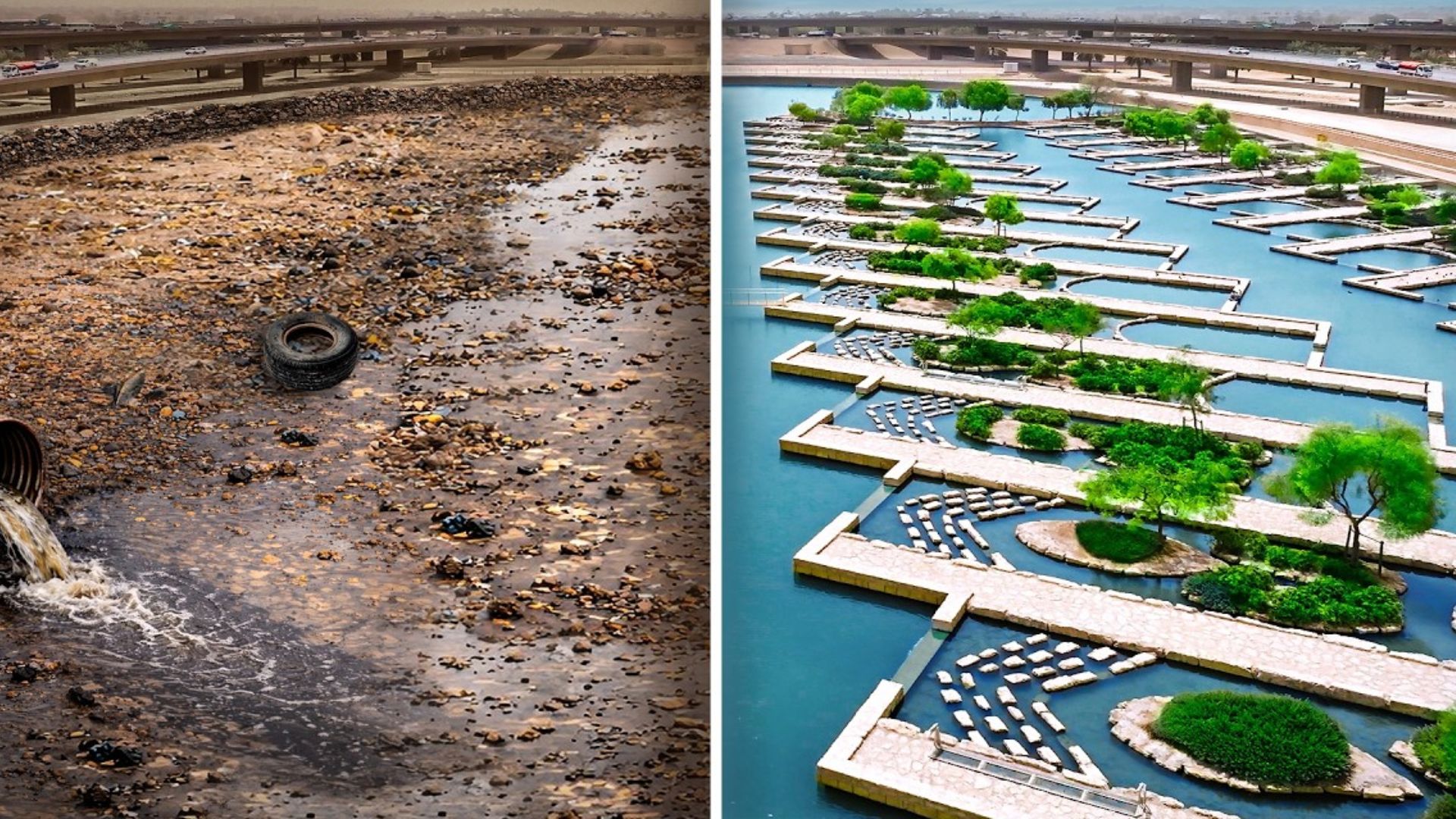


In Riyadh, Saudi Arabia uses bioremediation to clean wastewater with plants, algae, and fish, creating a functional oasis in Wadi Hanifa. The system treats millions of liters per day, supplies local farmers, and supports the plan to plant 7.5 million trees by 2030 in the Saudi desert.
The water that once carried sewage and urban waste through Wadi Hanifa, in Riyadh, is now treated by a biological facility described as the largest of its kind on the planet. The solution was observed by permaculture educator Andrew Millison in 2026, in Saudi Arabia, where plants, algae, microorganisms, and fish help clean the flow before its reuse.
The project exists because Riyadh is growing in a hyper-arid region, relies on expensive water systems, and needs to deal with sewage, dust, extreme heat, and urban expansion. Instead of just discarding the problem, the city uses bioremediation to transform waste into a water resource, irrigate farms, and support a strategy of urban vegetation. What was a sanitary liability has become part of an ecosystem in the desert.
Riyadh faces a heavy water bill in the middle of the desert

The Saudi capital is in a hyper-arid area of the Arabian Peninsula. According to the analyzed material, the city imports water from the Persian Gulf through desalination, a high-energy consumption process that removes salt from seawater and then requires pumping for almost 400 kilometers to Riyadh.
-
Concrete-filled PVC homes could be cheaper than traditional masonry, UPF research finds; with ready modular panels, less waste, and faster construction, the Concrete-PVC system aims to cut costs and transform affordable housing in Brazil.

-
Brazilian House Built with 32.8 Tons of Construction Debris Offers Affordable Housing Solution
-
Americans Build Entire Homes in a Day Using Compact Sand Foundations and Pre-Made Wooden Trusses, Reducing Construction Costs

-
China’s Largest Floating LNG Plant, NGUYA, Sets Sail for Congo: 2.4 Million Tons Annually for Italy’s Eni


This scenario makes every liter valuable. The contradiction is that part of this water that is expensive to produce ends up going down toilets, sinks, and car washes. In a city without natural abundance, throwing treated water away means wasting energy, infrastructure, and money.
Wadi Hanifa has gone from being a sanitary problem to becoming a living laboratory

Before the recovery, Wadi Hanifa was described as an area impacted by untreated sewage, leaks, septic tanks, industrial effluents, and urban runoff. The result was a health and environmental degradation problem for families and farmers living near the valley.
The turnaround came with a low-tech solution compared to desalination: using natural processes to filter water waste. The channel that once concentrated dirt began to operate as an ecological corridor, with vegetation, fish, insects, and birds in the middle of the desert.
Plants, algae, and fish work as part of the treatment
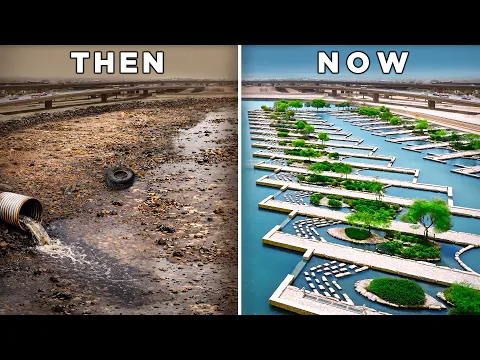

The system diverts millions of liters of wastewater per day into a sequence of channels and biocells. The water travels through the system by gravity, passes through constructed wetlands, and crosses biofilters more than once before moving forward.
Inside the biocells, the most important part occurs. Algae, plants, microorganisms, stones, and aquatic organisms help decompose pollutants and transform excess nutrients into biomass. The cleaning does not rely solely on machines; it uses the food chain as a sanitation tool.
The system treats millions of liters per day and creates life in the desert
The facility was designed to produce 45 million gallons of treated water waste per day, according to the data presented. The material also states that tests indicated the removal of 94% of suspended solids and 89% of fecal mass.
These numbers explain why the project draws attention. Bioremediation not only improves the quality of the water but creates a habitat for fish, insects, and water birds. In the middle of the Saudi desert, treated sewage has become the basis for a functional oasis.
Treated water irrigates farms and reduces pressure on potable resources
The water that exits the system is used by local farmers for irrigation. Instead of relying solely on potable or desalinated sources, small farms near Wadi Hanifa can use the filtered resource to maintain trees and production.
This reuse changes the economic and environmental logic. The sewage of a megacity ceases to be just something to remove and starts to feed productive areas. When wastewater returns to the soil in a controlled manner, urban waste becomes agricultural input.
Trees enter the center of Riyadh’s climate strategy
Saudi Arabia is also trying to expand the vegetation cover in Riyadh. The material mentions an initiative to plant 7.5 million trees by 2030, linked to the need to reduce heat, create shade, and help control dust storms.
The challenge is evident: trees need water, and Riyadh is in the desert. Therefore, bioremediation gains strategic importance. It’s no use promising millions of trees if the city doesn’t have a water source capable of sustaining them.
Urban growth increases sewage and also opportunity
As Riyadh grows, so does the volume of sewage produced. In traditional models, this usually increases environmental risk. In the Wadi Hanifa system, however, more waste can mean more nutrients to be recycled, as long as the treatment is well controlled.
This is the circular logic of the project: the city produces sewage, the system transforms part of this flow into treated water, farmers use the resource, vegetation grows, and the ecological corridor strengthens. The urban problem starts to feed the urban solution itself.
Bioremediation does not replace everything, but changes the discussion
The case of Wadi Hanifa does not mean that every city can abandon conventional sanitation systems. The model itself depends on technical design, monitoring, available area, quality control, and adaptation to the local climate.
Even so, the example broadens the discussion about water treatment. Instead of treating sewage just as waste, Saudi Arabia shows a path where sanitation, agriculture, environmental recovery, and urban cooling can operate together. The issue is no longer just cleaning the water but deciding what to do with it afterward.
The limit is in scale, management, and sanitary safety
Projects of this type need continuous testing. The material highlights that the water undergoes rigorous control, precisely because the use involves environmental contact, irrigation, and limited human presence at the end of the system.
This point is essential. Bioremediation can be efficient, but it does not allow for improvisation. It is necessary to ensure that pollutants, harmful microorganisms, and excess nutrients are under control before reuse. Nature helps, but sanitation requires measurement, maintenance, and public responsibility.
Saudi Arabia has transformed part of the sewage from Riyadh into an unusual water solution: plants, algae, microorganisms, and fish help filter wastewater, while the Wadi Hanifa becomes a green corridor, habitat for wildlife, and a source of irrigation for farms.
The case shows that dry cities can treat waste as a resource, but it also reveals the size of the challenge: without management, safety, and scale, the solution loses strength. Do you think systems like this should be tested in Brazilian cities with polluted urban rivers, or does the sanitary risk still weigh more? Share your opinion.