Portuguese
  Spanish


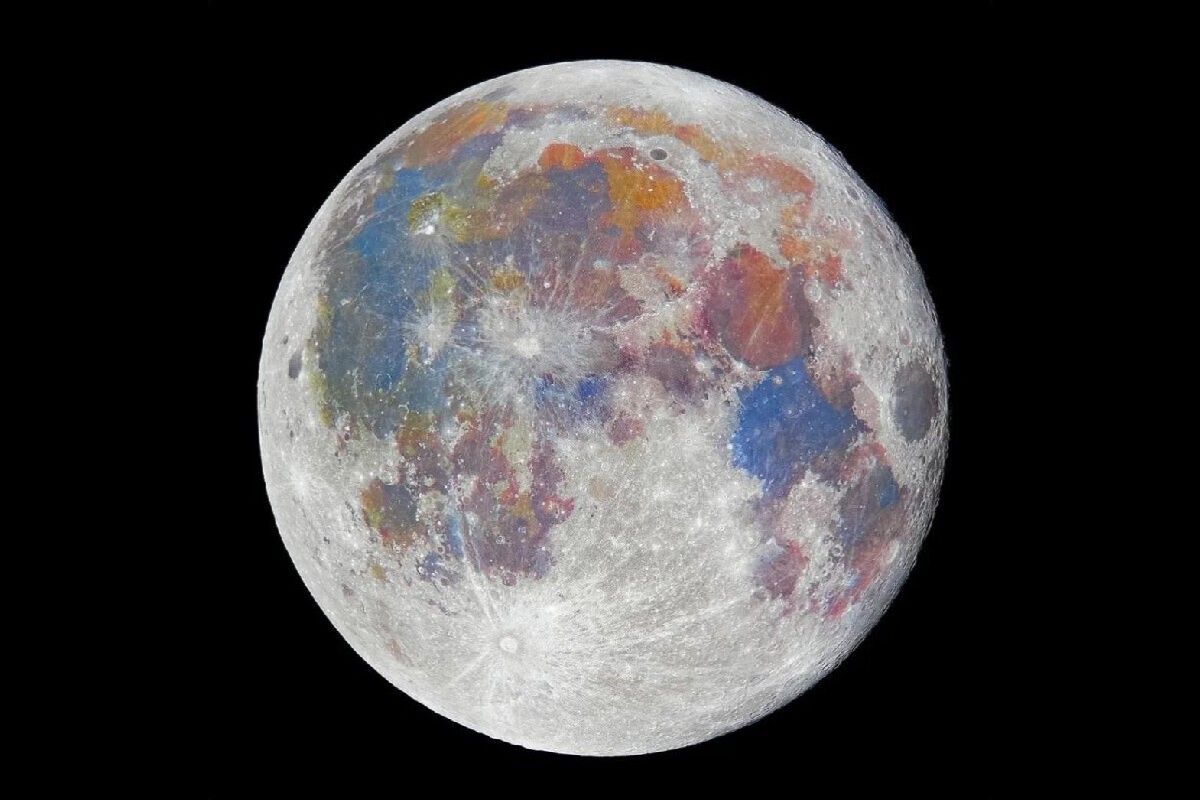


The Moon has subtle color variations, but photos with vibrant tones circulating on social media are not official from NASA and have been edited to highlight minerals
Images of the Moon in blue, pink, purple, and orange took over social media during the Artemis II mission and raised a common question: is the natural satellite really “colorful” like the photos that went viral?
The explanation is simpler and, at the same time, fascinating. The images were not captured by Artemis II and underwent digital processing to highlight chemical differences on the surface, something that is almost invisible to the naked eye.
Why the Moon images went viral as if they were from Artemis II

The posts claimed that the photos were taken by the Orion spacecraft during its flyby of the Moon, which gave an air of “official proof” to those who saw the posts for the first time. The visual appeal helped: strong colors and high-definition details attract attention and are highly shareable.
-
Polar Air Mass to Hit Brazil: Temperatures to Plummet in Nine States, Near Freezing in the South with Frost Risk Until Monday

-
Chinese “dark factories” produce electric cars 24/7 with minimal human intervention, as Zeekr assembles 800 units daily, raising concerns in Brazil.

-
Spectacular Green Aurora Seen from Space Illuminates International Space Station, Captivates French Astronaut

-
In Tasmania, a Beach Features a Natural Stone Mosaic Formed by Earth’s Cracks Millions of Years Ago



The problem is that, according to the source, none of these images appear in the official records released by NASA. The agency itself emphasizes that mission material is published only on its institutional channels.
The role of digital processing in the colors of the Moon
The Moon does have color variations, but they are subtle. What transforms these almost invisible differences into vibrant areas is digital processing. According to Bruno Morgado, this type of editing increases saturation to enhance chemical contrasts.
That’s why the colors should not be read as “what you would see in space with the naked eye,” but rather as a way to highlight composition. The result functions as a visual chemical map of the lunar surface.
What the colors indicate: titanium and iron oxides
According to the explanation cited in the source, bluish regions indicate a higher presence of titanium. Reddish tones relate to iron oxides. Lighter areas indicate a different mineral composition.
In practice, these images help visualize variations on the surface of the Moon that do exist, but at a level of subtlety that the human eye, without processing, almost does not perceive.
Who took the photos and how they were produced

Part of the material that went viral was produced by Ildar Ibatullin. He confirmed that the photos were captured from Earth using a GSO 150/750 telescope and a Canon 550D camera.
The astrophotographer also stated that the final result involves the combination of thousands of photographs to reduce noise and improve quality, as well as editing to increase saturation and highlight color differences. And he made it clear: the images have no relation to the Artemis II mission.
Why the Moon still looks “gray” to those who look at the sky
Even with real variations, the Moon does not appear colorful like in the edited images. Therefore, it is normal for it to look gray or slightly yellowish when viewed with the naked eye.
In other words, what went viral was not a “different Moon,” but rather a Moon interpreted through processing, with colors enhanced to reveal mineral information.
Had you seen these colorful images of the Moon and believed they were from Artemis II, or did you suspect there was editing behind them?
Image credits: Ibatullin Ildar.